

Editor's Note: Less than a week after taking office, Prime Minister Le Minh Hung set a deadline for ministries and agencies to submit plans to reduce business conditions, lower compliance costs, and prioritize resources for institutional reform. These decisive directives send a very clear message: To achieve double-digit growth, Vietnam cannot continue to move slowly in reform. Cutting unnecessary permits, removing legal bottlenecks, and building institutional trust for the private sector are no longer just things to do, but essential if we want to unlock resources and pave the way for sustainable growth. Lesson 1: Not just cutting sub-licenses |
To move faster, the first thing to do is not to find more money, but to awaken the dormant resources within the economy itself.
A large amount of resources are being "neglected".
Finance Minister Ngo Van Tuan stated that there are currently approximately 200,000 hectares of land and numerous unfinished investment projects with a total value of about 3.3 million billion VND that are stalled. This figure is three times the total public investment capital expected to be disbursed in 2026.
But more importantly, as he said, this is both a bottleneck and a resource and a driver of growth if it is unlocked.
Viewed in that light, this is not the story of a few real estate projects, nor is it a call to "rescue the real estate market."
A successful project not only revives a business but also restores jobs, revenue, credit flows, and investment confidence. In other words, it's a story about the nation's ability to mobilize resources.
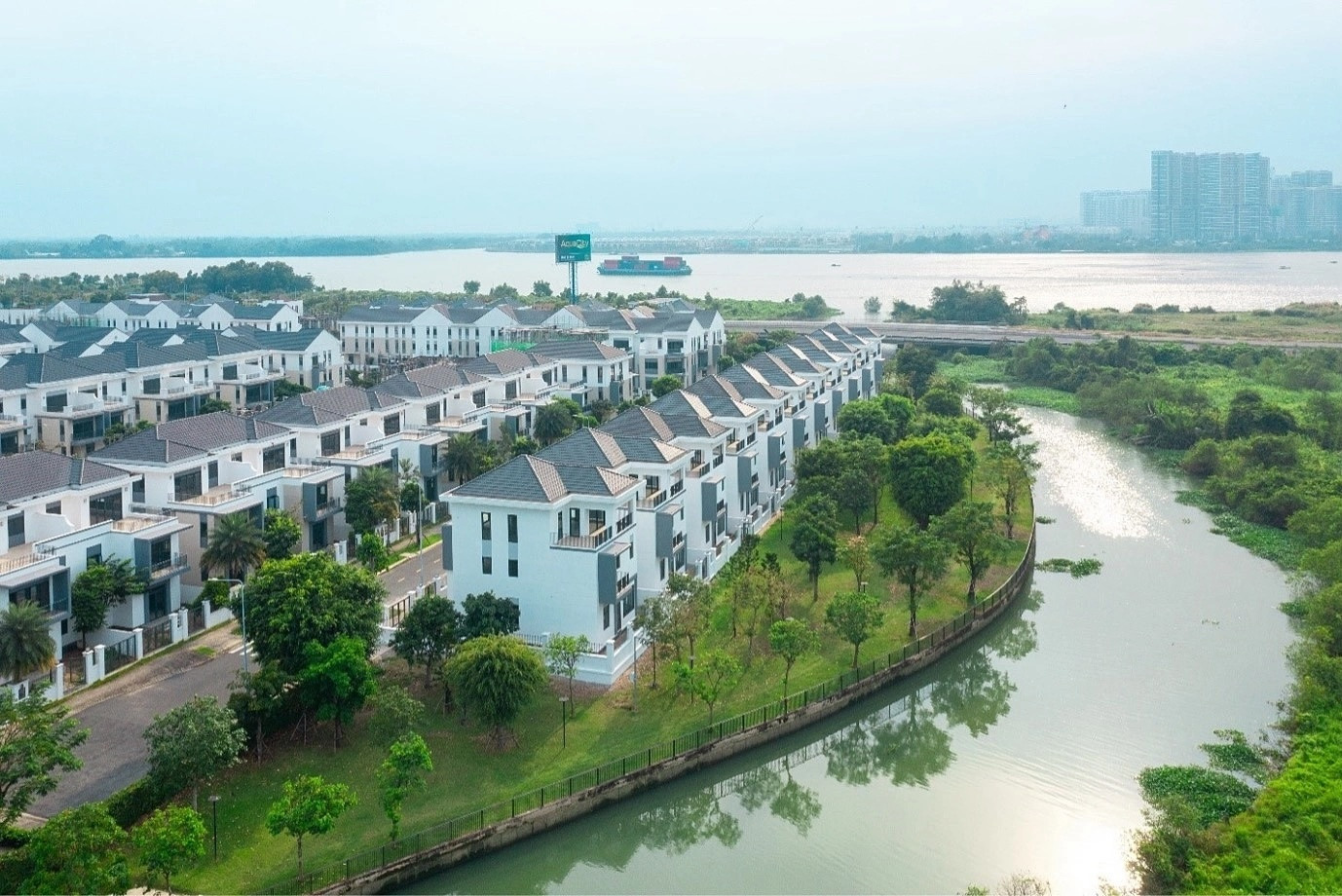
The story of the Aqua City project in Dong Nai is a clear example after it was restarted. This case shows that institutions are not an abstract concept; rather, they represent the speed of decision-making, the ability to unleash resources, and the accountability of leaders.
According to the development plan for the period 2026–2030, Vietnam needs approximately 38–38.5 million billion VND in total social investment capital over the next five years, equivalent to about 40% of GDP. Of this, more than 80% must come from the non-budgetary sector, i.e., from private enterprises, social capital, FDI, and other market resources.
This means that the state cannot generate growth alone. Double-digit growth can only come when the private sector dares to invest more, for longer periods, and with greater confidence.
From that perspective, the 3.3 million billion VND currently tied up is essentially equivalent to nearly one-tenth of the investment capital needs for the entire next five years. If that resource were released, it wouldn't just be about resolving a few stalled projects, but would open up enormous growth potential for the entire economy.
This highlights the importance of institutional reform. There's no need for another support package worth hundreds of trillions of dong, no need for new loans; we just need to remove the bottlenecks that are holding resources back.
What businesses need most right now isn't necessarily more incentives, but a stable environment that allows them to invest confidently in the long term.
When property rights are protected, the rules of the game are clear, and management decisions are predictable, businesses will confidently invest capital, expand production, and keep cash flow within the economy.
An investor is only willing to go the distance when they believe that today's efforts will not be negated by unexpected changes tomorrow. Institutional stability, therefore, is not only a legal requirement but also the foundation of market confidence.
Once that confidence is strengthened, businesses will not choose to retreat defensively but will choose to invest in development. And that is the most sustainable source of growth.
Belief in institutions
It is at this point that Prime Minister Le Minh Hung's recent directives are of great significance. The requirement for ministries and agencies to prioritize resources for building and perfecting institutions, and to include draft decrees and guiding circulars with draft laws, shows that the government is correctly identifying the root of the problem.
For a long time, one of the biggest obstacles has not been the lack of laws, but the fact that laws exist but businesses still have to wait for decrees and circulars. When a law has to wait for implementing documents, what is delayed is not only the legal regulations but also investment decisions, project progress, and the cash flow of the economy.
The law cannot continue to exist in a state of "having a framework but no clear path forward."
For businesses, institutional delays are not an abstract concept. They represent rising capital costs, disappearing market opportunities month after month, and stalled investment plans. Conversely, a clear, consistent, and quickly enforced legal system becomes a national competitive advantage.
Conclusion 18-KL/TW of the Politburo clearly defined the direction: urgently and fundamentally remove institutional barriers and bottlenecks; strongly shift the method of state management from pre-inspection to post-inspection; and minimize the time and cost of compliance for citizens and businesses.
This is not just about administrative reform. This is the foundation of growth.
In addition, Resolution 68 identifies the private sector as one of the most important driving forces of the economy and sets a target of having 2 million operating businesses nationwide by 2030.
That goal would be much more achievable when the investment environment is sufficiently stable, allowing businesses to confidently develop long-term plans and focus on growth rather than mitigating policy risks.
Today, the private sector is no longer just an entity to be managed. They have entered core technology sectors, strategic infrastructure, data security, and major economic projects. They are not only creating wealth but are becoming co-entities in national development.
This requires a new perspective: If the private sector has been identified as the most important driver of growth, then institutions must also shift significantly towards a more favorable environment for investment, innovation, and production expansion.
At this stage, the role of local authorities and their leaders becomes particularly important, as this is where the speed of transforming policies into tangible results is determined.
When a provincial governor dares to resolve a stalled project, when a department dares to choose the right solution instead of the safest one for itself, it's not just about handling an administrative case, but about freeing up resources for the entire economy.
Vietnam does not lack resources for development. There is ample gold held by the population, deposits in the banking system, land, social assets, and the capacity of the private sector.
What is most needed right now is an institution transparent enough to allow that money to flow freely, a system proactive enough to ensure those resources are utilized, and a spirit of reform strong enough to ensure growth is not just confined to resolutions.
Double-digit growth doesn't just come from additional capital; it begins with timely decisions, clear accountability, and sufficient confidence to unleash resources waiting to be awakened.
And institutional reform, ultimately, is not about rescuing a few projects, but about awakening the future growth potential of the entire nation.

Source: https://vietnamnet.vn/3-3-trieu-ty-dong-dang-cho-duoc-danh-thuc-2510602.html


![[Photo] General Secretary and President To Lam presides over the meeting to approve the draft report on the results of the second inspection by the Politburo of the Standing Committee of the Hanoi City Party Committee.](https://vphoto.vietnam.vn/thumb/1200x675/vietnam/resource/IMAGE/2026/05/26/1779789811432_a2-bnd-4430-9620-jpg.webp)









































































































Comment (0)