

Expanding domestic and export markets.
Visiting Langbiang Farm in Lac Duong commune, one can see a modern, interconnected system of digitally controlled equipment across more than 5 hectares of greenhouses where recirculating hydroponic lettuce is grown and harvested continuously, yielding 5-6 tons per day. In early winter 2025, 60% of the hydroponic lettuce produced will be exported to South Korea, Singapore, Malaysia, and Taiwan; the remaining 40% will be consumed domestically. To maintain the freshness of the vegetables for customers, the farm operates a 1,500 m2 processing, packaging, and transportation facility that delivers the produce to the customer's location daily according to the contract, without storing it overnight.
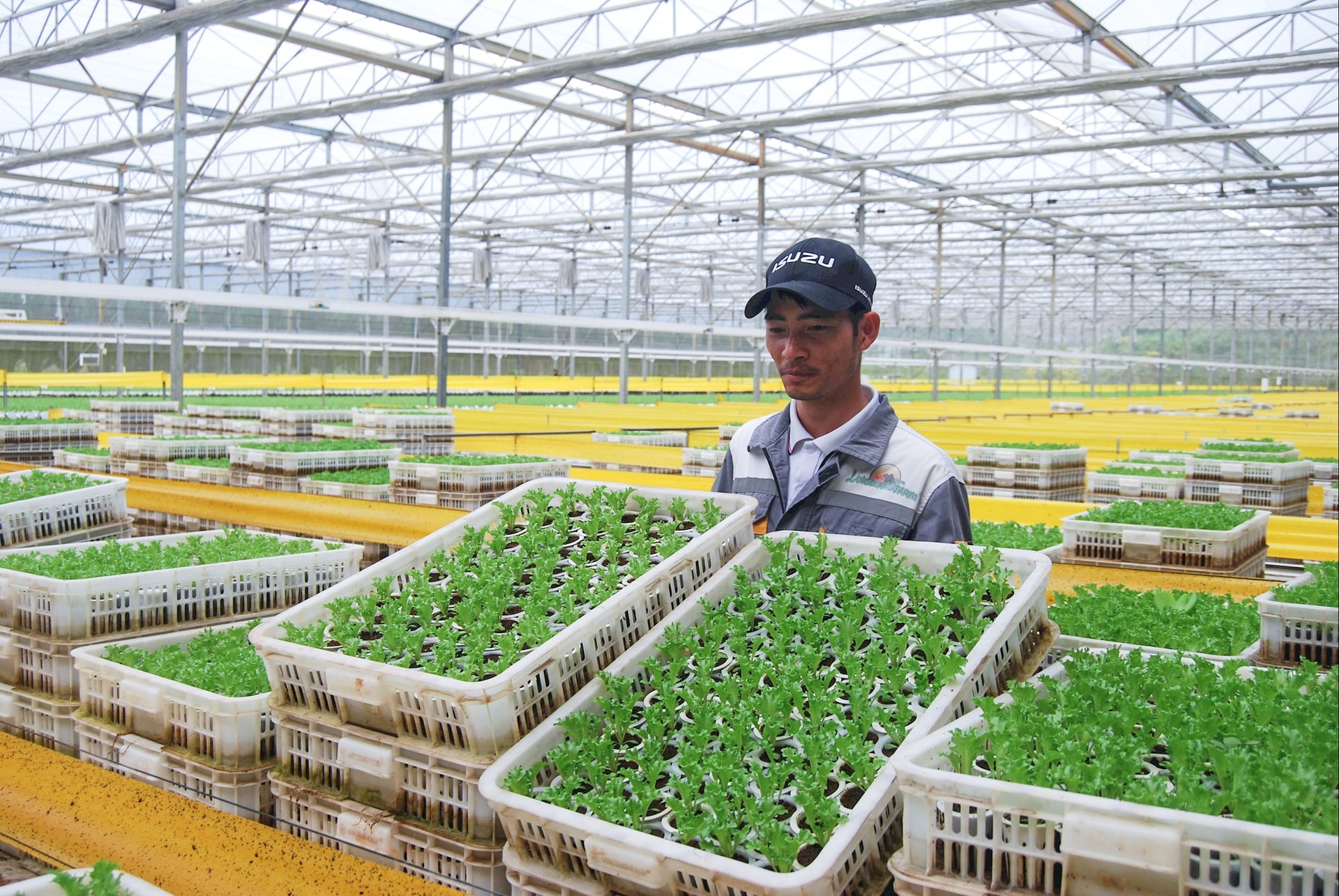
According to Nguyen Quang Khanh, Director of Langbiang Farm Co., Ltd., this is the sixth year the farm has converted its vegetable and fruit cultivation area from traditional soil-based and semi-hydroponic methods to specialized recirculating hydroponic lettuce cultivation. After successfully establishing a model of approximately 5,000 m² , the farm gradually expanded to a total area of 5 hectares four years later.
In particular, with its completely upgraded technology line, Langbiang Farm has installed a demonstration plot of recirculating hydroponic lettuce cultivation on an area of approximately 300 m2, located on Xo Viet Nghe Tinh Street, Lang Biang Ward - Da Lat, within an agro -tourism area with a total area of about 6,000 m2 . This includes a weekly organic market with dozens of stalls selling vegetables and fruits produced in Lam Dong province, attracting a large number of consumers. This also allows customers to experience and learn about the technical process of recirculating hydroponic lettuce cultivation at the farm, so they can research and adapt it to suit their own farming areas.
In the same Lac Duong commune, Truong Phuc Farm harvested hydroponic lettuce in the winter of 2025, regularly exporting over 5 tons to South Korea every 5-6 days. This corresponds to a 50% export and 50% domestic production ratio. Mr. To Quang Dung, Director of Truong Phuc Farm Co., Ltd., said that for many years, the farm has maintained its lettuce export volume to South Korea during both summer and winter seasons, exporting 50% of the aforementioned production each season. From a total greenhouse area of 2.5 hectares, they harvest 10,000 hydroponic lettuce plants daily, each plant weighing an average of 250 grams, resulting in a total production of over 2.5 tons. In spring and autumn alone, the farm exports 10-15% of its total production to South Korea.
Realizing ecological agriculture that adapts to climate change.
Director Dung shared: “To stabilize the production of hydroponic lettuce year-round, linked to domestic and export contracts, the farm has undergone nearly 10 years of development. Initially starting on an area of 0.3 hectares, we annually evaluate and select the most effective technological solutions to expand to each greenhouse section, bringing the total area to 2.5 hectares today.” Accordingly, the farm strictly adheres to the process of controlling and preventing the emergence of pathogens in the irrigation water and recirculating nutrient system through each crop of vegetables produced. In the output stage, the farm consistently meets the increasing demand for fresh vegetables through contracts with supermarkets and convenience stores both domestically and internationally. Recently, another partner from South Korea signed a contract to import Truong Phuc brand hydroponic lettuce during the spring and summer months each year, with a stable monthly order of about 5 tons. Currently, the farm is accelerating the installation of a new 6,000 m2 greenhouse to meet the export volume stipulated in this contract.
The production results, linked to the expansion of the domestic and export markets for the aforementioned hydroponic lettuce, have contributed to the development of over 107,306 hectares of high-tech production and over 149,700 hectares of safe production in Lam Dong province by the end of 2025. This contributes to realizing the goal of developing a modern, high-tech, and ecological agriculture adapted to climate change by 2030; and maximizing the potential and advantages of the local agricultural sector.
Source: https://baolamdong.vn/4-mua-xa-lach-thuy-canh-406361.html
![[Photo] Admire the coral "masterpiece" amidst the million-year-old heritage of Dak Lak province.](https://vphoto.vietnam.vn/thumb/1200x675/vietnam/resource/IMAGE/2026/05/31/1780221235105_anh-man-hinh-2026-05-31-luc-16-53-27.png)
![[Photo] Solemn bathing ceremony and Buddha procession in Hue](https://vphoto.vietnam.vn/thumb/1200x675/vietnam/resource/IMAGE/2026/05/31/1780228263543_1-jpg.webp)


![[Photo] The General Secretary, President and his wife begin their state visit to the Philippines.](https://vphoto.vietnam.vn/thumb/1200x675/vietnam/resource/IMAGE/2026/05/31/1780230559452_anh-man-hinh-2026-05-31-luc-19-28-11.png)









![[Video] Sunset at Lap An Lagoon – Where the sun sets over the fishing nets](https://vphoto.vietnam.vn/thumb/340x192/vietnam/resource/IMAGE/2026/05/31/1780192137701_beach-landscape-sea-water-nature-grass-745871-pxhere-com.jpeg)

































![[Photo] Admire the coral "masterpiece" amidst the million-year-old heritage of Dak Lak province.](https://vphoto.vietnam.vn/thumb/402x226/vietnam/resource/IMAGE/2026/05/31/1780221235105_anh-man-hinh-2026-05-31-luc-16-53-27.png)
































Comment (0)