

This debate took place so early that neither participant had yet been officially nominated. Since the first televised debate in 1960 between John F. Kennedy and Richard Nixon, all such events have been held in September or October.
Presidential debates have long been criticized for both their content and the candidates' attitudes, but they remain an important part of the election season. Here are five things to know ahead of the first debate between Biden and Trump tomorrow.
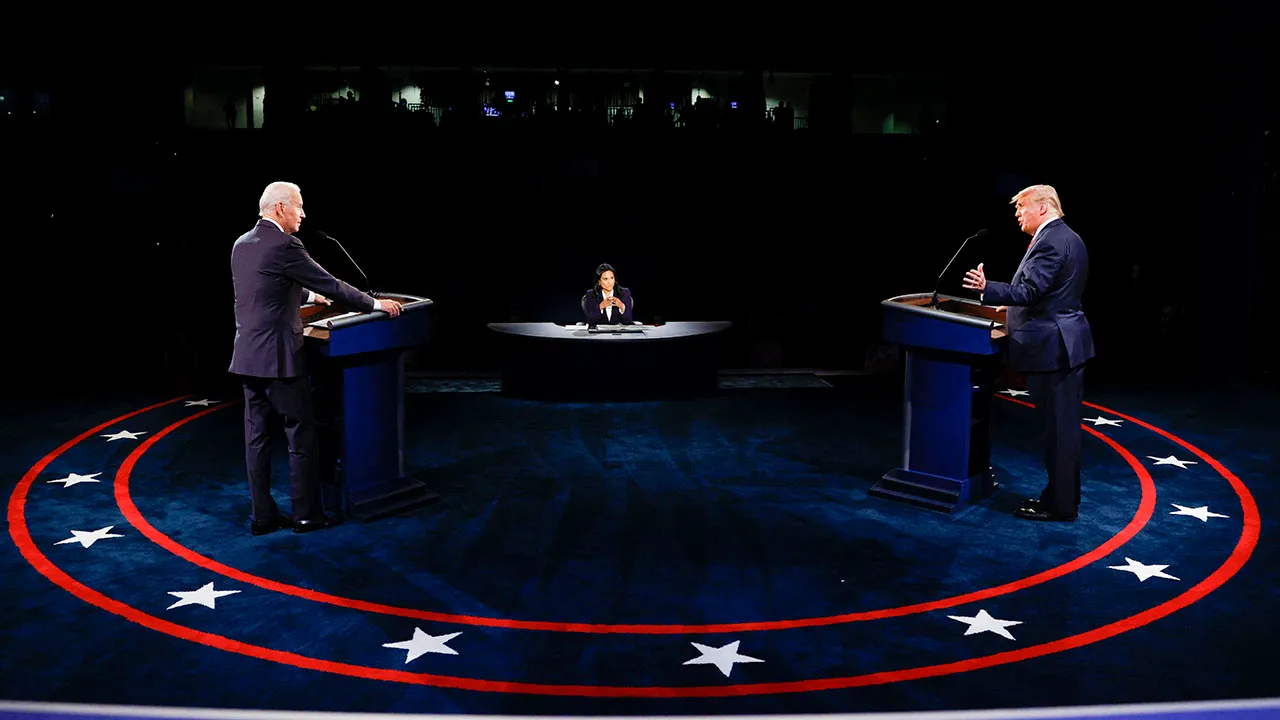
The debate between Joe Biden and Donald Trump in Nashville, Tennessee, USA, on October 22, 2020. Photo: AFP
The debates attracted a large audience.
Although the viewership of debates as a percentage of the total television audience has declined over the decades, they can still attract more people than any other televised event.
According to Nielsen Media Research, more than 73 million people watched at least some of the Trump-Biden debates in 2020. That's the third-largest debate viewership ever, surpassed only by the first debate between Hillary Clinton and Trump in 2016 (84 million viewers) and the 1980 debate between Jimmy Carter and Ronald Reagan (80.6 million).
According to Nielsen data, ratings for presidential debates have fluctuated over the decades. All four debates in 1960 had ratings around 60.0, meaning about six out of ten households with TVs watched the debates. By the time of the 1976 debates, ratings had dropped lower, typically around 50.0.
Ratings for debates tended to be lower over the next two decades. The third debate between Al Gore and George W. Bush in 2000 only had a rating of 25.9. Since then, debate ratings have generally tended to rise modestly: The first Biden-Trump debate in 2020 garnered a rating of 40.2.
The debates were helpful but not decisive.
The Pew Research Center conducted post-election surveys from 1988 to 2016. In most cases, six or more out of ten voters said the debates were helpful or somewhat helpful in deciding which candidate to vote for.
The peak was in 1992, when 70% of voters felt that the three debates that year between candidates Bill Clinton, George HW Bush, and Ross Perot were at least somewhat useful.
In 2016, only 10% of voters said they made a definitive decision "during or immediately after" the presidential debates. 11% said they decided later, a few days or weeks before or on Election Day. 22% said they decided during or immediately after the summer party convention, and 42% said they decided before the convention.
There is also debate over the vice presidency.
In most years since 1976, when vice presidential candidates first held their own debates, the candidates competing for the position have consistently ranked second in viewership.
For example, in 2020, 57.9 million people watched the debate between Vice President Mike Pence and then-Senator Kamala Harris. This number was 8% lower than the viewership of the Biden-Trump debate.
Unlike the early debates
From the first debate in 1960 between Kennedy and Nixon to the 1988 showdown between George H.W. Bush and Michael Dukakis, the candidates simply answered questions from the panel of judges. The moderator's job was primarily to explain and enforce the basic rules and maintain the program.
But by the 1980s, critics argued that the debate resembled a general press conference more than anything else. Journalists and panelists were taking up too much of the candidates' time and attention.
By 1992, the Presidential Debate Commission had tried several different approaches. Then, along with two seminar-style debates, the commission introduced a "town hall" event where voters would ask questions.
Most of the executives are television journalists.
Most debate moderators since 1960 have been prominent television journalists. Exceptions include James Hoge, editor-in-chief of the Chicago Sun-Times, who moderated the 1976 vice presidential debate, and Susan Page, Washington bureau chief of USA Today, who moderated the 2020 vice presidential debate.
PBS journalists have moderated the most debates: 16. The only person to have moderated more than two presidential or vice presidential debates is Bob Schieffer of CBS News (2004, 2008, and 2012).
Ngoc Anh (according to Pew Research)
Source: https://www.congluan.vn/bau-cu-my-2024-5-dieu-can-biet-truoc-cuoc-tranh-luan-tong-thong-post300681.html

![[Photo] Secretary of the National Assembly Party Committee, Chairman of the National Assembly presides over the meeting of the Standing Committee and Executive Committee of the National Assembly Party Committee.](https://vphoto.vietnam.vn/thumb/1200x675/vietnam/resource/IMAGE/2026/06/03/1780480353201_ndo_br_bnd-2585-jpg.webp)
![[Photo] First session of the 14th Congress of the Vietnam Trade Union](https://vphoto.vietnam.vn/thumb/1200x675/vietnam/resource/IMAGE/2026/06/03/1780465947883_ndo_br_img-3852-jpg.webp)
![[Photo] General Secretary and President To Lam presides over a meeting with the Central Organizing Committee.](https://vphoto.vietnam.vn/thumb/1200x675/vietnam/resource/IMAGE/2026/06/03/1780482764658_a1-bnd-4741-3342-jpg.webp)















































![[Video] Sunset at Lap An Lagoon – Where the sun sets over the fishing nets](https://vphoto.vietnam.vn/thumb/1200x675/vietnam/resource/IMAGE/2026/05/31/1780192137701_beach-landscape-sea-water-nature-grass-745871-pxhere-com.jpeg)
































Comment (0)