


From "logistics" to a technology race.
For many years, logistics was often viewed as a "support" service industry, associated with warehousing, transportation, and delivery of goods. However, under the pressure of ultra-fast delivery in e-commerce and the constant fluctuations of the global supply chain, that way of operating is changing rapidly.
Associate Professor Dr. Nguyen Thanh Chuong - Chairman of the Vietnam Logistics Human Resources Development Association (VALOMA), believes that technology is fundamentally changing the way businesses operate as well as the structure of global supply chains. While previously logistics mainly played a supporting role, it has now become a foundational service sector for the digital economy , the green economy, and international trade.
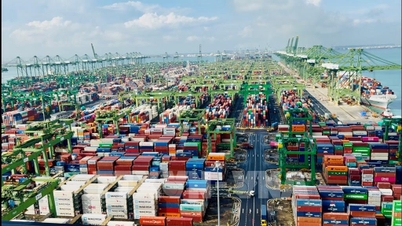
AI is emerging as the most impactful technology in logistics in recent decades. It's already present in many operational activities such as optimizing transport routes, forecasting cargo demand, intelligent warehouse management, port automation, container optimization, reducing carbon emissions, and real-time supply chain data analysis.
“The core objective of businesses in the logistics service industry is to improve labor productivity and business efficiency. In this context, AI is becoming a very important supporting tool, helping workers and managers make faster and more accurate decisions,” Mr. Chuong stated, adding that one of the biggest benefits of AI is reducing intermediary costs and optimizing operations. The logistics industry has many repetitive processes and handles large volumes of data, so AI can support process automation, replace manual operations, and improve the efficiency of supply chain management.
Associate Professor Dr. Nguyen Binh Minh - Director of the Institute of Digital Technology and Economics ( Hanoi University of Science and Technology) - believes that AI is no longer just a reference option but has become a "core competitive infrastructure" for the logistics industry. The pressure to transform has shifted from a "should do" to a "must do" to survive. Citing a Deloitte survey, Dr. Minh stated that within the next five years, the percentage of supply chain organizations applying or preparing to apply AI is expected to increase from 28% to 82%. At the same time, up to 71% of business leaders believe that if they do not adopt AI in time, their business operations risk disruption.
"Now we're not asking whether or not to use AI, but how to use AI, where to use AI, and whether using AI is safe," Mr. Minh emphasized.
Meanwhile, Mr. Ngo Ngoc Hoan, the Asia-Pacific business representative of Samsung SDS, argued that logistics is no longer simply an operational problem but has become a problem of data and risk forecasting capabilities. "The question now is no longer whether AI is needed, but whether businesses can operate without AI," Mr. Hoan stated.
According to Mr. Hoan, global supply chains are becoming increasingly complex due to the impact of the pandemic, geopolitical fluctuations, and production relocation trends. In this context, many businesses are moving towards a "hyper-automation" model, combining AI with automation technologies to optimize the entire logistics process.
Data and human resources will determine competitiveness.
Although AI offers great potential, the gap between the technology's applicability and its actual implementation in Vietnamese logistics businesses remains quite significant.
Associate Professor Dr. Nguyen Thanh Chuong stated that most Vietnamese logistics businesses are currently only at the basic stage of digitizing processes; the number of businesses that are actually applying AI systematically in data analysis, forecasting, or decision support is still quite modest.
According to him, the current challenges lie not only in technology but also in data quality, system connectivity, human resource capabilities, logistics infrastructure, investment capacity, and the transformation mindset of businesses.
The biggest bottleneck, as mentioned by many experts, is data. Mr. Nguyen Tien Dong, AI Engineering Director at CMC Group, believes that most logistics businesses still operate using traditional models. Although data has been digitized in each department, it remains fragmented, while operational processes and management decisions are still separate between departments. AI has proven effective in many tasks such as forecasting, operational optimization, decision support, and process automation. Businesses can transition from a slow, linear model to an intelligent, real-time adaptive model by applying AI.
From a strategic implementation perspective, Associate Professor Dr. Nguyen Binh Minh believes that businesses should start with a data-driven platform instead of chasing expensive AI systems. Businesses need to prioritize data digitization and standardization, because "without reliable data, AI will only remain at the demo level." At the same time, businesses should implement small-scale projects that can be measured effectively using KPIs within 90 days, such as optimizing vehicle routes or automating goods sorting.
Associate Professor Dr. Nguyen Binh Minh also noted that businesses need to build risk management mechanisms related to data security, AI ethics, responsibility, and approval processes when applying this technology to their operations.
Besides data, human resources are also a matter of particular concern. According to Associate Professor Dr. Nguyen Thanh Chuong, the current training goal is not to turn all students into AI experts, but to help learners understand, know how to use, and apply AI to their work after graduation. "Previously, students learned Word and Excel, but now they need to know what AI is, how it's applied, and how to use it in their work," Dr. Chuong noted.
Many experts believe that in the context of increasingly competitive global supply chains that demand greater speed, transparency, and resilience, AI will become a decisive tool for the competitiveness of logistics businesses.
Vietnam currently aims for 100% of logistics service businesses to adopt digital transformation by 2035, thereby reducing logistics costs to approximately 10-12% of GDP. However, to achieve this goal, logistics businesses cannot simply stop at individual digitalization solutions.
Source: https://daidoanket.vn/ai-se-tai-dinh-hinh-nganh-logistics.html










































































































Comment (0)