

According to data from the Organization for Economic Cooperation and Development (OECD), the UK is the only country in the G7 where inflation is still rising.
The UK's consumer price index (CPI) rose 7.9% year-on-year in May, a slight increase from the 7.8% rise in April, according to the OECD. Meanwhile, the rest of the G7 countries – the US, Canada, France, Germany, Italy, and Japan – all recorded a slowdown in inflation.
Across the G7 group, inflation fell to 4.6% in May, down from 5.4% in April, its lowest level since September 2021. Many major central banks have begun considering ending interest rate hikes as prices cool down.
Meanwhile, the Bank of England (BoE) last month raised interest rates by 50 basis points, larger than many had predicted. This 13th consecutive increase by the BoE brought the base interest rate to 5%, the highest level since 2008.
The Consumer Price Index (CPI) calculated by the OECD for the UK includes the cost of ownership and living for a family, making it the most comprehensive measure of inflation. Meanwhile, the CPI measured by the European Statistical Agency (Eurostat) was recorded at 8.7% in May, unchanged from April.
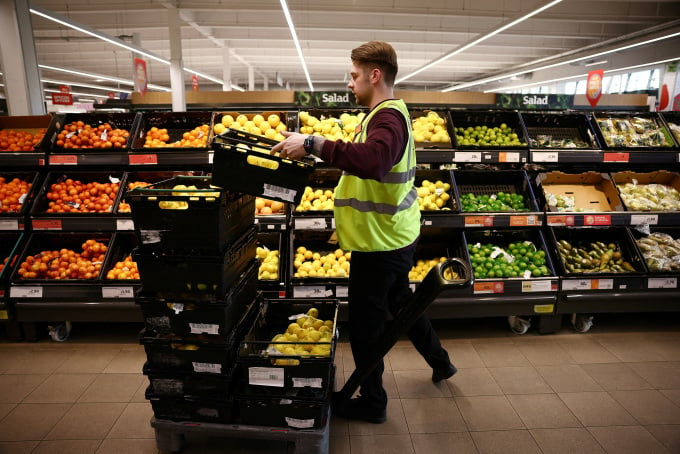
A shop assistant arranges products inside a Sainsbury's supermarket in Richmond, London, on June 27, 2022. Photo: Reuters
On July 4th, British Prime Minister Rishi Sunak acknowledged that inflation is "more persistent than many people predicted."
Neil Shah, research director at investment research firm Edison Group, explains that the combination of the energy price crisis and labor shortages has led to much more severe inflation in the UK than in G7 economies. "Brexit is partly to blame, reshaping the labor market and putting pressure on employers to raise wages to attract talent," he added.
The UK economy relies more heavily on services than manufacturing, a key difference from more balanced European economies like Germany. In the eurozone, inflation has also begun to cool, albeit slowly. Eurostat reported that the CPI for the eurozone in June was 5.5%, a larger decline than expected.
According to a June survey by Citi and market research firm YouGov, UK public expectations for inflation over the next 12 months have risen to 5%, up from 4.7% in the May survey. The Bank of England (BoE) is monitoring inflation expectations amid concerns about upward price pressures in the economy. Their target is to bring inflation back to 2%.
Megan Greene, a member of the Bank of England's Monetary Policy Committee, recently warned that interest rates could remain stable at higher levels for an extended period. "It would be a mistake for central banks to become complacent, assuming that inflation and interest rates will automatically return to the low levels we saw before the pandemic," she stated.
Phiên An ( according to CNBC, FT )
Source link













































































































Comment (0)