

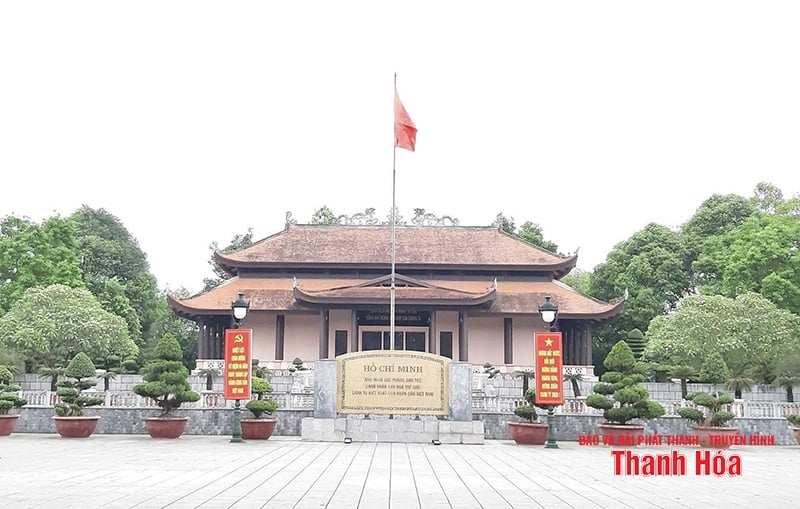
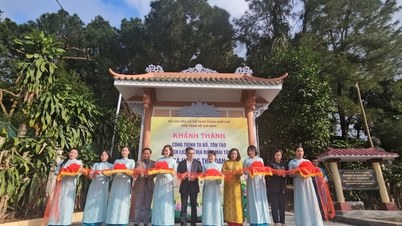
The Ho Chi Minh Memorial Cultural Area is located in the heart of Thanh Hoa City.
The history of Vietnam in the late 19th and early 20th centuries bears witness to the journey of Phan Boi Chau and Phan Chau Trinh, who belonged to the last generation of Can Vuong scholars and were enlightened by new ideologies. The patriotic and revolutionary movement with bourgeois tendencies led by Phan Boi Chau and Phan Chau Trinh was a step forward for the national democratic movement at that time.
For the first time in our country, new forms of struggle emerged alongside armed struggle. These included forming associations, holding rallies and demonstrations, publishing newspapers, and even going abroad. The social landscape of the national democratic movement became broader and richer. However, in a context of many upheavals, the failure of these movements was inevitable and unavoidable. Fundamentally, figures like Phan Boi Chau and Phan Chau Trinh had significant limitations in their approaches to national salvation. The crisis of a national salvation strategy remained the most fundamental problem facing the Vietnamese revolution at that time.
Born into a patriotic Confucian family in a land with a revolutionary tradition, from a young age, Nguyen Tat Thanh harbored a fervent love for his country and a deep hatred for colonialism. The painful and dark realities of the nation, along with the failures of the patriotic movements at the time, constantly troubled the young man. On June 5, 1911, young Nguyen Tat Thanh resolutely boarded the Admiral Latouche-Tréville ship, leaving Nha Rong Wharf to fulfill his ambition of liberating his country from the yoke of colonial and imperialist rule: "Freedom for my people, independence for my homeland, that is all I want, that is all I understand."
On his journey to save the country, the young man in his twenties, with faith in his own hands and mind, and with all his fervent love for his country and people, and a burning desire for independence and freedom, accepted the challenge of boarding an ocean-going ship, sailing the seas, traveling through many countries, and doing all kinds of arduous work to find a path to national liberation and bring happiness to the people. He once docked at the ports of Marseille and Le Havre in France; he once worked on a ship of the Charles Reunion company, circling Africa. Along with the ship's journey, he stopped at ports in several countries such as Spain, Portugal, Algeria, Tunisia..., and also traveled through Martinique, Uruguay, Argentina, and finally stopped in the United States. Putting aside all personal worries, the youth of Nguyen Tat Thanh drifted along with these voyages, his only baggage being his fervent love for his country and people.
From the places he visited, the work he did, the people he met and witnessed, Uncle Ho drew a painful conclusion: Everywhere, imperialists and colonialists were brutal and cruel; everywhere, laborers were heavily exploited and oppressed, and "regardless of skin color, there are only two kinds of people in this world: the exploiters and the exploited." He once stood at the foot of the Statue of Liberty in America, but his heart ached with sorrow at the suffering and injustice endured by the downtrodden and oppressed: "The light on the head of the Statue of Liberty shines brightly across the blue sky, but at the foot of the Statue of Liberty, Black people are being trampled upon. When will Black people be equal to white people? When will there be equality between nations? And when will women be equal to men?"
In late 1917, Uncle Ho returned to France from England, choosing Paris as his base of operations. In 1919, he joined the French Socialist Party, the most progressive political party in France at that time. In June 1919, upon hearing that delegations from over a dozen victorious Allied nations were meeting in Versailles, 14km from Paris, Uncle Ho, on behalf of patriotic Vietnamese in France, sent to the conference the "Petition of the Vietnamese People," signed by Nguyen Ai Quoc. The "Petition of the Annamite People" consisted of eight basic points demanding that the French government and the Allied nations recognize the freedom, democracy, equality, and self-determination of the Vietnamese people.
In July 1920, Uncle Ho read Lenin's "First Draft of the Theses on the National and Colonial Questions," published in the newspaper L'Humanité of the French Socialist Party. Through these Theses, he found the path to national salvation and liberation. He embraced Marxism-Leninism as "a historical rendezvous" between genuine patriotism and the revolutionary and scientific doctrine of the era. At the moment he found the path to national salvation, he shed tears – tears of overwhelming happiness and faith: "The Theses reached Uncle Ho. And he wept / Uncle Ho's tears fell on Lenin's words / The four walls silently listened as he turned each page / Imagining the country outside waiting for news / He exclaimed to himself as if speaking to the nation / 'Food and clothing are here! Happiness is here!' / The image of the Party is intertwined with the image of the Nation / The first moment of weeping was the moment Uncle Ho smiled" (The Man Who Sought the Path to National Salvation, Che Lan Vien).
At the 18th Congress of the French Socialist Party, held in Tours at the end of December 1920, he voted in favor of establishing the French Communist Party and joining the Third International. This event marked a crucial turning point in his revolutionary life, from genuine patriotism to communism, "from a progressive patriot to a socialist fighter."
To liberate the nation, there was no other path than the proletarian revolution. This conviction was earned at the cost of his youth, blood, and tears – a man who loved his country and people with burning passion. From 1921, he actively propagated Marxism-Leninism in Vietnam, preparing the political, ideological, and organizational foundations for the establishment of a Communist Party in Vietnam. He, along with several French colonial revolutionaries, founded the Union of Colonial Peoples, published the newspaper "The Oppressed," wrote plays, and published books... In June 1923, he secretly went to Moscow (Soviet Union), continuing his vigorous and effective activities, "gradually perfecting his revolutionary worldview and philosophy of life, and also outlining the major strategic lines of the national liberation revolution."
One hundred and forty years have passed since President Ho Chi Minh left Nha Rong Wharf to embark on his journey to find a way to save the nation (June 5, 1911 - June 5, 2025). On the day he left Nha Rong Wharf, the sounds of Saigon poured down the river, enveloping him. The sharp, piercing sound of the ship's horn pierced the air, causing a painful sensation. He strode quickly and hurriedly onto the ship... The entire face of Vietnam captivated his heart.
In that setting, Uncle Ho's message to those who remained stirred the hearts of millions of Vietnamese people: "Our country, our people, will not tolerate this life of oxen and beasts of burden forever. We must abolish slavery, and our lives will certainly change... We believe in the future, we believe in the nation's destiny... Suddenly, amidst the howling wind at Nha Rong Wharf, we hear Brother Ba whispering to Ut Hue: "There must be freedom! Hue. Our homeland, our people must have independence and freedom, not slavery forever... Because of the loss of our country, we have to leave home. If we cannot find a way to regain independence for our country and happiness for our people, I will not return, and no one will expect me to."
The journey of the young man Nguyen Tat Thanh, just 21 years old, leaving his homeland to seek a way to save the country, will forever be etched in the history of the nation, in the hearts of every Vietnamese person... He was the great pioneer of the Vietnamese revolution.
*This article uses material from the book "The Historical Process of Vietnam" (Education Publishing House, Nguyen Quang Ngoc (editor-in-chief); and "Green Lotus Bud" by writer Son Tung (Kim Dong Publishing House).
Text and photos: Huong Thao
Source: https://baothanhhoa.vn/bac-ho-va-hanh-trinh-tim-duong-di-cho-dan-toc-theo-di-252533.htm

































































Comment (0)