

Diversifying rural water supply models
Previously, Ms. Nguyen Thi Hanh's family in Doc village, Lien Bao commune, used rainwater and well water for daily life. However, due to groundwater pollution, to obtain hygienic water, her family had to invest in building a manual filtration system using yellow sand and activated carbon, and purchasing an RO water filter. According to calculations, the cost of replacing the filter materials plus electricity for pumping water was approximately 220,000 VND per month. Therefore, as soon as the Tri Phuong commune's centralized clean water station was completed, her family registered to install and use the clean water supplied by the station. According to her, besides the peace of mind regarding water quality, the monthly cost was significantly lower compared to using well water previously.
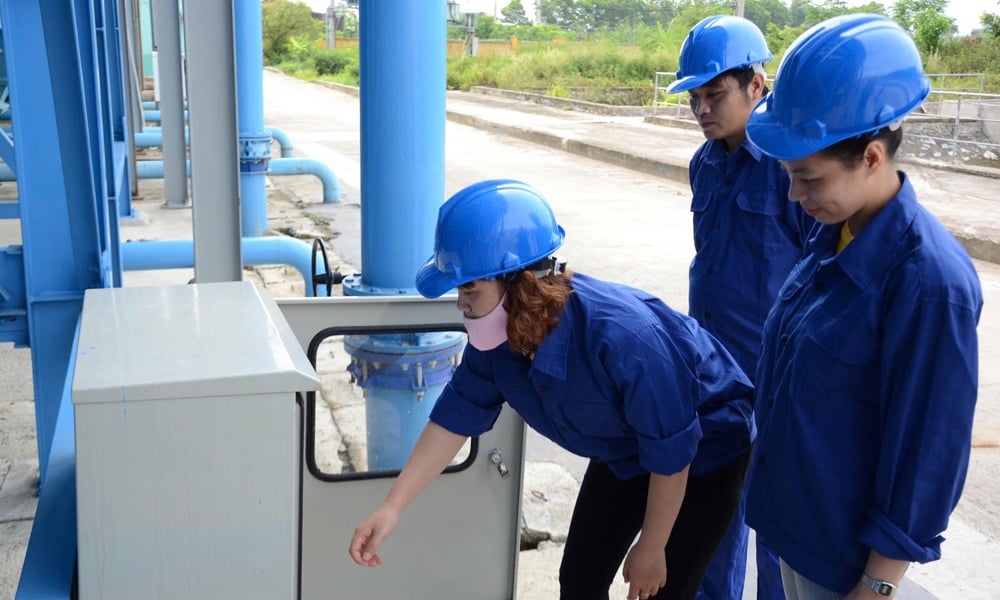 |
Workers at the Tri Phuong Water Treatment Plant inspect the sediment discharge valve of the treatment system. |
Construction of the Tri Phuong centralized clean water station began in late 2013 and was officially completed and put into operation in May 2016. With a designed capacity of 6,000 m³ /day in phase 1, 12,500 m³ /day in phase 2, and an upgraded 17,500 m³ /day in phase 3, after 12 years of investment, construction, and operation, nearly 30,000 households have now been connected to and are using the water supplied by the station.
The An Thinh clean water plant, invested and built by Phu Quang Construction and Trading Joint Stock Company using its own capital, has a capacity of 6,000 m³ /day, meeting the clean water needs of more than 10,000 rural households in Trung Kenh commune. Currently, the company is striving to increase the plant's capacity to 8,000-10,000 m³ /day, better meeting the growing water demand of the people.
According to Mr. Ngo Xuan Hiep, Chairman of the People's Committee of Trung Kenh commune, since the An Thinh clean water plant was put into operation, it has made a significant contribution to improving the quality of life, ensuring the health of the people, reducing the rate of people suffering from diseases related to water quality such as trachoma, diarrhea and skin diseases, and at the same time improving the environmental criteria in building new rural areas and advanced new rural areas.
Implementing the national target program on clean water and rural sanitation; the rural water supply program funded by World Bank loans; the national target program on building new rural areas; and capital from private enterprises, investment in the construction of centralized rural water supply systems in the province has received attention. Many projects and works on centralized water supply systems prioritized for investment in rural areas have made a significant contribution to improving the health and quality of life for the people.
According to information from the Department of Agriculture and Environment, the province currently has 123 rural clean water stations, of which 14 are managed and operated by the Rural Clean Water and Environmental Sanitation Center; the remaining stations are invested in, exploited, and operated by private enterprises or managed by the People's Committees of the communes.
Continue investing in renovation and upgrading.
According to Mr. Nguyen Xuan Hieu, Deputy Director of the Center for Rural Water Supply and Sanitation (Department of Agriculture and Environment), to control and improve the quality and percentage of households using clean water, the Center maintains and improves the quality management system of its laboratory according to ISO/IEC 17025:2017 standards. In addition, it regularly takes samples and tests the quality of finished water at centralized clean water supply stations in rural areas of the province managed and operated by the unit, in accordance with Circular No. 41/2018/TT-BYT dated December 14, 2018, issued by the Ministry of Health , promulgating national technical standards and regulations on inspection and monitoring of clean water quality for domestic use.
By the end of November 2025, the total number of customers using water from stations managed and operated by the Center will reach 46,293 households; the percentage of households in the province using hygienic water will reach 100%; the percentage of rural households using clean water meeting Vietnamese standards will reach 73.28%; the percentage of poor households using hygienic water will reach 100%, of which the number of poor households using clean water meeting Vietnamese standards will reach approximately 60%.
| The percentage of households in the province using hygienic water reached 100%; the percentage of rural households using clean water meeting Vietnamese standards reached 73.28%; the percentage of poor households using hygienic water reached 100%, of which the number of poor households using clean water meeting Vietnamese standards reached approximately 60%. |
However, in addition to the operational, stable, and efficient water treatment plants that meet the needs of the people, the province currently has 10 rural water treatment plants that are operating inefficiently and unsustainably, and 36 water treatment plants that are not operating, causing losses and waste of state investment resources.
The task of providing water to rural residents in the coming period is to continue increasing the rate of water use from centralized water supply systems, limiting the use and exploitation of groundwater for domestic purposes. To achieve these goals, in the period 2026-2030, the entire province will focus on investing in the construction, upgrading, renovation, and repair of 66 clean water facilities. All levels, sectors, and localities will strengthen propaganda to raise awareness and change the behavior of people and communities regarding the benefits of using clean water and environmental sanitation; determined to implement the national strategy on clean water supply and rural environmental sanitation more effectively, improve the quality of clean water and sanitation, raise awareness, and gradually increase the number of households using clean water that meets the standards of the Ministry of Health; change behaviors to maintain hygiene and minimize environmental pollution, contributing to improving the quality of life and strengthening the health of rural residents.
Source: https://baobacninhtv.vn/bac-ninh-nang-ty-le-nguoi-dan-nong-thon-su-dung-nuoc-sach-dat-chuan-postid433162.bbg





![[Image] A brilliant symphony and explosive power in the skies of Da Nang.](https://vphoto.vietnam.vn/thumb/1200x675/vietnam/resource/IMAGE/2026/05/31/1780196945787_anh-man-hinh-2026-05-31-luc-10-08-51.png)


















![[Video] Sunset at Lap An Lagoon – Where the sun sets over the fishing nets](https://vphoto.vietnam.vn/thumb/340x192/vietnam/resource/IMAGE/2026/05/31/1780192137701_beach-landscape-sea-water-nature-grass-745871-pxhere-com.jpeg)








































































Comment (0)