

Playa de Las Teresitas, a popular international tourist destination in Spain, is an artificial beach made with 270,000 tons of sand imported from the Sahara Desert.
More than 50 years ago, Playa de Las Teresitas on the island of Tenerife looked very different from the beach that tourists are familiar with today. One of the most famous beaches in the Canary Islands, it was once full of pebbles and black volcanic sand. The waves were also not as calm as they are now. Playa de Las Teresitas was then considered a very dangerous beach by locals, where the water crashed violently against the rocks.

The beach today is filled with white and yellow sand, but it was all pebbles and rocks more than 50 years ago. Photo: Playa de lasteresitas/Desposit photos
But it was the only beach near Santa Cruz, the capital of Tenerife. In 1953, the city council decided to build an artificial beach at Las Teresitas. The design took eight years to complete and four years to convince the council and the Spanish government to approve it.
As a first step, the architects and engineers involved in the project planned to protect the beach from strong waves. They erected a large breakwater and a barrier to prevent water from washing away the sand.
Later, 270,000 tons of white sand were brought from the Sahara Desert to create a 1.3 km long, 80 m wide beach. The beach opened in 1973 and quickly became a favorite destination for locals and tourists alike. There are 1,000 free parking spaces at the beach entrance. Visitors can rent sun loungers and umbrellas for as little as 5 euros, according to Tripadvisor.
The beach's website advises visitors to only swim when the authorities display a green flag. A red flag indicates a high risk level, while a yellow flag may indicate potential dangers such as rip currents or jellyfish. Visitors are also advised to use sunscreen because sun exposure is higher while swimming, and to swim parallel to the shoreline to avoid large waves. In addition to swimming, visitors can also enjoy kayaking.
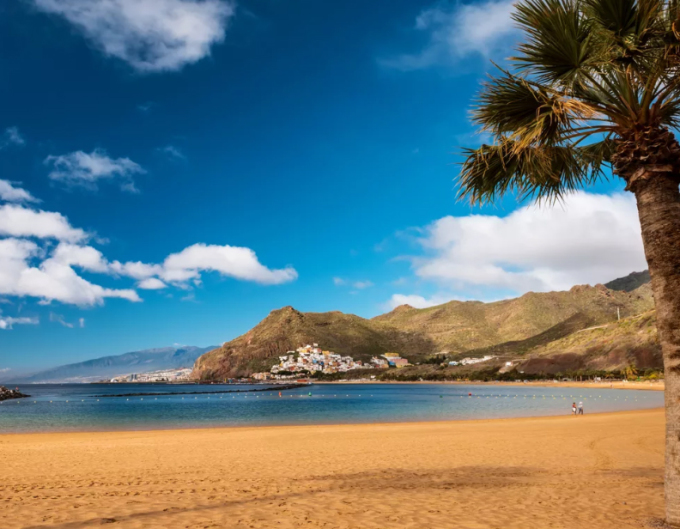
Playa de Las Teresitas when it's empty. Photo: Desposit photos
The beach is 7 km from the center of Santa Cruz, a 15-20 minute drive. Visitors can reach it by car or bus number 910, with fares starting from 1.25 euros. Room and apartment rentals in the surrounding area start from 80 euros, according to Booking.com.
Besides Playa de Las Teresitas, the Canary Islands often import sand from Western Sahara for beach reconstruction and other large-scale projects. However, according to an assessment by ENACT Africa, an organization combating transnational crime in Africa, sand mining has many negative consequences for local people in the Sahara desert region. " Economically , the government and companies in Morocco benefit. Environmentally, the mining distorts the landscape and erodes the ecosystem."
( According to Playa de lasteresitas, Tripadvisor )
Source link

![[Image] Nearly 125,000 Hanoi students completed the Literature exam for the 10th grade entrance exam.](https://vphoto.vietnam.vn/thumb/1200x675/vietnam/resource/IMAGE/2026/05/30/1780117233041_ndo_br_thiet-ke-chua-co-ten-2-png.webp)























![[Photo] Admire the coral "masterpiece" amidst the million-year-old heritage of Dak Lak province.](https://vphoto.vietnam.vn/thumb/1200x675/vietnam/resource/IMAGE/2026/05/30/1780107638639_y25-jpg.webp)





































































Comment (0)