

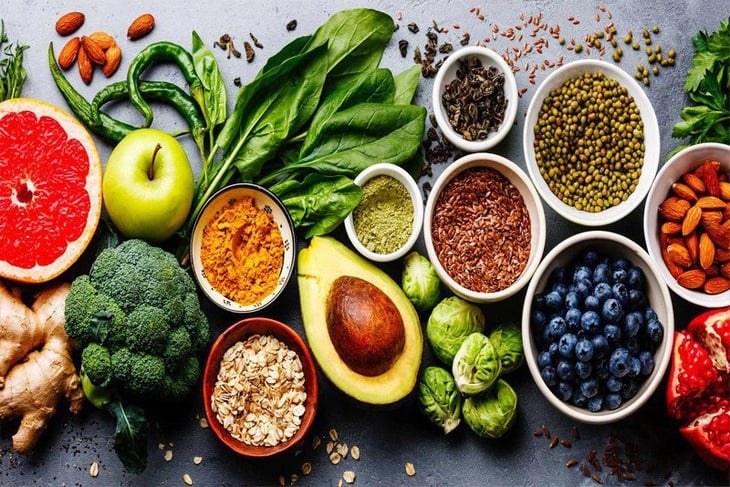
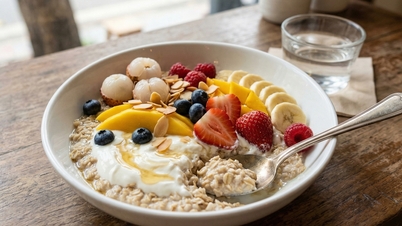
Vegetables, fruits, and nuts - sources of daily fiber - Illustration
Recommended daily fiber intake
The recommended daily fiber intake for adults is 21-38g, according to the Institute of Medicine (IOM).
Age | Female | Male |
1-3 | 14g | 14g |
4-8 | 17g | 20g |
9-13 | 22g | 25g |
14-18 | 25g | 31g |
19-30 | 28g | 34g |
31-50 | 25g | 31g |
51 and above | 22g | 28g |
Additionally, there is the Daily Value (DV) for fiber, which indicates the amount of fiber that should be consumed daily based on a 2000-calorie diet. The DV for fiber is 28g per day for adults and children over 4 years old.
To give you an idea of the fiber content in some foods, experts have calculated that 100g of guava contains 5g of fiber; 3 fresh apricots contain 1g of fiber, and 5 dried apricots contain 2.9g of fiber.
100g of whole apples contain 2.4g of fiber; half a grapefruit contains 6.1g of fiber; one orange contains 5g of fiber; 100g of strawberries contains 2g of fiber; two dried figs contain 3.7g of fiber; one cantaloupe contains 1.3g of fiber; three pieces of dried peaches contain 3.2g of fiber; 100g of bananas contain 2.6g of fiber...
Foods rich in fiber
Fiber is commonly found in plant-based foods such as vegetables, fruits, and nuts. Here are a few good sources of dietary fiber:
- Vegetables: Sweet potatoes, peas, kale, spinach
- Fruits: Avocado, raspberry, guava, pear
- Seeds: Chia seeds, sunflower seeds
Health benefits of fiber
There are two main types of fiber: soluble fiber and insoluble fiber. Soluble fiber dissolves in water, passes through the small intestine, and is broken down by bacteria in the colon (large intestine). Insoluble fiber does not dissolve in water and remains intact as it moves through the intestine.
Benefits of soluble fiber:
- Strengthening the intestinal mucosa
- Improve immune function
- It draws water into the stool, making it softer and easier to pass.
- Lower high blood pressure
The main benefit of insoluble fiber: Promotes comfortable and regular bowel movements by increasing stool volume.
Benefits of a high-fiber diet
- Reduces the risk of several common diseases, such as type 2 diabetes, heart disease, and colon cancer.
- Regulating appetite
- Promotes weight loss and reduces the risk of obesity.
What do you do if you need to increase your fiber intake?
- Eat plenty of whole, plant-based foods: this may include fruits, vegetables, legumes, nuts, etc.
- Taking fiber supplements: While fiber supplements may be beneficial for some people, they are not suitable or safe for everyone. Talk to your doctor before starting.
- Increase your overall water intake: Because fiber binds with water in the digestive tract, you need to drink enough water as recommended.
- Increase fiber intake gradually: Gradually increasing fiber intake over time can help the digestive system adapt to higher fiber levels and reduce the risk of digestive symptoms such as bloating, gas, and diarrhea. These symptoms can occur when switching to a higher-fiber diet too quickly.
Source: https://tuoitre.vn/ban-can-bao-nhieu-chat-xo-moi-ngay-20251005080457777.htm


![[Photo] National Assembly Chairman Tran Thanh Man attends the policy seminar to promote Vietnam-Türkiye cooperation.](https://vphoto.vietnam.vn/thumb/1200x675/vietnam/resource/IMAGE/2026/04/16/1776351415367_vna-potal-chu-tich-quoc-hoi-tran-thanh-man-du-toa-dam-chinh-sach-thuc-day-hop-tac-viet-nam-tho-nhi-ky-8705791-jpg.webp)



























![[Image] Bridges and roads connecting the eastern part of Ho Chi Minh City](https://vphoto.vietnam.vn/thumb/1200x675/vietnam/resource/IMAGE/2026/04/16/1776328595108_ndo_br_bh-vt5-jpg.webp)



































![[Infographic] Details of the Hanoi-Quang Ninh High-Speed Railway Project](https://vphoto.vietnam.vn/thumb/402x226/vietnam/resource/IMAGE/2026/04/16/1776338188424_anh-man-hinh-2026-04-16-luc-18-16-10.png)

![[Photo] National Assembly Chairman Tran Thanh Man meets with the Speaker of the Georgian Parliament](https://vphoto.vietnam.vn/thumb/402x226/vietnam/resource/IMAGE/2026/04/16/1776338494029_anh-man-hinh-2026-04-16-luc-18-21-21.png)






























Comment (0)