

Back then, every Tet holiday, my sisters and I would make cakes and candied fruits with our mother to offer to the ancestors and to entertain guests. And it wasn't just a consumer need, but also a source of joy during Tet.
1. Every Tet holiday, although our family wasn't well-off, my mother would make dozens of kinds of cakes. I remember the printed rice cake the most because it was easy to make, could be made in large quantities, and could be stored for a long time. My mother would put sugar and finely ground roasted glutinous rice flour into a small bowl, and her thin, bony hands, worn from hard work in the fields, would quickly knead until the flour absorbed all the sugar water.
Then my mother took a mold, poured a layer of batter, sprinkled some filling in the middle (a mixture of peanuts, sesame seeds, sugar, and cinnamon powder), poured another layer of batter, and pressed it firmly with both hands to form a cake.
The smooth, round rice cakes with the word "fortune" on top look appealing. But we children didn't like eating them because we found them not tasty and often choked us. Therefore, rice cakes are the most common thing left over after each Tet holiday.
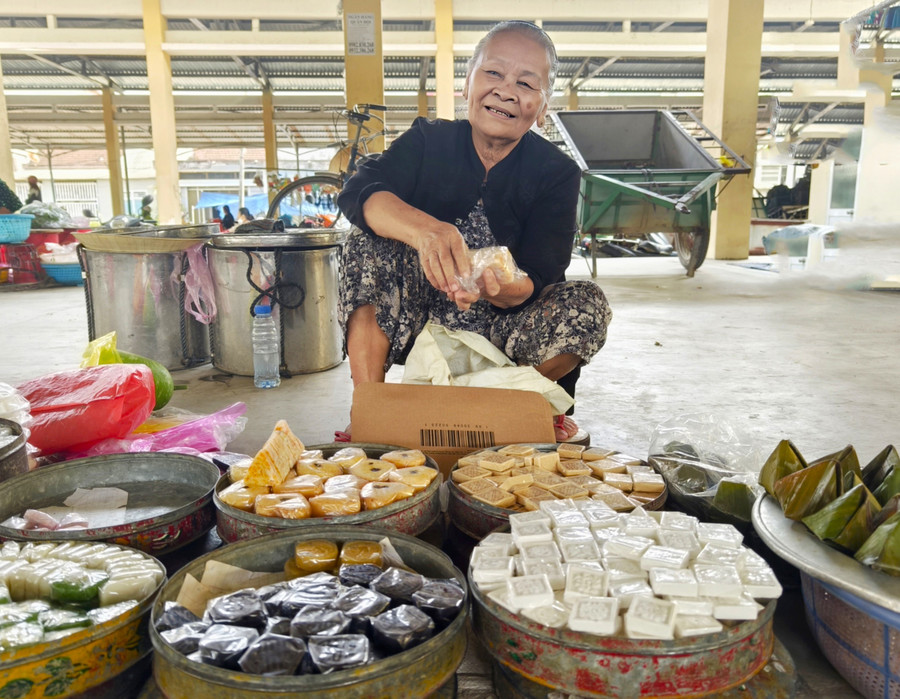
There's another type of cake that's also easy to make, but kids like it more: puffed rice cake. It's called puffed rice cake because when roasted, the glutinous rice pops into tiny white grains, making a pleasant crackling sound. The method is similar to making printed rice cake, the only difference being that the ingredient isn't flour but puffed rice.
The plump, round rice flakes carry the scent of the countryside. My mother mixes the rice flakes with sugar water and ginger, then presses them into molds to form cakes. These rhombus-shaped cakes are crispy and have a subtle ginger aroma, making them a favorite among both children and adults.
Even more elaborate is the "bánh thuẫn" cake. The main ingredients of bánh thuẫn are also flour and sugar, but with the addition of eggs and other spices. My mother mixes the flour, sugar, and eggs, then whisks them until smooth; then she places the mold on a charcoal stove, and when the mold is hot, she pours the batter in and bakes it.
When baked, the rice cake is golden brown and puffs up like the petals of a plum blossom during Tet (Vietnamese New Year). The cake is light, fluffy, and delicious, and is reserved for guests, so the children are given only a limited number by their mothers.
My mother makes many kinds of jam: ginger jam, coconut jam, pumpkin jam… But making ginger jam is the most elaborate. The ginger jam I'm referring to here is made from whole ginger root, not sliced ginger.
Making candied ginger slices is simple: take a ginger root, slice it thinly, marinate it with sugar, then simmer it over low heat, stirring constantly until the sugar crystallizes. The result is a delicious, warming candied ginger.
But making candied ginger root is much more elaborate. My mother goes to the garden to pull up ginger plants, selecting the beautiful roots, usually with five branches, so that when finished, the candied ginger pieces resemble a hand with five fingers.
After selecting the best ginger roots, my mother soaked them in water, peeled them, washed them thoroughly, and soaked them in salt water overnight to soften them and release some of the sap. The next day, my sisters and I painstakingly pricked each root, making sure to prick them evenly and carefully until they were soft, easily absorbed the sugar, and less spicy.
Each tattooing stick had about ten sharp needles, and my sister once accidentally pricked her hand, causing her so much pain she cried. After tattooing, my mother would rinse them, boil them, and simmer them with sugar until they turned an ivory white color, then take them out and dry them in the sun.
Homemade candied whole ginger carries the warmth of loved ones' hands, creating a colorful and vibrant picture of Tet (Vietnamese New Year).
After making each type of cake and jam, my mother carefully arranged and stored them in aluminum containers or glass jars for use during Tet. Throughout the three days of Tet, she would arrange the cakes and jams on plates and place them on the altar to offer to her ancestors.
When guests came to visit during the spring festival, my mother would prepare a plate of sweets and preserves to enjoy with a cup of hot tea, chatting about farming, village affairs, and local news. Seeing the guests, we children would often linger around, hoping to receive lucky money. But my father would gently remind us: "When you're out playing, children shouldn't eavesdrop."
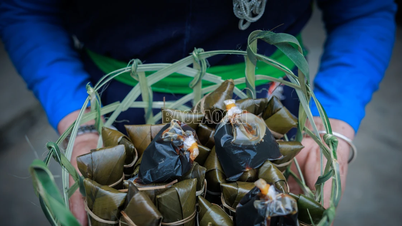
2. But perhaps nothing is more heartwarming than making banh tet (Vietnamese sticky rice cake). To make a pot of delicious banh tet, my mother chooses good quality sticky rice, soaks it in clean water, drains it, then goes to the garden to cut fresh, vibrant green banana leaves to wrap the cakes.
Spreading leaves on a tray, my mother poured a layer of sticky rice, then a layer of filling made from mung beans and pork belly, then another layer of sticky rice, and wrapped it up. She rolled the cake neatly so that the sticky rice layer embraced the filling in the middle, then used bamboo string to tie it.
My mother tied the strings while instructing my sisters, "Tie them just right; if they're too loose or too tight, the cakes won't taste good."
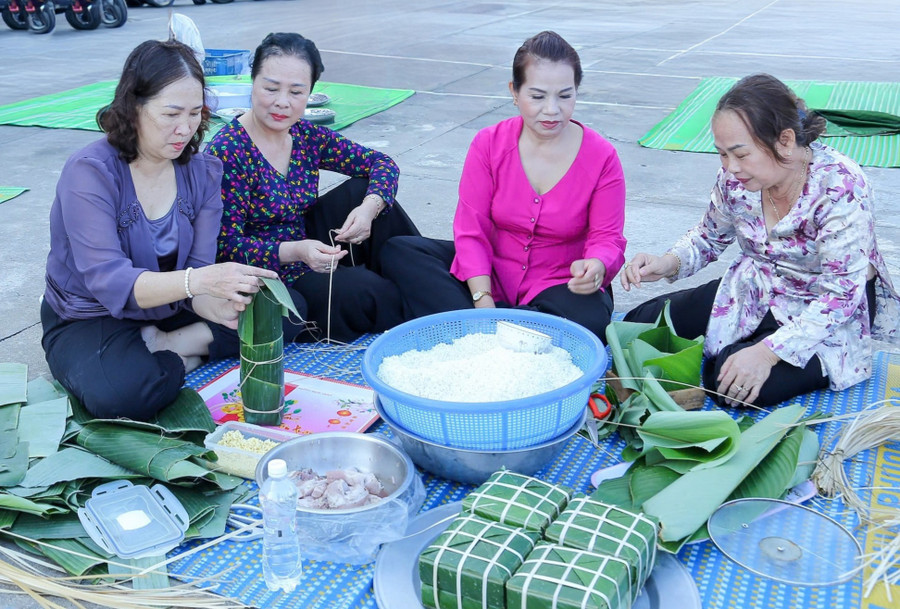
The leftover glutinous rice wasn't enough to make banh tet (a type of Vietnamese rice cake), so my mother would usually make a few small banh u (another type of Vietnamese rice cake), which was our reward when the cakes were cooked. Making banh tet usually took place on New Year's Eve; we children would gather around the fire, listening to the adults' lively conversations until we drifted off to sleep without realizing it.
Like other types of cakes and sweets, during the three days of Tet (Lunar New Year), my mother would tear open the cakes every day and place them on the altar as offerings. She used the same string that tied the cakes to tear them open. One end of the string was held firmly in place by her strong, dark teeth, while the other end was torn open with her hand.
Yet the slices of cake were perfectly uniform, as if molded. When guests came to visit during the spring festival, and my mother didn't have time to cook rice for mealtime, she would tear the cake into pieces and offer them to the guests with pickled vegetables instead of rice; everyone was happy.
Nowadays, as Tet approaches, I go to Ngoc Nga and Ba Xe bakeries to buy banh tet and banh chung (traditional Vietnamese rice cakes). These are well-known brands, and many people praise their deliciousness, but for me, they still lack something I can't quite put into words.
It seems to lack the rustic charm, the smell of the fields, the warm hearth that accompanied me throughout my childhood.
Source: https://baogialai.com.vn/banh-tet-trong-gian-bep-tuoi-tho-post578277.html

![[Photo] General Secretary and President To Lam presides over a meeting with the Central Organizing Committee.](https://vphoto.vietnam.vn/thumb/1200x675/vietnam/resource/IMAGE/2026/06/03/1780482764658_a1-bnd-4741-3342-jpg.webp)
![[Photo] First session of the 14th Congress of the Vietnam Trade Union](https://vphoto.vietnam.vn/thumb/1200x675/vietnam/resource/IMAGE/2026/06/03/1780465947883_ndo_br_img-3852-jpg.webp)
![[Photo] Secretary of the National Assembly Party Committee, Chairman of the National Assembly presides over the meeting of the Standing Committee and Executive Committee of the National Assembly Party Committee.](https://vphoto.vietnam.vn/thumb/1200x675/vietnam/resource/IMAGE/2026/06/03/1780480353201_ndo_br_bnd-2585-jpg.webp)









![[Infographic] Over 1.2 million candidates registered for the 2026 High School Graduation Exam](https://vphoto.vietnam.vn/thumb/402x226/vietnam/resource/IMAGE/2026/06/03/1780496872518_w_20260603205412.jpeg)



![[Podcast] Capital City Law 2026: Increased penalties for violations in the fields of culture and advertising](https://vphoto.vietnam.vn/thumb/402x226/vietnam/resource/IMAGE/2026/06/03/1780487283783_4522222.png)






















![[Video] Sunset at Lap An Lagoon – Where the sun sets over the fishing nets](https://vphoto.vietnam.vn/thumb/1200x675/vietnam/resource/IMAGE/2026/05/31/1780192137701_beach-landscape-sea-water-nature-grass-745871-pxhere-com.jpeg)




















Comment (0)