

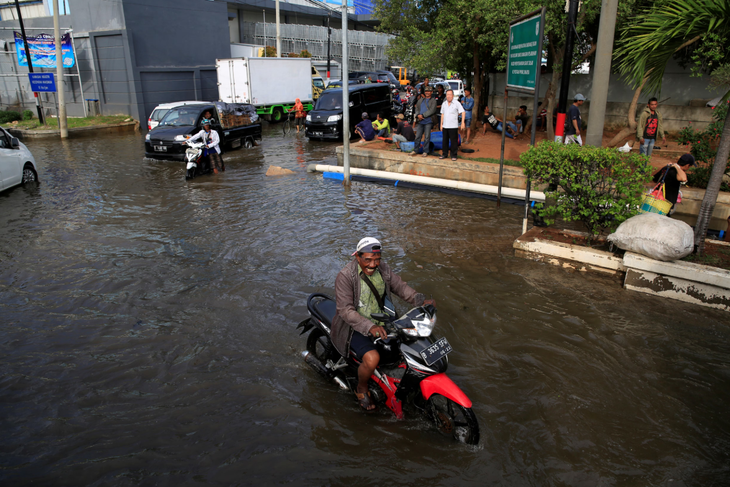
Many cities around the world are sinking at an increasingly rapid rate - Photo: REUTERS
The land is sinking faster than sea levels are rising.
A new study published in the journal Nature shows that for delta regions, home to approximately 350-500 million people globally, a more pressing threat lies right beneath their feet: sinking cities.
Using satellite radar data from 2014-2023, scientists have for the first time created a high-resolution global picture of land subsidence in 40 major river deltas.
The results show that more than half of the deltas are subsiding, at least 35% of the land in these areas is sinking, and in most deltas, more than half of the surface is subsiding over time.
Notably, in 18 of the 40 deltas analyzed, the average rate of land subsidence exceeded the rate of local sea level rise.
From Asia and Africa to Europe and the Americas, relative sea levels are rising not only because of rising oceans, but also because land is sinking.
"In terms of risk, sea level rise and land subsidence are essentially the same. The end effect is the same, but the response is not," Professor Robert Nicholls, a coastal science expert at the University of Southampton and co-author of the study, told BBC Science Focus .
Delta plains are formed from soft, waterlogged sedimentary layers, so even under natural conditions, they tend to subside over time.
Previously, this process was compensated for by floods carrying silt, continuously building up the land.
However, modern development has disrupted that balance, making land subsidence the dominant factor in flood risk in many of the world's most densely populated areas.

People in many coastal areas are facing the "double" impact of rising sea levels and land subsidence - Photo: REUTERS
The Mekong, Yellow River, and deltas are 'sinking'.
Among the most severely impacted deltas, many in Asia, including the Mekong Delta, are clearly demonstrating the negative consequences of development heavily reliant on groundwater resources and water flow control. This is also a general trend observed in research globally.
Three main drivers related to human activity have been identified: over-exploitation of groundwater, depletion of alluvial deposits due to dams and dikes, and rapid urbanization.
Of these, groundwater extraction is the most prominent factor. When water is pumped out of underground aquifers, the surrounding soft sedimentary layers collapse and become compacted. This process is almost irreversible even if the water source is replenished.
In 10 of the 40 deltas studied, groundwater loss was the primary cause of land subsidence.
In many other places, groundwater depletion is combined with a lack of alluvial deposits and the weight of large cities built on weak soil.
In the United States, the Mississippi River Delta is a prime example, with over 90% of its area subsiding at an average rate of about 3.3 mm per year.
Meanwhile, the most severe subsidence rates are concentrated in South Asia and Southeast Asia.
In deltas such as the Mekong, Ganges-Brahmaputra, Chao Phraya, and Yellow River, many areas are subsiding faster than the global rate of sea level rise, in some places exceeding 1 cm per year.
Megacities like Bangkok, Dhaka, Shanghai, and Jakarta are all built on land that is gradually sinking.
The positive aspect is that, unlike sea level rise, human-induced land subsidence can be controlled with the right policies.
Tokyo subsided by more than 4 meters in the mid-20th century due to excessive groundwater extraction, but when the government tightened water pumping regulations and invested in alternative water sources, the rate of subsidence slowed dramatically in a short period of time.
According to the authors, land subsidence is being underestimated in global climate risk response strategies, even though, even in worst-case climate scenarios, it will still be a dominant factor influencing relative sea levels in many deltas for decades to come.
Once the ground has subsided, "lifting" the entire city is impossible, and the cost of delaying action will only increase.
Source: https://tuoitre.vn/bao-dong-nhieu-thanh-pho-dang-chim-nhanh-hon-nuoc-bien-dang-20260129123001795.htm

![[Photo] General Secretary and President To Lam presides over a meeting with the Central Organizing Committee.](https://vphoto.vietnam.vn/thumb/1200x675/vietnam/resource/IMAGE/2026/06/03/1780482764658_a1-bnd-4741-3342-jpg.webp)
![[Photo] First session of the 14th Congress of the Vietnam Trade Union](https://vphoto.vietnam.vn/thumb/1200x675/vietnam/resource/IMAGE/2026/06/03/1780465947883_ndo_br_img-3852-jpg.webp)
![[Photo] Secretary of the National Assembly Party Committee, Chairman of the National Assembly presides over the meeting of the Standing Committee and Executive Committee of the National Assembly Party Committee.](https://vphoto.vietnam.vn/thumb/1200x675/vietnam/resource/IMAGE/2026/06/03/1780480353201_ndo_br_bnd-2585-jpg.webp)
















































![[Video] Sunset at Lap An Lagoon – Where the sun sets over the fishing nets](https://vphoto.vietnam.vn/thumb/1200x675/vietnam/resource/IMAGE/2026/05/31/1780192137701_beach-landscape-sea-water-nature-grass-745871-pxhere-com.jpeg)
































Comment (0)