

Remembering a time when "we went to the battlefield without regretting our youth."
On April 30, 1975, the Ho Chi Minh Campaign, which completely liberated the South and unified the country, ended in victory, ushering in a new era for our nation.
Not only during wartime but also in peacetime, he has diligently and wholeheartedly spent nearly 20 years collecting war relics, creating a private museum to honor his comrades and educate the younger generation about the glorious traditions of the nation. This is veteran Lam Van Bang (born in 1943, from Phu Xuyen, Hanoi), who comes from a family with a revolutionary tradition. In 1965, when the US expanded the war to the North, like many young people who "went to the battlefield without regretting their youth," he answered the call of the Fatherland and enlisted in the army.
In 1966, he and his comrades advanced south. During the extremely fierce Tet Offensive of 1968, he was captured by the enemy and imprisoned in Bien Hoa prison before being exiled to Phu Quoc. In 1973, he and many of his comrades were released according to the Paris Agreement.
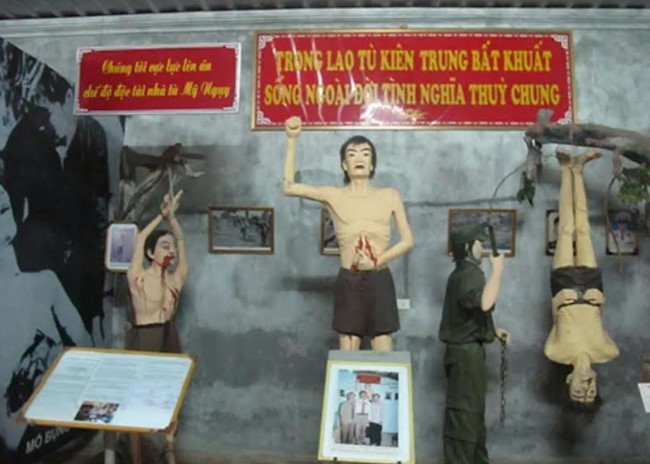
Images of prison guards at Phu Quoc prison torturing revolutionary fighters.
"During my time in enemy prison, I witnessed many comrades with unwavering courage, steadfastly defending the revolutionary ideals, ready to die even when the enemy subjected them to the most brutal torture."
"While I was in Chi Hoa prison, I witnessed many comrades being severely wounded, brutally tortured, their screams of pain and agony slowly fading away… That was when the soldiers passed away, but those sacrifices ignited unwavering loyalty in the hearts of everyone who survived," Mr. Bang recounted.
The veteran said that in the years after the war ended, he could still hear the painful cries of his comrades echoing in his ears… All of that haunted his mind for years and urged him to do something to honor his fellow soldiers.
"I needed to find war relics to preserve and express my gratitude to my comrades who fell for our homeland and country, and at the same time remind future generations of the meaning of peace and freedom," Mr. Bang recounted, adding that the idea of establishing the Museum of Revolutionary Soldiers Imprisoned by the Enemy gradually took shape from there.
After the war ended, Mr. Bang continued to dedicate his efforts to the nation-building process as the Head of Traffic Management District No. 5. In 1985, while supervising the repair of Gie Bridge (now Phu Xuyen District), the workers discovered a bomb.
Mr. Bang asked an expert to remove the detonator and all the explosives, then brought the casing back to headquarters. There, he detonated the bomb and wrote the words: "Girl from Suoi Hai, boy from Cau Gie."
The next morning, before going to work, he saw many workers gathered to look at the bomb casings. Sitting on the second floor working, looking down, he thought: "These soldiers were captured, imprisoned, and subjected to horrific torture by the enemy, always on the brink of death; there are so many artifacts... So why don't we gather them all together and display them?"
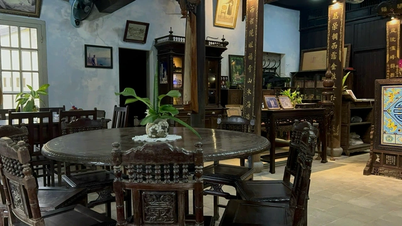
When he started working on the project, Mr. Bang was fortunate to receive great encouragement and support from his comrades. Undeterred by the long distances, the veteran traveled thousands of kilometers to find artifacts belonging to his fellow soldiers. After many years of tireless searching, on October 11, 2006, the "Museum of Revolutionary Soldiers Imprisoned by the Enemy" was officially established.
To date, after nearly 20 years of operation, the museum has 10 exhibition rooms and has collected nearly 5,000 artifacts. "The artifacts in the museum aren't anything too grand, but behind each artifact is a story, containing an incredibly profound meaning. Each artifact is the bone and blood of my comrades," Mr. Bang said.
He cited the example of the Party flag painted with blood in the prison of Mr. Nguyen Van Du (Hong Duong commune, Thanh Oai district, Hanoi ). Previously, to "persuade" Mr. Du's family to donate it to the museum, his group had cycled to Mr. Du's house more than a dozen times.
“At first, he disagreed, then avoided meeting us. Later, he said his wife didn’t agree to ‘hand over’ the Party flag to us. We tried to persuade his wife, but she said their children didn’t agree,” Mr. Bang recounted.
"If you keep this precious Party flag, only your family will know. But when I bring it to the tradition room for display, many people will know about it. This is also one of the ways to report to the Party, the Army, and the People about the loyal, indomitable, and steadfast revolutionary soldiers. And to educate future generations about our traditions," I said this after more than a dozen visits to his house and finally persuading him.
The veteran continued: “When Mr. Du handed me the flag, we both cried, because for him, the flag represented his whole life. When the enemy searched us, we rolled up that special flag (which, when unfolded, was only the size of a hand) and stuffed it into our mouths, or into the crutches of the wounded… The Party flag, painted with blood, was not something easily obtained.”
Faith in the younger generation
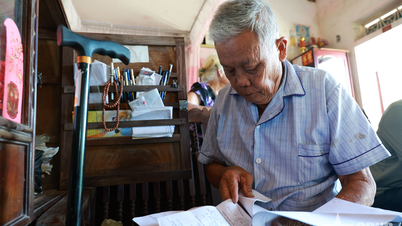
Mr. Bang happily shared that every year, on the anniversaries of the Liberation Day of Southern Vietnam (April 30th), the Day of War Invalids and Martyrs (July 27th), and the founding day of the Vietnam People's Army, his museum welcomes many visitors, both domestic and international, who come to visit and learn.
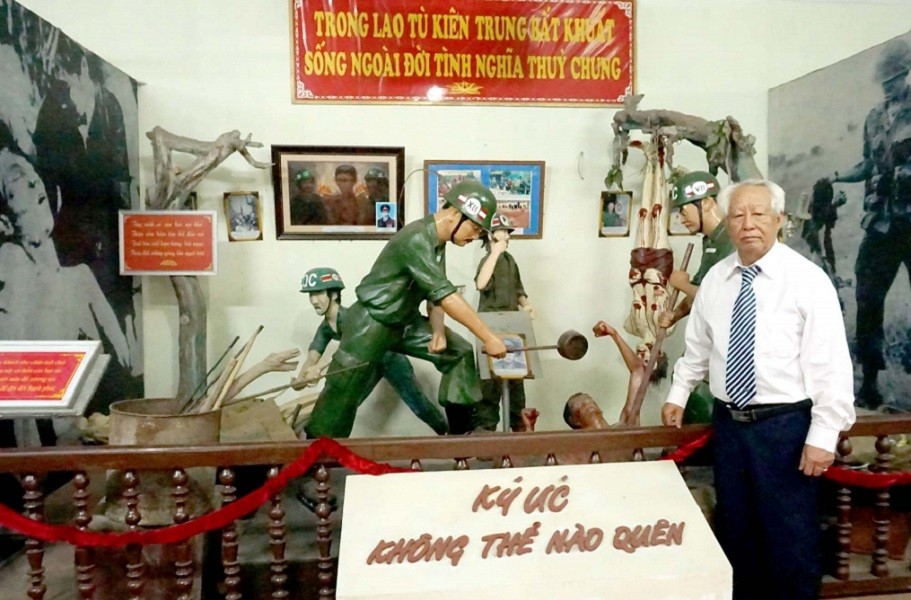
Returning home after the war, Mr. Lam Van Bang was always concerned about establishing a museum to collect artifacts to honor his fallen comrades.
In particular, the museum has also received attention from all levels of government, and the local education sector regularly organizes trips for students to visit and learn. "That is a great encouragement for me and my colleagues who are taking care of and preserving the museum here," Mr. Bang said, expressing his hope for even more attention from the government and the people so that the museum can develop further.
With the belief that "our army comes from the people" and "our army is loyal to the Party and devoted to the people," he said that from his time in school, through his time in the army, his imprisonment by the enemy, to his return to civilian life, he has always been committed to doing things that benefit society and the country, following President Ho Chi Minh's teachings.
"Following Uncle Ho's teachings on educating the younger generation about revolutionary traditions and promoting national unity, my comrades and I have established this museum to educate the present and future generations about revolutionary traditions."
"Each story shared reminds everyone, especially the younger generation, to see the sacrifices of the heroic martyrs and to deeply understand how precious Uncle Ho's teaching 'Nothing is more precious than independence and freedom' truly is," Mr. Bang said.
For his contributions, Mr. Lam Van Bang was honored with the Third-Class Labor Medal by the President of Vietnam, the title of Outstanding Citizen of Hanoi in 2014 by the Chairman of the People's Committee of Hanoi, and many other prestigious awards…
In 2018, he was one of 70 exemplary individuals honored at the ceremony commemorating the 70th anniversary of President Ho Chi Minh's call for patriotic emulation. In 2019, the museum was honored to receive a Certificate of Merit from the Prime Minister…
Thuan Nguyen
Source
![[Photo] The courage of new recruits of Brigade 144 on the training ground.](https://vphoto.vietnam.vn/thumb/1200x675/vietnam/resource/IMAGE/2026/05/27/1779881651341_anh-man-hinh-2026-05-27-luc-18-32-52.png)
![[Photo] The heat at the fireworks display site on the opening night of the Da Nang International Fireworks Festival 2026](https://vphoto.vietnam.vn/thumb/1200x675/vietnam/resource/IMAGE/2026/05/27/1779889741485_ndo_br_z7872039145157-fecaba5112f39e8352544099d7ef4738-5140-jpg.webp)



















































Comment (0)