

(Dan Tri Newspaper) - Solar flares strike Earth, disrupting the magnetic field and quickly intensifying into geomagnetic storms.
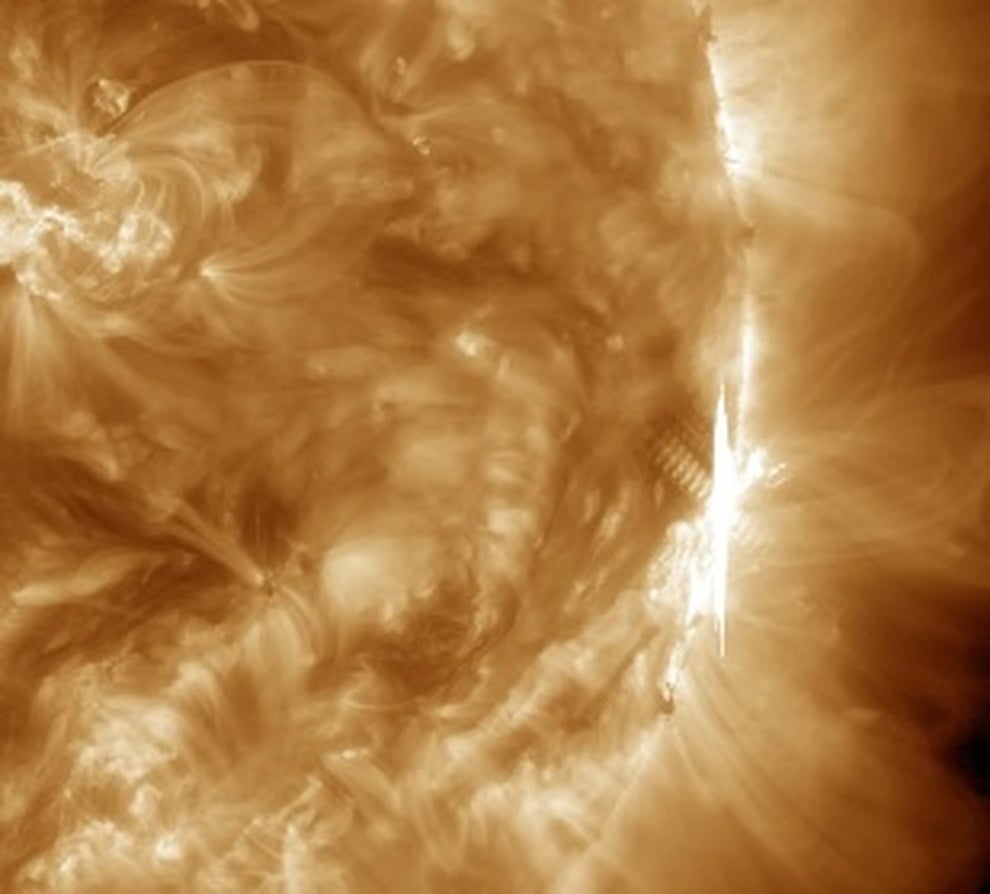
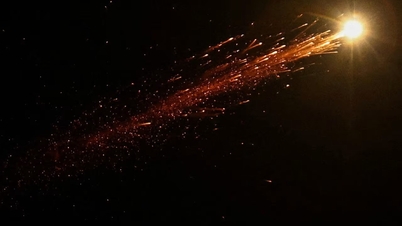
NASA's Solar Activity Observatory captured this image during the storm on October 10th. On the right is a bright flash of lightning, which is where the storm originated (Image: NASA/SDO).
On October 10th, a coronal mass ejection struck Earth at 10:17 PM (Vietnam time). This super-strong geomagnetic storm disrupted Earth's magnetic field and quickly intensified into a Category 4 geomagnetic storm (Category 5 is the strongest) around 11 AM on October 11th.
Currently, the Sun is at its peak activity in its 11-year cycle. According to a warning from the US Space Weather Prediction Center (SWPC), when coronal mass ejections enter the Earth's magnetosphere, they can cause geomagnetic storms.
These storms sometimes disrupt the operation of satellites in orbit around Earth and negatively affect many systems such as radio signals and GPS navigation. Geomagnetic storms can also cripple power grids.
The storm from Halloween in October 2023 caused complete power outages in many parts of Sweden and damaged South Africa's electrical infrastructure.
The storm that occurred in May 2024 affected GPS systems across the American Midwest and damaged several high-voltage substations.
During this storm, experts had to readjust the operations of approximately 5,000 satellites because the storm inflated the ionosphere, causing the satellites to slow down and deviate from their orbits.
Solar flares and the accompanying geomagnetic storms are a natural occurrence in the Sun's activity cycle.
When this cycle is at its peak, the Sun is at its most active, eruptions occur more frequently, and as they head towards Earth, our atmosphere absorbs an enormous amount of energy.
Therefore, many ground-based activities are also affected to varying degrees.
Source: https://dantri.com.vn/khoa-hoc-cong-nghe/bao-tu-gop-phan-huy-hoai-mat-dat-nhu-the-nao-20241011162029877.htm



![[Photo] General Secretary and President To Lam presides over the meeting to approve the draft report on the results of the second inspection by the Politburo of the Standing Committee of the Hanoi City Party Committee.](https://vphoto.vietnam.vn/thumb/1200x675/vietnam/resource/IMAGE/2026/05/26/1779789811432_a2-bnd-4430-9620-jpg.webp)
































































Comment (0)