

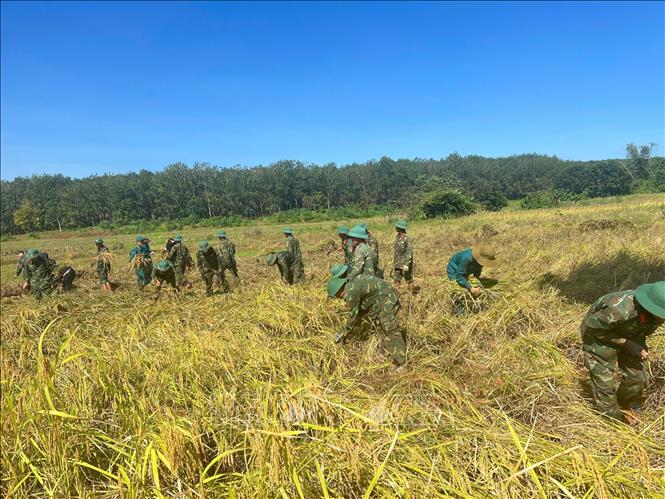
According to reports from localities, the average yield of the summer rice crop nationwide this year is estimated at 52.4 quintals/hectare, an increase of 2.2 quintals/hectare compared to the 2024 summer crop; of which, localities in the North are estimated at 50.7 quintals/hectare, an increase of 3.2 quintals/hectare. The average yield of the summer rice crop in localities in the South is estimated at 55.3 quintals/hectare, an increase of 0.3 quintals/hectare compared to the 2024 summer crop. The total summer rice production nationwide is estimated at 8.07 million tons, an increase of 314.7 tons compared to the 2024 summer crop.
The area planted with autumn-winter rice in 2025 in the Mekong Delta and Tay Ninh is estimated at 716.6 thousand hectares, a decrease of 1.3 thousand hectares compared to the same period in 2024. This decrease is due to some localities converting a portion of their rice land to fruit trees and vegetables for higher economic efficiency. In addition, some areas have not yet planted, proactively bringing water into the fields to receive alluvial soil in preparation for the 2025-2026 winter-spring crop.
As of November 20, 2025, localities had harvested 435.7 thousand hectares of autumn-winter rice, accounting for 60.8% of the planted area and 95.9% of the same period in 2024. This was mainly due to late planting, especially in An Giang , the locality with the largest autumn-winter rice area in the region. The harvested area in An Giang currently only reaches 155.7 thousand hectares, accounting for 62.9% of the planted area and 84.9% of the same period in 2024.
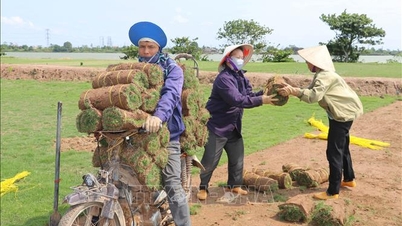
Regarding annual crops, due to the impact of natural disasters and floods, the planted area of most vegetable crops has decreased compared to the same period in 2024. Although planting progress has slowed down for most crops, in general, localities in the North quickly restored production as soon as weather conditions stabilized. Specialized vegetable growing areas in Hanoi, Hai Duong, and Vinh Phuc are actively expanding their planted area to meet the demand for the end of the year and the Lunar New Year.
In addition, buffalo farming continues its downward trend, mainly due to shrinking natural grazing areas, high investment costs, long rearing periods, and low profits. The cattle herd has decreased slightly, primarily due to a shortage of green fodder, high input costs, and inefficient small-scale farming. However, the cattle herd is still increasing in some localities thanks to stable consumer markets and the development of high-tech farming systems.
Meanwhile, pig farming in many localities has begun to recover after the impact of African swine fever, but in the central provinces, due to the severe impact of floods and heavy rains, the restocking process has been disrupted, the scale of farming has shrunk, and the ability to restore production faces many difficulties.
Poultry farming in the South Central coastal provinces and the Central Highlands was affected by floods, causing a localized decline in production, but the national poultry population continued to grow thanks to stable and expanding farming in other regions.
According to the General Statistics Office, the area of newly planted forests nationwide in November was estimated at 29.9 thousand hectares, a decrease of 4.8% compared to the same period in 2024; the volume of harvested timber reached 2,478.5 thousand cubic meters, an increase of 1.9% due to stable raw timber prices and many localities accelerating timber harvesting. Overall, in the first 11 months of 2025, the area of newly planted forests is estimated at 281.1 thousand hectares, an increase of 6.5% compared to the same period in 2024; the number of scattered forest trees planted reached 83 million trees, an increase of 1%; and the volume of harvested timber reached 22,881.5 thousand cubic meters, an increase of 6.8%.
The area of forest damaged in November reached 18.8 hectares, a decrease of 76% compared to the same period in 2024. Of this, 18.7 hectares were cleared (a decrease of 75.1%) and 0.1 hectares were burned (a decrease of 96.9%). Overall, in the first 11 months of 2025, the area of forest damaged was 1,059.6 hectares, a decrease of 33.1% compared to the same period in 2024.
The General Statistics Office also reported that the estimated seafood production in November reached 904.5 thousand tons, an increase of 2.6% compared to the same period in 2024. Aquaculture production in the month was estimated at 625.7 thousand tons, an increase of 5.4% compared to the same period in 2024. Fishery production from fishing in the month was estimated at 278.8 thousand tons, a decrease of 3.2% compared to the same period in 2024 due to unfavorable weather conditions caused by Typhoon No. 13 and its aftermath, with fishing vessels staying ashore to avoid the storm, directly affecting marine fisheries activities. The estimated production from marine fishing reached 259.5 thousand tons, a decrease of 2.8% compared to the same period in 2024.
Overall, in the first 11 months of 2025, the estimated seafood production reached 9,049.6 thousand tons, an increase of 2.9% compared to the same period in 2024.
Source: https://baotintuc.vn/kinh-te/san-luong-lua-vu-mua-ca-nuoc-dat-hon-8-trieu-tan-20251206175359778.htm

![[Video] Sunset at Lap An Lagoon – Where the sun sets over the fishing nets](https://vphoto.vietnam.vn/thumb/1200x675/vietnam/resource/IMAGE/2026/05/31/1780192137701_beach-landscape-sea-water-nature-grass-745871-pxhere-com.jpeg)
















![[Video] Sunset at Lap An Lagoon – Where the sun sets over the fishing nets](https://vphoto.vietnam.vn/thumb/340x192/vietnam/resource/IMAGE/2026/05/31/1780192137701_beach-landscape-sea-water-nature-grass-745871-pxhere-com.jpeg)













































































Comment (0)