 |
| Compare the actual parameters at the observation tent (right) and the automatic weather station (left). |
The heatwave, which has lasted for more than 10 days, has been marked by several worrying figures: the highest temperatures in all locations have exceeded the highest temperatures of 2025, and the lowest humidity has surpassed historical values. At the city's meteorological station, the temperature measured was 39.8°C (higher than 2025: 38.7°C), the lowest humidity was 28% (exceeding the historical value for April: 32%); at the Nam Dong station, it was 40.0°C (higher than 2025: 38.8°C), the lowest humidity was 32%; and at the A Luoi station, it was 37.0°C (higher than 2025: 36.1°C), the lowest humidity was 29% (exceeding the historical value for April: 32%).
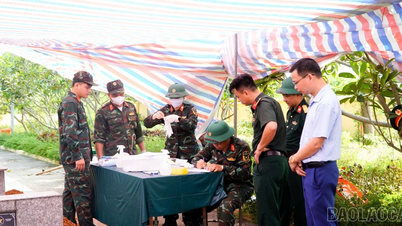
Each day, the Meteorological Station (City Meteorological and Hydrological Observatory) has 4 people working, divided into 3 shifts. The daily meteorological data update times are: 1:00 AM, 4:00 AM, 7:00 AM, 1:00 PM, 4:00 PM, 7:00 PM, and 10:00 PM. Of these, the 1:00 AM, 7:00 AM, 1:00 PM, and 7:00 PM time slots are the main observation periods. Around 1:00 PM each day is the peak heat level; observers must record the actual parameters, analyze, synthesize, and transmit the data electronically to the Meteorological and Hydrological System, while also sending international reports.
Ms. Le Thi Hong Van, a weather observer, shared: "At 1 PM, going to the meteorological garden sometimes makes me dizzy, but the priority is updating accurate data. After 5 minutes of the exact hour, the person on duty must immediately switch the electrical code!"
To ensure accurate heatwave warnings, the city's meteorological station is also equipped with an Italian-technology automatic meteorological station, transmitting data to the Central Meteorological and Hydrological Bureau in real time every 10 minutes.
According to Mr. Che Quang Hoi, head of the city's meteorological station, everyone must strictly adhere to procedures in carrying out their duties, especially the update schedule – this is the top priority. Besides checking the equipment, station staff must wear protective clothing, drink plenty of water, and record parameters such as cloud cover, air temperature, humidity, and ground temperature at the observation garden.
In the current hot weather conditions, observational data from meteorological stations is crucial for calculating and developing accurate weather forecasts. This helps agencies and the public be more proactive in preventing and responding to extreme heat.
Hue Today Online captures moments of meteorological observers tracking the intense heat:



![[Photo] First session of the 14th Congress of the Vietnam Trade Union](https://vphoto.vietnam.vn/thumb/1200x675/vietnam/resource/IMAGE/2026/06/03/1780465947883_ndo_br_img-3852-jpg.webp)
![[Photo] General Secretary and President To Lam presides over a meeting with the Central Organizing Committee.](https://vphoto.vietnam.vn/thumb/1200x675/vietnam/resource/IMAGE/2026/06/03/1780482764658_a1-bnd-4741-3342-jpg.webp)

![[Photo] Secretary of the National Assembly Party Committee, Chairman of the National Assembly presides over the meeting of the Standing Committee and Executive Committee of the National Assembly Party Committee.](https://vphoto.vietnam.vn/thumb/1200x675/vietnam/resource/IMAGE/2026/06/03/1780480353201_ndo_br_bnd-2585-jpg.webp)





























































![[Video] Sunset at Lap An Lagoon – Where the sun sets over the fishing nets](https://vphoto.vietnam.vn/thumb/1200x675/vietnam/resource/IMAGE/2026/05/31/1780192137701_beach-landscape-sea-water-nature-grass-745871-pxhere-com.jpeg)





































Comment (0)