


A cathedral?
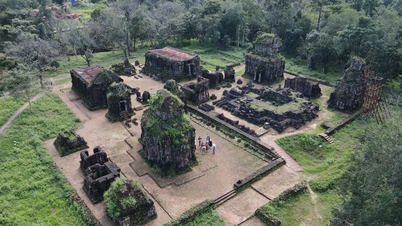
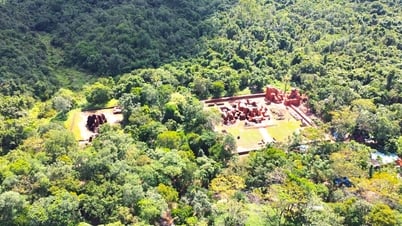
Nestled in a small valley surrounded on three sides by low hills and a short distance from the ancient capital of Tra Kieu as the crow flies, the Chiem Son ruins complex has a relatively wide geographical area.
In 1980, researchers from Vietnam and abroad conducted field surveys in the Chiêm Sơn valley, discovering traces and artifacts of several architectural structures at four locations: Triền Tranh, Gò Lồi, Chùa Vua, and Gò Gạch.
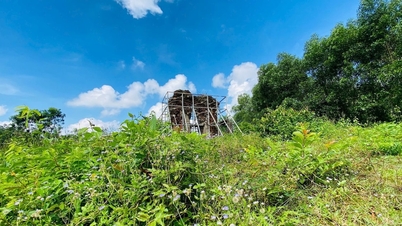
In particular, in August 2014, when the Da Nang - Quang Ngai expressway project crossed the Trien Tranh ruins, it uncovered traces of a Champa architectural structure hidden deep underground at the construction site, drawing even more attention to the Chiem Son ruins.
In December 2024, the Vietnam Institute of Archaeology, in collaboration with the Department of Culture, Sports and Tourism of Quang Nam (formerly), conducted excavations of the Trien Tranh ruins (approximately 3,800 m2), discovering numerous fragments of bricks, tiles, pottery, etc. Notably, the excavation also revealed 8 traces of ancient architecture related to the lifestyle/architecture of the ancient Champa people.
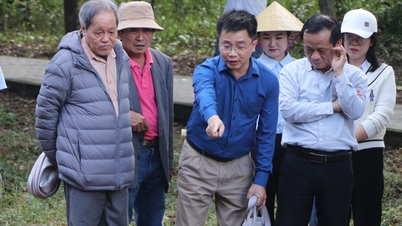
Dr. Nguyen Ngoc Quy, from the Vietnam Institute of Archaeology, who directly participated in the excavation project of the Trien Tranh ruins at that time, said that based on the excavation and connection of the system of nearby ruins as well as comparison with Hindu temples, the initial assessment is that this may have been a royal palace serving the religious practice of monks and the royal and priestly classes of the ancient Champa dynasty.

The role of Chiem Son in Champa history
Dating back to approximately the 8th-14th centuries, the existence of the Chiem Son ruins is considered a fascinating mystery by researchers, especially the role and location of the architectural structures associated with the Tra Kieu citadel and the My Son temple complex.
According to architect Le Tri Cong, a researcher of Cham culture, through studying and comparing several other Hindu structures, the Chiem Son ruins may have been an administrative center of the ancient Champa kingdom.
With dozens of Cham relics and ruins still present in Da Nang city, it is evidence of the prominent role and position of Quang Nam province throughout the history of the Cham dynasties.
Associate Professor Ngo Van Doanh, former Deputy Director of the Institute of Southeast Asian Studies (Vietnam Academy of Social Sciences ), shared that it is difficult to make any definitive statements without complete scientific documentation about the ruins while they are still underground. This is especially true for the Chiem Son ruins complex. “To assess the role of Chiem Son in the overall spatial context from Tra Kieu to My Son, we must first rely on inscriptions or archaeological investigation and exploration data… Next, we must select each issue and each ruin for in-depth study, avoiding a comprehensive or hasty approach that could damage the site,” suggested Associate Professor Ngo Van Doanh.
In fact, the lack of documents and inscriptions, along with the fact that most of the architecture remains buried deep underground, has made Chiem Son one of the rare Cham ruins that both sparks many interpretations and forces researchers to maintain a cautious attitude.
According to Associate Professor Ngo Van Doanh, the appeal of Chiem Son lies in the possibility of interpretation based on each new discovery, but it also raises many questions that need explanation. Therefore, speculating on the function and role of the ruins based solely on architectural layout or comparing their form with other Hindu structures always carries inherent risks. Thus, the research process at Chiem Son must be conducted step by step, with selective exploration and excavation phases, closely integrating archaeology, history, epigraphic research, cultural geography, and modern survey technology.
Source: https://baodanang.vn/bi-an-cum-phe-tich-cham-chiem-son-3321549.html

![[Photo] General Secretary and President To Lam and the President of the Philippines hold talks.](https://vphoto.vietnam.vn/thumb/1200x675/vietnam/resource/IMAGE/2026/06/01/1780283481955_vna-potal-tong-bi-thu-chu-tich-nuoc-to-lam-va-tong-thong-philippines-hoi-dam-8797519-1429-jpg.webp)

















![[Image] Hanoi Police officially crowned champions of V-League 2025/2026](https://vphoto.vietnam.vn/thumb/1200x675/vietnam/resource/IMAGE/2026/05/31/1780244769054_ndo_br_039d561b692be875b13a-jpg.webp)
![[Photo] The General Secretary, President and his wife begin their state visit to the Philippines.](https://vphoto.vietnam.vn/thumb/1200x675/vietnam/resource/IMAGE/2026/05/31/1780230559452_anh-man-hinh-2026-05-31-luc-19-28-11.png)



















































Comment (0)