

This article discusses the presence of horses in Champa art; their economic and strategic role in the Southeast Asian trade network from the 7th to 13th centuries; and the connection between Champa and major trade routes such as the "Tea Horse Road," which connected Tibet and Yunnan with Southeast Asia, as documented in historical records and archaeological evidence.
Symbols and visual language
Horses appear in various forms on Champa artifacts and reliefs from the 7th-8th centuries. First and foremost, the image of the horse associated with the wind god Vāyu is typical.
In the Vedas, Vāyu is associated with wind and the storm gods Maruts, from whom he is born. In the hymns, Vāyu is described as having extraordinary beauty, moving on a chariot pulled by two, forty-nine, or sometimes up to a thousand white or purple horses, creating a powerful and tumultuous sound. The image of the horses in this context represents the strength and speed of the god of wind.
The image of the sun god Surya riding a seven-headed horse – a Hindu symbol that spread to Southeast Asia through religious and artistic exchanges – also appears in Champa art. Surya is sometimes depicted standing on a chariot pulled by seven horses, symbolizing the seven colors of visible light and the seven days of the week.
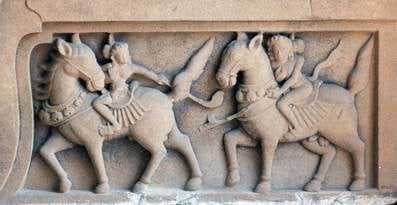
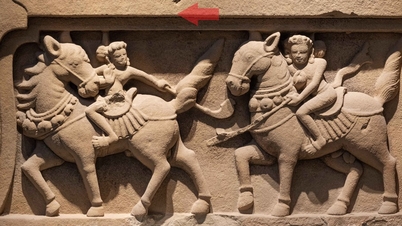
Another remarkable work is the relief "Riding a Horse and Playing Polo" (Polo/Horse Ball), one of the most vivid depictions of horseback riding in Champa art. Discovered in 1923 at Thach Han, Quang Tri, this relief not only reflects daily life but also demonstrates the power of the Champa aristocracy, through the adoption and localization of symbols from India and China (this site was a large temple-tower structure that was destroyed in the early 20th century; a Catholic church was later built there, now the Thach Han Church - author's note).
This work is noteworthy for its technique in depicting horses and riders: it is the only relief discovered in Cham sculpture that shows a horse with a full saddle and stirrups. These features have so far been little studied. Its formal similarities to reliefs of the same period at Phra That Phnom (Northeast Thailand) or some rare reliefs on Borobudur Temple (Indonesia) suggest a vast network of artistic interactions across mainland and island Southeast Asia.
Detailed analysis suggests that Cham artisans may have adopted animal sculpting techniques from outside sources and combined them with observations of horseback riding in Champa to localize the imagery of horses in particular and animals in general.
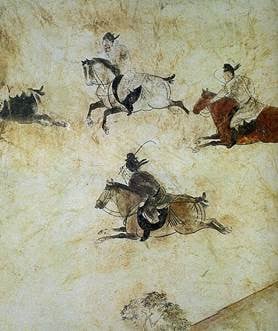
The similarities between the Champa "Riding and Playing Polo" relief and contemporary works in Asia—such as the "Polo Players" mural in the tomb of Prince Truong Hoai of the Tang Dynasty, buried in 706, or Tang Dynasty ceramic statues depicting noblewomen playing polo—show that Champa was part of a regional artistic exchange. In a later period, this imagery can be compared to a Persian painting depicting polo in the poem by Guy-o Chawgan during the Safavid period (1546).
In-depth studies of Champa art suggest that Champa artisans adopted horse motifs from India and Persia, but expressed them with a local aesthetic sensibility, reflecting both the sacredness of religion and the material life of the local inhabitants.
Horses and daily life in Champa
Although no horse remains have been found in Champa archaeological sites or in Southeast Asia to date, the image of the horse in regional art is believed by many scholars to depict a breed of horse originating from Yunnan-Tibet or China.
According to some studies, Champa not only consumed but also supplied horses to Java and Khmer. Horses from Yunnan were transported along the Red River system to the Gulf of Tonkin in Dai Viet; then transferred to Champa; and further transported by land to the Khmer market during the Angkor period.
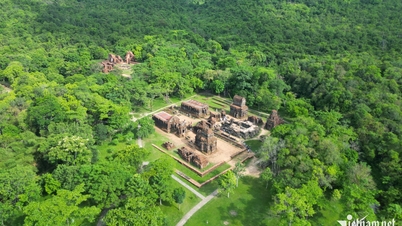
The small-bodied, round-headed horse figures seen in Champa art at the Dong Duong, Khuong My, and My Son sites have provided the basis for the hypothesis that the horse imagery appearing on Angkor reliefs is characteristic of Yunnan/Yi horses; and that they may have been supplied to the Angkor market by Champa merchants.

The 9th-10th century brick temple of Phra That Phnom in the Khorat Plateau, Nakhon Ratchasima Province, Thailand, features Cham artistic characteristics and "flying horse" motifs influenced by China, leading art historians to argue that the Cham may have directly brought horses to trade in this region via a system of land routes connecting small states in mainland Southeast Asia.
The horse trade between the Cham people and Chinese merchants across the Gulf of Tonkin was formalized during the Song dynasty, when the Gulf of Tonkin became the "Mediterranean of East Asia". Horse trade between Champa and the Song dynasty lasted for over a century, from 959 to 1068.
Overall, the image of the horse in ancient Champa and Southeast Asian art suggests that the horse was primarily a symbol of power, nobility, and religion, rather than a military means. Simultaneously, thanks to its horse trade network, Champa transmitted artistic elements, equestrian techniques, and religious symbolism into Khmer and Southeast Asian culture.
Source: https://baodanang.vn/ngua-trong-van-minh-champa-3324528.html















































































Comment (0)