


For those familiar with polo, this is a paradox. According to the rules of the sport, from ancient times to the present day, using the right hand to hold the baton is almost an unchanging principle. The left hand only holds the reins. So, did the Champa artisans perhaps "carve the wrong rules"?
Why is Polo required to use his right hand?
Unlike ground-based combat sports , polo is a competition played on horseback at high speed. This unique setting necessitates extremely strict safety regulations.
Firstly, the riders move parallel to each other in the same direction when contesting the ball; the rules prohibit cutting across the "ball's path" directly.
Secondly, if there are two opposing left-right swing directions, the risk of hitting or striking an opponent is very high, potentially leading to serious injury.
Third, for safety reasons, even left-handed people are forced to practice striking with their right hand. Consistency of movement is not a personal choice but a principle of survival on horseback.
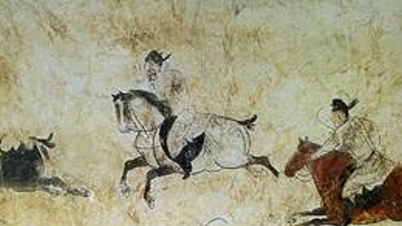
Archaeological and artistic records from the Tang Dynasty in China reveal this consistency. Murals in the tombs of Prince Zhang Huai Li Xian and Li Yong depict knights holding staffs in their right hands. This convention was later standardized in the rules of the International Polo Federation (FIP), but it had actually existed as an "unwritten rule" for thousands of years.
Therefore, if we view Champa reliefs as independent images, we have the right to ask: why is there a "left hand"?
The answer may not lie in understanding the rules of the game, but in the original location of the artifact.


This sculptural block is not a standalone wall panel. It is the left side (when viewed from inside the temple) of the balustrade – a type of architectural element often called a Sopāna-vedikā . This type is characterized by its axial orientation and strict symmetrical organization principles.
In Champa temple architecture, the entrance is a sacred space organized along a central axis. On either side of the steps, there are often symmetrical carvings arranged according to the principle of "mirror symmetry." This means that the image on the left reflects the image on the right, creating perfect balance for the entire structure.
If we assume that the right side (which has not yet been found) depicts two knights holding staffs in their right hands according to standard conventions, then the left side must have the hands reversed to ensure the complete reflection effect. Thus, the "left hand" is not against the rules—but rather a natural consequence of symmetrical design thinking.
From a single detail, a methodology emerges.
This interpretation not only vindicates the Champa artisans but also suggests an important research principle: a sculptural piece should not be interpreted as a separate image. Each detail only truly has meaning when placed within the context of the original architectural whole.
In the case of the Polo Thach Han relief, if separated from the structure of the railing and the spatial axis of the temple tower, the image of the "left hand" could easily be interpreted as an error. But when placed within the overall symmetrical system, that detail becomes evidence of a rigorous architectural thinking.
The principle of "mirror symmetry" and spatial axis organization therefore needs further systematic examination at other Champa relics—such as the Khuong My altar—in order to better identify the sculptural logic and symbolic structure of Champa art.
Source: https://baovanhoa.vn/van-hoa/khi-kien-truc-len-tieng-207964.html
























































































Comment (0)