Germany is independently researching and developing high-speed rail technology, both in terms of infrastructure and vehicles, with the goal of achieving speeds "half as fast as airplanes and twice as fast as cars".
Passenger transport is prioritized, while freight transport is scheduled at night. Speaking of world-renowned high-speed rail lines, one cannot fail to mention the famous InterCity Express (ICE) brand from Germany. The ICE system officially began operation in 1991, aiming to improve long-distance transport and connectivity between major economic centers in Germany. Furthermore, this system not only serves domestic destinations but also extends to neighboring countries, including Austria, France, Belgium, Switzerland, and the Netherlands, in cross-border services.
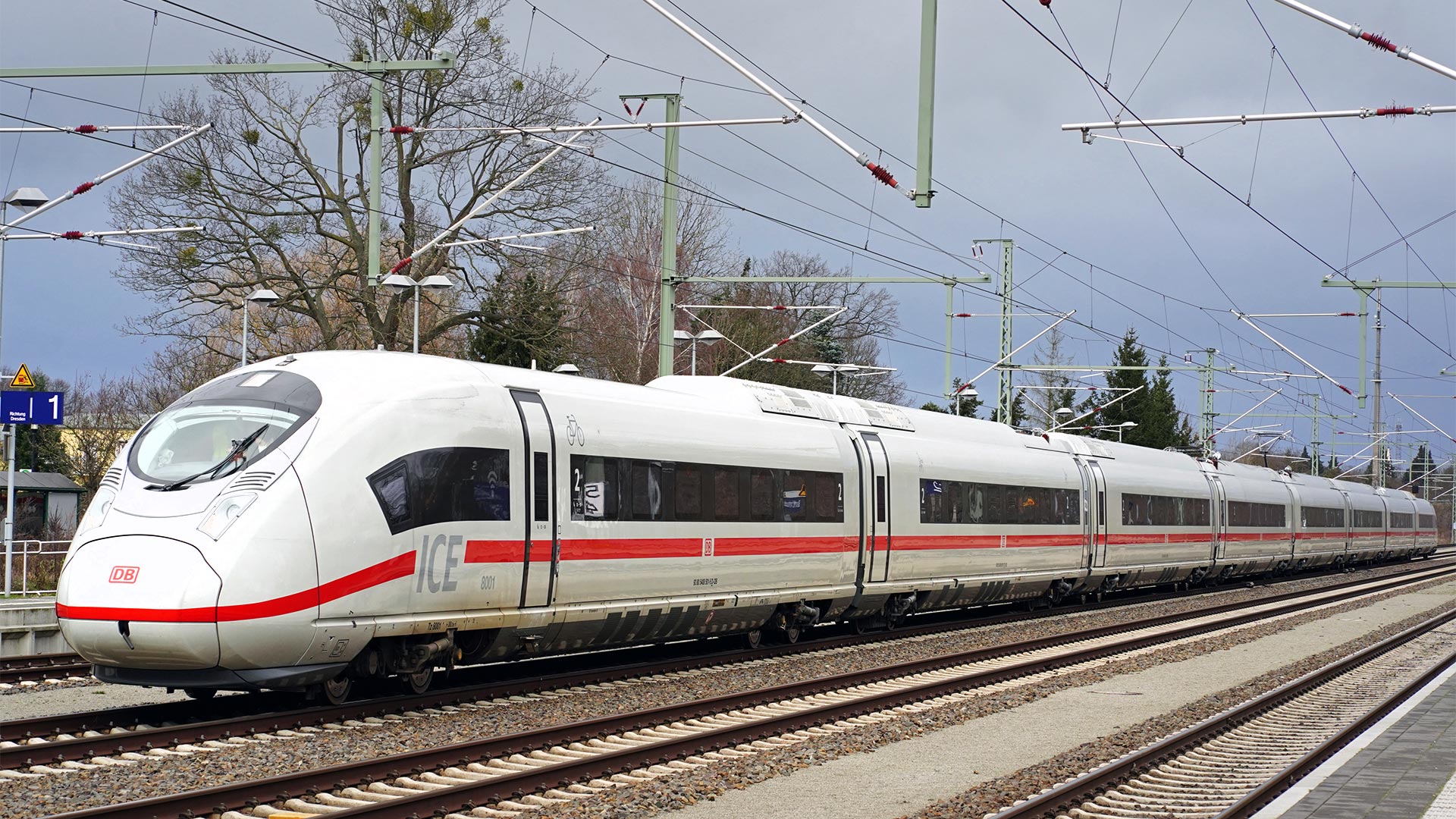
German high-speed trains (Photo: Internet).
According to research by the Transport Newspaper, after World War II severely damaged Germany's railway system, the German government developed a comprehensive plan for the development of its transportation system, including railways. Accordingly, this country, dubbed the "heart of Europe," planned to build 2,225 km of high-speed rail (HI) lines with a speed of 300 km/h and develop an additional 1,250 km of lines reaching 200 km/h. The goal of investing in HI trains was to make them "half as fast as airplanes and twice as fast as cars." In June 1991, Germany's HI (ICE) began operating. The first lines selected in Germany were the Hanover-Würzburg and Mannheim-Stuttgart lines. These were mixed lines combining passenger and freight transport, unlike the HI lines of Japan and France, which focused solely on passenger services. Germany's railway network rapidly expanded with the addition of the Wolfsburg-Berlin line in 1998 (the East-West railway). This was considered a symbol of political reunification between West and East Germany, connecting the new political capital, Berlin, with cities in the west of the country. Subsequently, the Cologne-Frankfurt line was put into service in 2002, and the Nieders-Munich line in 2006.
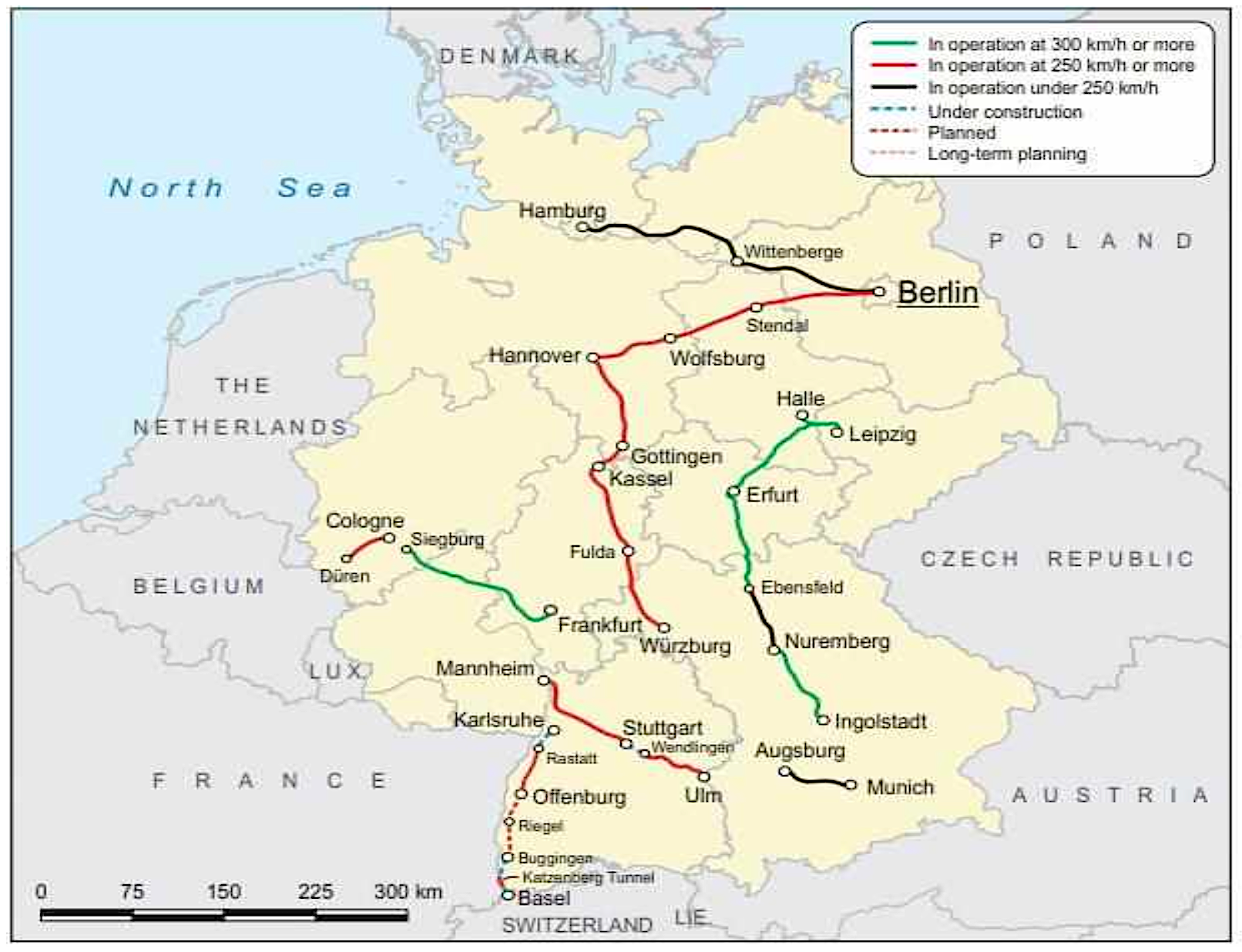
According to the International Union of Railways (UIC) High Speed Rail Atlas (2023), Germany currently has 14 operational high-speed rail lines, totaling 1,631 km in length, with maximum speeds of 230-300 km/h. Germany is currently constructing 87 km and planning 81 km, bringing the total to 1,799 km.Regarding maximum operating speeds, 2 lines (369 km, accounting for 23% of the total high-speed rail length) operate at speeds above 200 km/h; 7 lines (739 km, accounting for 47%) operate at speeds above 250 km/h; and 4 lines (463 km, accounting for 30%) operate at speeds above 300 km/h. Thus, the dominant trend for Germany's high-speed rail system is that 77% of its lines operate at speeds above 250 km/h.
To date, Germany has a high-speed rail network spanning 1,631 km, with 14 operational lines. The existing railway density is very high (93 km/1,000 km²). Six main lines run along the North-South axis, and three run along the East-West axis. The most heavily used route by ICE is the Mannheim-Frankfurt line, due to the convergence of many ICE lines in this area. Considering traffic including freight trains, local trains, and long-distance passenger trains, the busiest line is Munich-Augsburg with approximately 300 trains per day. It's worth noting that Germany is one of the pioneering countries in developing high-speed rail networks worldwide . However, Germany's railway development strategy prioritizes optimizing train schedules and reducing passenger waiting times at stations over increasing train speeds. Therefore, the main routes are formed on the basis of upgrading the existing 1,435mm gauge railway network to operate a mixed passenger and freight service with an average speed of 160km/h for passenger trains and 100km/h for freight trains. Passenger transport is prioritized, while freight transport is scheduled at night or outside of peak hours. Only the Cologne-Frankfurt route, approximately 180km long, has high passenger demand and therefore runs exclusively for passenger trains at a maximum speed of 300km/h. Regarding passenger transport, the ICE system targets business travelers and long-distance commuters, and is promoted by the German National Railways (DB) as an alternative to flights to the same destination. Government at all levels is responsible for infrastructure investment . Regarding investment models, in Germany, infrastructure investment is primarily public investment, including funds allocated from the federal budget, local budgets, support from the European Commission (for European intermodal railway lines), and capital contributions from the German National Railways (DB). Projects must undergo macroeconomic evaluation and then be included in the overall railway infrastructure plan for study and implementation. For example, the Nuremberg-Ingolstadt line, built in 2006, had 58% of the investment contributed by the federal government, 32% by the DB, 5% by regional governments, and 5% by the European Commission. The German government has also developed legal frameworks for PPP investment, but this has not yet been applied to railway projects. Regarding locomotives and rolling stock, transport companies invest and operate their own capital.
Map of the high-speed rail network in Germany (Source: UIC).
According to German regulations: The federal government is responsible for providing funding for federal railway infrastructure such as upgrades and new construction, excluding locomotives and carriages; it is also responsible for establishing the legal framework, ensuring compliance with European legal frameworks, and the organizational structure of the German National Railways (DB). The state governments (16 states) are responsible for organizing investment and passenger rail transport at the local and regional levels (outside the railway network managed by DB); applying the principle of decentralization, with investment funding from the federal government. There are two agencies overseeing the operation of German railways: the Federal Railway Network Authority (BnetzA), responsible for establishing regulations, supervision, ensuring non-discriminatory access between private transport companies and DB companies; verifying published information on the railway network and services; and reviewing the number and structure of infrastructure usage fees. The Federal Railway Authority (EBA), under the Ministry of Transport, is responsible for supervising the capacity and licensing of transport companies and locomotive and rolling stock investment companies. The German National Railways (DB) operates as a 100% state-owned parent company. DB is responsible for managing, maintaining, and operating its assets. DB manages the national railway infrastructure and transport business. Currently, DB directly manages the second largest railway network in Europe with a total length of 33,000 km of standard gauge 1435 mm tracks. Like other railway operators, DB pays operating fees for German railway infrastructure. DB uses state capital, revenue from leasing railway infrastructure, commercial operation of stations, and other related revenues for maintenance and investment. According to DB, the group received approximately 8.5 billion Euros from the government budget between 2019 and 2023 for infrastructure projects, a significant portion of which was allocated to high-speed rail (ICE). In 2020, Germany announced a plan to invest 86 billion Euros in railway infrastructure over the next 10 years (2020-2030), with the majority of that allocated to upgrading and maintaining high-speed rail lines. Revenue from operating... The revenue from terminals, yards, warehouses, shopping centers, and services accounts for a significant proportion of DB's total revenue, which is then reinvested to improve the quality of transportation services and increase revenue from transportation and support services.
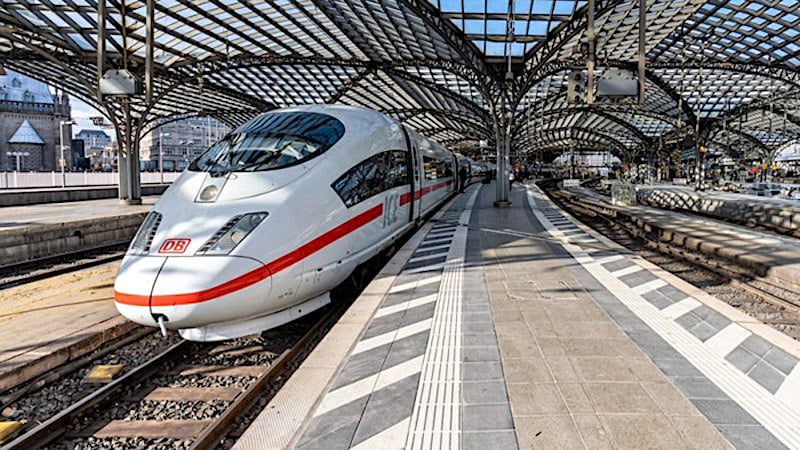
High-speed rail station (Photo: Internet).
Beyond commercial exploitation at the station areas, high-speed rail (ICE) systems contribute to economic development in the regions along the railway lines. The ICE system has transformed the way major cities and rural areas connect. Areas previously far from economic centers are now more easily connected, attracting investment and skilled labor. Regions near ICE stations often experience significant growth in real estate values and commercial infrastructure. For example, in Kassel, according to a report by the German Institute for Real Estate Research (IVD), since ICE extended its line to Kassel-Wilhelmshöhe, real estate prices have increased by an average of 10-20% annually in the first five years after the ICE station became operational. The regional economy has also grown strongly, with many businesses choosing to locate their headquarters or branch offices there due to the quick connectivity to major centers such as Frankfurt, Hamburg, and Berlin.
Germany belongs to the group of countries with original technology that have independently researched and developed high-speed rail. All German high-speed rail lines have a gauge of 1,435mm and are electrified using a 15 kV AC, 16.7 Hz power source. German high-speed rail technology mainly comes from Siemens and has now been exported to many European countries. The train technology includes two types: centralized propulsion technology for older train generations with operating speeds of 200-280 km/h; and distributed propulsion (EMU) technology for newer train generations with operating speeds of 250-300 km/h. Currently, Siemens is trending towards transitioning train technology to distributed propulsion (EMU) instead of the previous centralized propulsion technology.



![[Photo] General Secretary and President To Lam presides over a meeting with the Central Organizing Committee.](https://vphoto.vietnam.vn/thumb/1200x675/vietnam/resource/IMAGE/2026/06/03/1780482764658_a1-bnd-4741-3342-jpg.webp)

![[Photo] Secretary of the National Assembly Party Committee, Chairman of the National Assembly presides over the meeting of the Standing Committee and Executive Committee of the National Assembly Party Committee.](https://vphoto.vietnam.vn/thumb/1200x675/vietnam/resource/IMAGE/2026/06/03/1780480353201_ndo_br_bnd-2585-jpg.webp)
![[Photo] First session of the 14th Congress of the Vietnam Trade Union](https://vphoto.vietnam.vn/thumb/1200x675/vietnam/resource/IMAGE/2026/06/03/1780465947883_ndo_br_img-3852-jpg.webp)







































![[Video] Sunset at Lap An Lagoon – Where the sun sets over the fishing nets](https://vphoto.vietnam.vn/thumb/1200x675/vietnam/resource/IMAGE/2026/05/31/1780192137701_beach-landscape-sea-water-nature-grass-745871-pxhere-com.jpeg)





























Comment (0)