

Integrating heritage into educational materials in general education.
Resolution 71 on developing education in line with local realities clearly defines the role of experiential learning in shaping students' qualities and competencies. In Quang Ninh , this orientation is being concretized through the exploitation of its rich heritage system as a living, valuable, and accessible source of learning materials for students.
Quang Ninh possesses a diverse system of heritage sites, ranging from natural to cultural and historical. Places like Ha Long Bay, Yen Tu historical site, Cua Ong Temple, and the Quang Ninh Museum not only have tourism value but also serve as valuable resources for teaching.
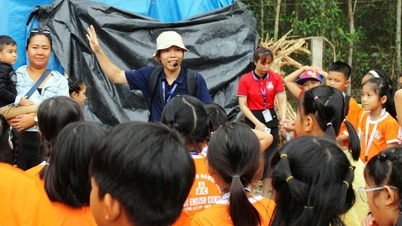
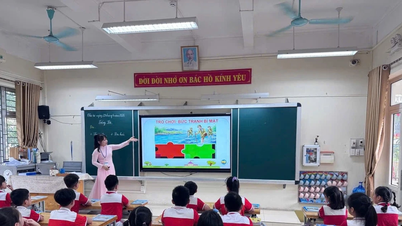
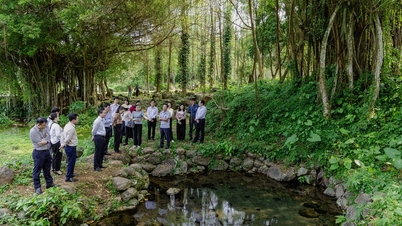
Following the principle of linking education with practical experience, many schools have proactively incorporated heritage into their curricula. Lessons are no longer confined to the classroom but are held at historical sites and scenic spots, allowing students to directly observe and experience them.
"Bringing the classroom out of its four walls" contributes to making knowledge more visual and engaging. Subjects such as History, Geography, and Local Education are implemented flexibly, linked to real-world settings, thereby enhancing learning effectiveness.
Beyond just visiting historical sites, many schools organize diverse learning activities such as heritage exploration projects, reenacting historical events, role-playing, or hands-on experiences at traditional craft villages. Through these activities, students develop initiative and creativity in their learning.
According to Ms. Pham Thi Nhung, a history teacher at Uong Bi High School (Uong Bi ward), organizing study tours at historical sites helps increase students' interest in learning; students proactively explore and retain knowledge more deeply and for longer compared to classroom learning.
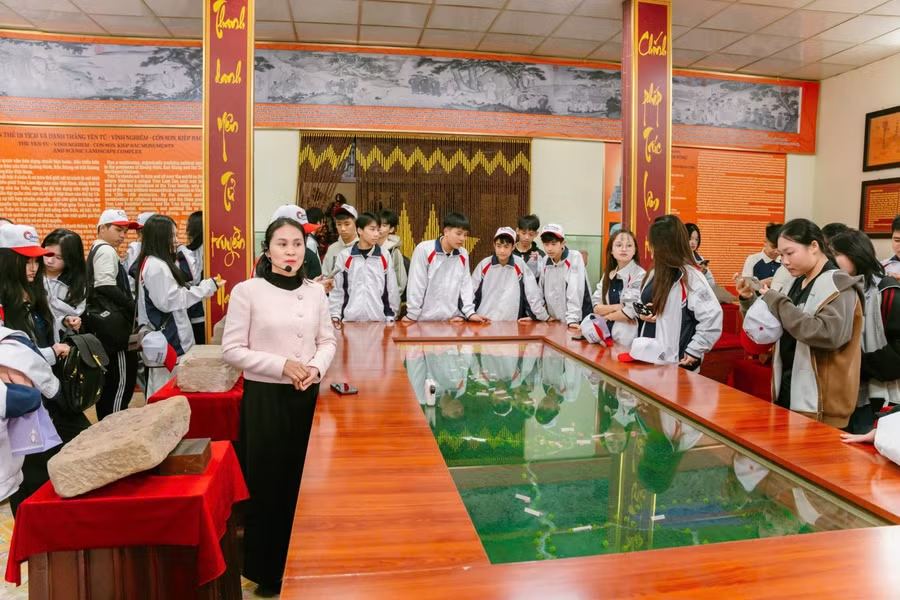
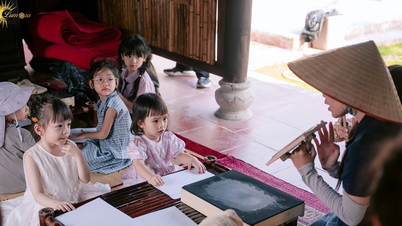
In addition, collaboration with local artisans and cultural researchers has also yielded positive results. Students get to directly listen to stories, observe performances, and experience traditional cultural values.
Developing qualities and competencies through experiential education.
Experiential education linked to heritage is playing a crucial role in the holistic development of students.
First and foremost, studying in heritage spaces helps children develop a love for their homeland and national pride. History and cultural lessons become more relatable and emotionally engaging when linked to specific landmarks.
Nguyen Minh Anh, a student from Nguyen Du Secondary School (Dong Trieu ward), shared: “When I studied at the Quang Ninh Museum and visited Ha Long Bay, I found the knowledge much easier to understand. I understand my homeland better and feel very proud.”
Through practical experiences, many students have developed a proactive awareness of learning about, protecting, and spreading the value of heritage. Some even actively participate in extracurricular activities, becoming "young tour guides."
Beyond just developing qualities, experiential learning activities contribute to the development of core competencies such as critical thinking, communication, collaboration, and problem-solving. During the learning process, students must independently gather information, work in groups, and present their findings.
Many schools have implemented interdisciplinary teaching linked to heritage, combining subjects such as History, Literature, Fine Arts, and Civic Education. This approach helps students not only grasp knowledge but also gain a deeper understanding and clearer appreciation of the value of heritage.
Some educational institutions also incorporate the results of experiential learning activities into regular assessments, contributing to the innovation of testing and evaluation towards competency development.
To maximize effectiveness, it is necessary to develop local education programs that systematically integrate heritage content; and at the same time, enhance the capacity of teachers to organize experiential activities.
In addition, building a "heritage learning map," strengthening coordination between schools and heritage management units, and applying digital technology will help expand the learning space for students.
In the context of integration and development, preserving national cultural identity is becoming increasingly urgent. Education is the most sustainable way to achieve this goal. When heritage is systematically integrated into schools, it not only helps improve the quality of teaching but also contributes to the long-term and sustainable preservation and promotion of cultural values.
In Quang Ninh, experiential education linked to heritage is gradually proving effective, transforming cultural and historical values into important educational resources. More importantly, through these activities, students are nurtured with love for their homeland, a sense of responsibility, and a desire to contribute. This is the foundation for building a generation of well-rounded citizens, meeting the demands of the new era.
Source: https://giaoducthoidai.vn/bien-di-san-thanh-lop-hoc-mo-cho-hoc-sinh-quang-ninh-post775902.html



![[Photo] General Secretary and President To Lam presides over a meeting on preparations for the review of one year of operation of the three-tiered government system.](https://vphoto.vietnam.vn/thumb/1200x675/vietnam/resource/IMAGE/2026/06/02/1780391821195_a1-bnd-4595-9717-jpg.webp)














![[Image] Affirming the aspirations and new standards of the Vietnamese real estate market in the new era.](https://vphoto.vietnam.vn/thumb/1200x675/vietnam/resource/IMAGE/2026/06/03/1780441948766_giai-thuong-bat-dong-san-2026-minh-duy-6-7364-jpg.webp)





































Comment (0)