

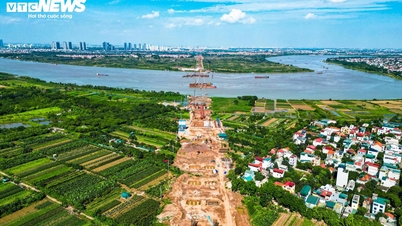
The province is aiming to develop industry, logistics, and the marine economy , and attract large-scale investment. Transportation infrastructure is considered the "lifeblood" that determines the locality's competitiveness. From projects like the Dai Ngai bridge across the Hau River, the expansion of National Highway 60, to the CT33 expressway project and the eastern coastal road… all are opening up great expectations for a new development space for the province in the future.
 |
| The development of expressways CT33, CT36, and the coastal road will propel the province's development (Diagram of the 3 transportation axes soon to be invested in). |
Determined to make breakthroughs in transportation infrastructure.
Currently, the road network in the province has a total length of approximately 8,955 km, including: the My Thuan- Can Tho expressway passing through the province, which is 12.5 km long, and the expressway's access road, which is 13.38 km long; 9 national highways connecting different regions; and 29 provincial roads.
The province is also focusing on investing in the CT33 expressway ( Ho Chi Minh City - Tien Giang - Ben Tre - Tra Vinh - Soc Trang); the CT36 expressway (Hong Nguy - Tra Vinh); the extended Vo Van Kiet road (connecting to the My Thuan - Can Tho expressway); the coastal road, Cua Dai bridge, Co Chien 2 bridge; National Highways 57, 57B, 57C, 60, 53, 53B, 54 and other key provincial roads; and implementing the Ho Chi Minh City - Can Tho high-speed railway line…
According to the My Thuan Project Management Board, the approved additional components of the My Thuan-Can Tho Expressway Project include 3 bridges, 4 interchange branches totaling 1.45km in length, the Vo Van Kiet road section of 0.72km, a 10.67km access road, along with a drainage system, intelligent transportation system (ITS), 1 central control building, and 3 toll stations. The project has a total investment of over 971 billion VND, commenced on December 31, 2025, and is expected to be completed in December 2026.
The province has also finalized the plan for the CT33 expressway project. Investing in the construction of the CT33 expressway is essential to create a high-capacity, high-speed transportation axis, ensuring fast and safe connectivity between Ho Chi Minh City and the eastern coastal provinces of the Mekong Delta. It will also contribute to socio-economic development, improve transportation capacity, and alleviate congestion on the existing transportation system.
Mr. Le Quynh Mai, Vice Chairman of the Board of Directors of Deo Ca Group, said that the proposed route has a scale of 4 lanes and a design speed of 100 km/h. The chosen option basically follows the road network planning, utilizing National Highway 60, National Highway 57C, and large river crossing structures to reduce investment costs. The option has a length of approximately 150.8 km, adjusting some sections through Tra Vinh (old) to avoid residential areas and reduce land acquisition costs; utilizing structures such as Rach Mieu 2 Bridge, Dai Ngai Bridge, connecting with CT01, National Highway 60, and National Highway 57C.
 |
| With a series of strategic projects being promoted and implemented, the province is facing the opportunity to form a modern transportation network, creating a seamless connection between industry, logistics, and the maritime economy. |
Currently, the province is proposing priority investment in the CT36 expressway (Hong Ngu - Tra Vinh), in accordance with Decision No. 12/QD-TTg dated January 3, 2025, of the Prime Minister approving the adjustment of the road network planning for the period 2021-2030, with a vision to 2050.
The province has requested the Ministry of Construction to coordinate with relevant ministries and agencies to submit to the Government and the National Assembly for consideration the allocation of central government budget funds for the 2026-2030 period to expedite the construction of Co Chien 2 Bridge and Cua Dai Bridge; and to prioritize investment in upgrading and expanding important national highways passing through the province. The province also proposed support for completing the embankment system protecting the Quan Chanh Bo canal, considering the addition of an overpass at the intersection with National Highway 60, and investing in the construction of Thom Bridge…
Earlier, the Chairman of the Provincial People's Committee, Tran Tri Quang, chaired a meeting with leaders of departments and agencies to hear reports on the investment preparation for the coastal road. The coastal road has a total length of 112.7 km, starting from Tan Phu Dong commune (Dong Thap province) and ending at the intersection with National Highway 54 and the access road to Dai Ngai bridge in Hung Hoa commune (Vinh Long province).
The route comprises five projects, including bridges such as: Cua Dai (connecting the former Ben Tre and Tien Giang provinces), Ba Lai 8 (in the former Ben Tre province), and Co Chien 2 (connecting the former Ben Tre and Tra Vinh provinces); along with coastal roads connecting Ben Tre with the former Tien Giang and Tra Vinh provinces, and a coastal corridor in the former Tra Vinh province. The total investment for these projects exceeds 27,411 billion VND.
Breakthrough in transportation infrastructure
Currently, the road transport system connecting Ho Chi Minh City with the eastern coastal provinces of the Mekong Delta mainly relies on National Highway 60 and local roads with limited scale and low traffic capacity, failing to meet the increasing transport demands.
 |
| The province's transportation system is becoming increasingly完善, contributing to attracting investment. In the photo: My Thuan 1 Bridge. |
The Department of Finance has also submitted a proposal to assign a unit to prepare a report proposing the investment policy for the Project to Upgrade and Expand National Highway 60 (section from Co Chien Bridge to the access road to Dai Ngai Bridge). The project will be implemented in the communes of Nhi Long, Binh Phu, Tan An, Song Loc, Tap Ngai, and Hung Hoa. The total length of the route is approximately 32.12 km, a Class III road in the plains, with an 11m wide road surface and bridges along the route. The total investment is estimated at approximately 4,573 billion VND. The investment preparation period is scheduled for 2026.
In March 2026, during a meeting with provincial leaders, the Minister of Construction, Tran Hong Minh, stated that the CT36 expressway project – a horizontal axis connecting Hong Ngu (Dong Thap) to Tra Vinh (Vinh Long) – is divided into three sections.
Specifically, the Hong Ngu (Dinh Ba border gate) - Cao Lanh section is 68km long, with a total investment of approximately 22 trillion VND, and is part of the plan to develop 5,000km of expressways by 2030. The Cao Lanh - An Huu section is 27km long, with a total investment of approximately 7,496 trillion VND. The An Huu - Tra Vinh section alone is approximately 90km long, with a total investment of approximately 31.5 trillion VND, passing through the province. The Ministry of Construction has assigned Project Management Board 7 to conduct the investment study.
According to the province's five-year socio-economic development plan for 2026-2030, the province needs a breakthrough in investing in the development of a synchronous and modern socio-economic infrastructure. Priority should be given to building strategic transportation systems, vital transportation arteries, seaport and river port infrastructure, and logistics, linked with digital infrastructure and information technology infrastructure, ensuring inter-regional and intra-provincial connectivity, and effective integration with major economic centers in the Mekong Delta, the Southeast region, and international border gates.
Simultaneously, focus on developing a synchronous, modern, and interconnected regional infrastructure system. Prioritize public investment and medium-term loans for the 2026-2030 period to implement key projects such as: the coastal corridor road, Co Chien 2 Bridge, Cua Dai Bridge, Dinh Khao Bridge, and expressways connecting the Mekong Delta, Ho Chi Minh City, and the southeastern provinces.
Completing the transportation system in accordance with the National Transportation Development Plan and the Provincial Plan; closely coordinating with the Central Government to invest in upgrading and expanding National Highways 53, 54, 57, 57B, 57C, and 60, removing bottlenecks and obstacles to expand development space, improve logistics capacity, and attract high-quality investment to serve the socio-economic development of the locality…
Many economic experts believe that in the current competition to attract investment, localities with comprehensive transportation infrastructure will have a significant advantage. With a series of strategic projects being promoted and implemented, the province is facing the opportunity to form a modern transportation network, seamlessly connecting industry, logistics, and the maritime economy.
From these key infrastructure projects, a new face of development is gradually emerging. Vinh Long is progressively moving towards becoming a new economic hub connecting the region in the near future…
According to the Deputy Secretary of the Provincial Party Committee and Chairman of the Provincial People's Committee, Tran Tri Quang, the early investment in the construction of the CT33 expressway will create favorable conditions for regional connectivity; improve the efficiency of the transportation infrastructure system, facilitating trade and travel; contribute to reducing transportation costs, enhancing competitiveness, attracting investment, and promoting the development of industrial parks, economic zones, and tourism. At the same time, it will gradually and effectively exploit the potential and advantages of the region, opening up new development spaces, forming economic corridors, urban areas, service zones, and logistics centers along the route...
Text and photos: KHANH DUY
Source: https://baovinhlong.com.vn/thoi-su/202606/ky-vong-nhung-du-an-giao-thong-trong-diem-1f449bf/
![[Photo] Secretary of the National Assembly Party Committee, Chairman of the National Assembly presides over the meeting of the Standing Committee and Executive Committee of the National Assembly Party Committee.](https://vphoto.vietnam.vn/thumb/1200x675/vietnam/resource/IMAGE/2026/06/03/1780480353201_ndo_br_bnd-2585-jpg.webp)
![[Photo] General Secretary and President To Lam presides over a meeting with the Central Organizing Committee.](https://vphoto.vietnam.vn/thumb/1200x675/vietnam/resource/IMAGE/2026/06/03/1780482764658_a1-bnd-4741-3342-jpg.webp)
![[Photo] First session of the 14th Congress of the Vietnam Trade Union](https://vphoto.vietnam.vn/thumb/1200x675/vietnam/resource/IMAGE/2026/06/03/1780465947883_ndo_br_img-3852-jpg.webp)




![[Infographic] Over 1.2 million candidates registered for the 2026 High School Graduation Exam](https://vphoto.vietnam.vn/thumb/402x226/vietnam/resource/IMAGE/2026/06/03/1780496872518_w_20260603205412.jpeg)

































![[Video] Sunset at Lap An Lagoon – Where the sun sets over the fishing nets](https://vphoto.vietnam.vn/thumb/1200x675/vietnam/resource/IMAGE/2026/05/31/1780192137701_beach-landscape-sea-water-nature-grass-745871-pxhere-com.jpeg)



























Comment (0)