

Reporter: Could you please tell us about the recent impacts of climate change on Ninh Binh , as well as the trends of these impacts in the future?
Comrade Nguyen Tien Dung: Climate change is one of the greatest challenges facing humanity today due to its complexity and increasing impact on a global scale. It can be affirmed that climate change has, is, and will affect almost every aspect of social life.
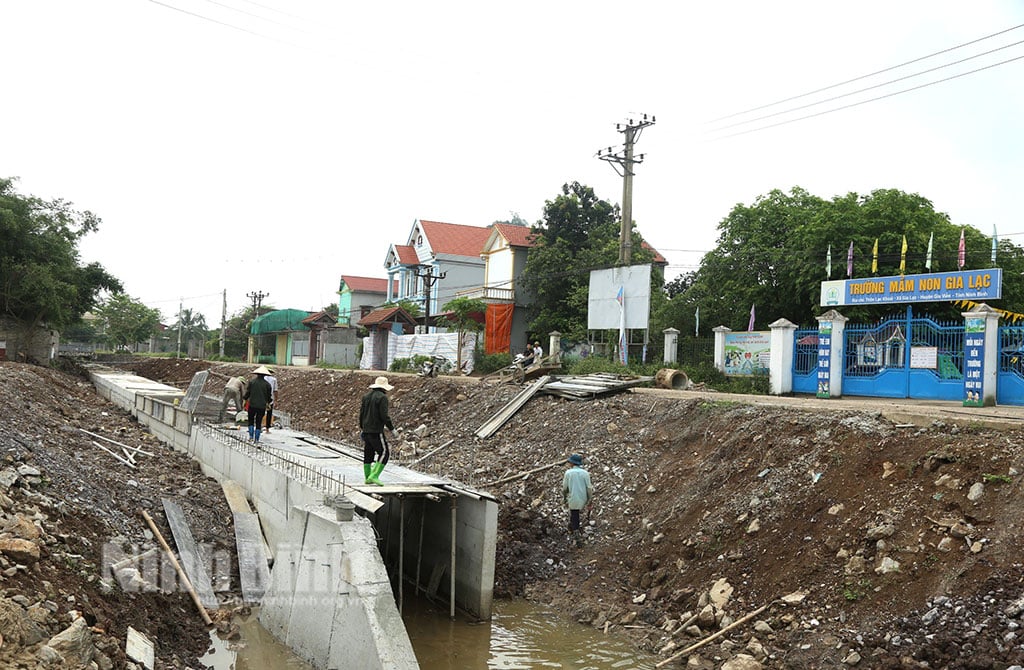
For Ninh Binh province, climate change has had diverse and noticeable impacts in recent years. Rising global temperatures have led to sea level rise, significantly affecting coastal areas and major river systems in Ninh Binh such as Gia Vien, Kim Son, and Nho Quan. Salinity intrusion has worsened over the past 10 years, not only penetrating further inland but also lasting longer. In the coastal area of Kim Son, salinity intrusion has encroached 20-30 km inland on the Day River and 10-15 km on the Vac River.
According to statistics from 2010 to the present, most localities in the province have experienced drought during the irrigation period for the winter-spring rice crop, especially in Nho Quan, Gia Vien districts, and Tam Diep city... the area affected by drought and water shortage accounts for an average of 15-20% of the cultivated area. In addition, Ninh Binh province also frequently experiences extreme weather phenomena such as prolonged intense heat or hailstorms.
One readily apparent consequence of climate change is its potential to alter rainfall patterns and water levels, disrupting Ninh Binh's irrigation system. Changes in rainfall and rainy seasons can increase the risk of floods or droughts, complicating water management and utilization in the region. A prime example of flooding over the past 30 years is the 15 flood diversion events experienced by communes in the floodplains of Nho Quan and Gia Vien districts, 10 in the Hoang Long River basin, and annual flooding in communes outside the dike system, significantly impacting the economic lives of the local population.
Furthermore, climate change affects ecosystems and plant and animal species; negatively impacts agricultural production; affects water resources; impacts forest ecosystems; impacts land resources, etc. The increase in extreme weather events also has a certain impact on tourist activities and festivals, especially at the beginning of the year.
PV: Comrade, given the increasingly complex developments of climate change, what specific solutions has Ninh Binh province implemented to respond?
Comrade Nguyen Tien Dung: In the past period, the province has implemented a number of specific solutions to minimize impacts and enhance resilience. In leadership and guidance, all levels, sectors, and localities have paid attention to responding to climate change; directing units under their management to strengthen coordination in implementing and integrating climate change response activities into specialized management activities; developing proactive solutions for disaster prevention, mitigation, and adaptation to climate change; preparing plans and conditions for disaster prevention, mitigation, and proactively handling worst-case scenarios affecting production, people's lives, and ensuring national defense and security.
The work of disseminating and educating the public on environmental protection, disaster prevention and control, and climate change adaptation has been emphasized and strengthened. Districts and cities have reviewed, supplemented, and adjusted development plans for sectors and socio-economic development in their areas; actively built and implemented projects and tasks to proactively adapt to climate change in coastal areas and prevent and control natural disasters in mountainous areas, such as: planting mangrove forests for coastal protection against erosion; building sea dikes, embankments, and sluices; establishing a system for monitoring and warning of flash floods and landslides; and planning and constructing flexible power plants using liquefied natural gas, wind power, and waste-to-energy plants.
The province has also focused on protecting and restoring water resources, including maintaining reservoir balance, controlling water pollution, and building rainwater harvesting and storage systems. In addition, it has promoted forest protection and restoration, limiting illegal deforestation. Furthermore, it has implemented training and support programs to enhance farmers' resilience to climate change; including providing knowledge on sustainable farming methods, efficient water use, and the application of technology in agricultural production, environmental protection, and climate change adaptation. Attention has been paid to investing in the development of monitoring, warning, and response systems for climate change-related incidents and disasters, such as floods and droughts, to provide early warnings and implement effective response measures to minimize losses and risks to communities.
On the other hand, to promote the use of renewable energy, the province is encouraging the use of renewable energy sources such as solar and wind power, helping to reduce dependence on fossil fuels and reduce greenhouse gas emissions. It is proactively researching, selecting, and introducing new plant and animal varieties suitable to the province's natural conditions; flexibly transforming the structure of crops and livestock; applying high technology in production, adopting good, organic practices, and moving towards organic farming to increase productivity and conserve resources; and investigating and assessing major emission sources in the area.
PV: Many argue that the most important thing is to have the participation of the local community, and furthermore, to focus on using indigenous knowledge in climate change adaptation solutions. What is your view on this issue?
Comrade Nguyen Tien Dung: It is true that community participation and the use of indigenous knowledge are very important in responding to climate change. Community participation helps ensure that solutions are tailored to the specific needs and circumstances of each locality; creating commitment and consensus in implementing response measures. Using indigenous knowledge is a crucial element in developing climate change adaptation solutions. Each geographical region has its own unique characteristics and different issues related to climate change.
Utilizing local knowledge helps to better understand the specific impacts and appropriate solutions for each geographic region. Furthermore, applying local knowledge encourages consensus and acceptance within the local community.
Each community and locality possesses a diverse range of cultures, knowledge, and technologies. Utilizing and integrating these resources in responding to climate change enhances adaptability and fosters creativity in finding effective solutions. Relying solely on external solutions without leveraging the inherent potential of the community and locality can lead to difficulties in implementing and sustaining response measures.
In summary, community involvement and the use of indigenous knowledge help ensure the sustainability and effectiveness of response measures and create consensus and commitment in mitigating the impacts of climate change.
PV: It can be said that climate change and sea level rise are inevitable trends that we must live with and adapt to. As the permanent agency advising on this field, how will the Ministry of Natural Resources and Environment continue to advise and plan actions to respond to this issue, Comrade?
Mr. Nguyen Tien Dung: As the permanent agency advising on climate change, the Ninh Binh Department of Natural Resources and Environment will continue to advise the province on directing and strengthening coordination and urging departments and agencies to effectively implement the Action Plan for Responding to Climate Change approved by the Provincial People's Committee for the period 2021-2030, with a vision to 2050. At the same time, it will advise the Provincial People's Committee on evaluating the results of the implementation of the Action Plan for Responding to Climate Change for this period and developing and updating climate change scenarios for Ninh Binh province based on the latest climate change and sea level rise scenarios published by the Ministry of Natural Resources and Environment.
The focus is on investigating, surveying, compiling statistics, and inventorying greenhouse gases; creating a list of greenhouse gas emitting facilities; and implementing greenhouse gas emission mitigation activities in the province. Building resilience includes investing in flood control infrastructure, strengthening flood warning systems, protecting biodiversity and mangrove forests; and developing adaptation solutions in agriculture, transportation, urban areas, tourism, and other industries. Protecting and restoring ecosystems such as forests, biodiversity conservation areas, and biosphere reserves are crucial for mitigating the impacts of climate change and sea-level rise. Strengthening communication and raising awareness will create consistency within the community to take action to reduce these impacts.
Along with that, it is necessary to strengthen and leverage investment resources to respond to climate change; focus on investing in research and application of science and technology to respond to climate change, with a focus on effectively carrying out scientific and technological tasks; prioritizing activities to respond to climate change, activities to mitigate greenhouse gas emissions, adapt to climate change, environmental remediation, and disaster mitigation...
PV: Thank you very much, Comrade!
Song Nguyen (compiled)
Source

![[Photo] Admire the coral "masterpiece" amidst the million-year-old heritage of Dak Lak province.](https://vphoto.vietnam.vn/thumb/1200x675/vietnam/resource/IMAGE/2026/05/31/1780221235105_anh-man-hinh-2026-05-31-luc-16-53-27.png)

![[Image] Hanoi Police officially crowned champions of V-League 2025/2026](https://vphoto.vietnam.vn/thumb/1200x675/vietnam/resource/IMAGE/2026/05/31/1780244769054_ndo_br_039d561b692be875b13a-jpg.webp)
![[Photo] The General Secretary, President and his wife begin their state visit to the Philippines.](https://vphoto.vietnam.vn/thumb/1200x675/vietnam/resource/IMAGE/2026/05/31/1780230559452_anh-man-hinh-2026-05-31-luc-19-28-11.png)
![[Photo] Solemn bathing ceremony and Buddha procession in Hue](https://vphoto.vietnam.vn/thumb/1200x675/vietnam/resource/IMAGE/2026/05/31/1780228263543_1-jpg.webp)

















![[Video] Sunset at Lap An Lagoon – Where the sun sets over the fishing nets](https://vphoto.vietnam.vn/thumb/340x192/vietnam/resource/IMAGE/2026/05/31/1780192137701_beach-landscape-sea-water-nature-grass-745871-pxhere-com.jpeg)







































![[Photo] Admire the coral "masterpiece" amidst the million-year-old heritage of Dak Lak province.](https://vphoto.vietnam.vn/thumb/402x226/vietnam/resource/IMAGE/2026/05/31/1780221235105_anh-man-hinh-2026-05-31-luc-16-53-27.png)





























Comment (0)