

One in 50 people suffers from difficulty remembering other people's faces. Researchers assert that this is not simply a case of 'forgetfulness'.

Many people have difficulty remembering other people's faces - Photo: THE MIRROR
The inability to remember other people's faces can cause many difficulties in social interactions. Scientists call this "face blindness," or prosopagnosia.
Symptoms of this type of disorder include not recognizing acquaintances in a crowd, confusing people on television, and being afraid to call people by their names for fear of... calling them wrong.
A recent study by Bournemouth University and Brunel University (UK) investigated whether "face blindness" is a distinct medical condition or simply a lack of sensitivity in recognizing faces. The study examined 300 British individuals who had experienced some of these symptoms since birth.
Professor Sarah Bate, the lead researcher, said that in mild cases, many people often don't notice it, but the reality is that this condition can limit social interaction. In more severe cases, sufferers may not be able to recognize their relatives or friends when they meet.
"Imagine how difficult it would be for a child with this condition to find their parents in a crowd without being able to recognize them," said Professor Sarah Bate.
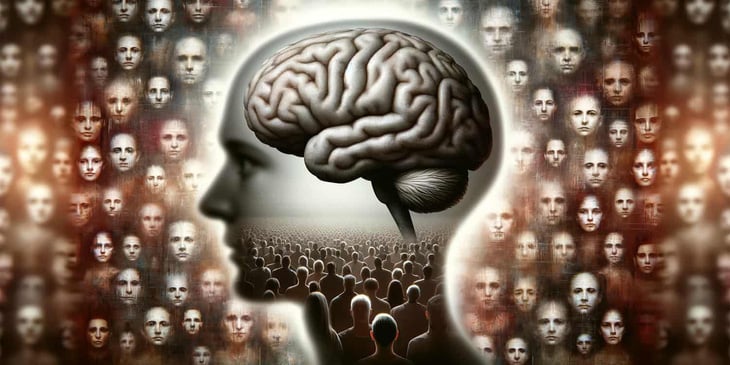
"Face blindness" is not just forgetfulness. Recently, scientists have suggested that it is also a distinct disorder. - Photo: PSYPOT
In general, people with prosopagnosia are unable to recognize familiar faces and must rely on other social cues or identifying characteristics to recognize people they know. Scientists believe this condition may be genetic or caused by severe brain injury.
According to the UK National Health Service (NHS), people with prosopagnosia may also have difficulty recognizing emotions on other people's faces, as well as determining their age and gender.
According to the NHS, with prosopagnosia you will still see parts of your face normally, but all your faces may look the same. This condition affects each person differently.
Some people may not be able to distinguish between strangers or people they don't know well. Others may not even recognize the faces of friends, family, or their own faces.
From this, researchers concluded that prosopagnosia should be classified as a separate disorder.
Professor Bate emphasized that their findings have significant implications for our understanding of prosopagnosia and challenge the traditional view that this condition is continuous.
"This could aid in diagnosis, especially when we need to determine the point at which a decline in facial processing ability is officially considered prosopagnosia," Professor Bate said.
The new findings have been published in the journal Cortex.
Source: https://tuoitre.vn/biet-ten-nhung-khong-nho-mat-nguoi-khac-bi-gi-20241129101906012.htm
![[Photo] Ba Lang An Lighthouse - the "eye of the sea" amidst the "rock museum" of Quang Ngai province.](https://vphoto.vietnam.vn/thumb/1200x675/vietnam/resource/IMAGE/2026/05/29/1780038698840_anh-man-hinh-2026-05-29-luc-14-10-42.png)
![[Image] Pleasant weather helps students enter the 10th grade entrance exam with confidence.](https://vphoto.vietnam.vn/thumb/1200x675/vietnam/resource/IMAGE/2026/05/29/1780034401612_ngay-1-thi-lop-10-minh-duy-8-5009-jpg.webp)













































































Comment (0)