

According to Live Science , the newly discovered creature is called Chimaera supapae, a cartilaginous fish belonging to the oldest living family of fish today: Chimaeriformes. It is a distant relative of sharks and rays.
The name "supapae" comes from Supap Monkolprasit, a scientist from Thailand who dedicated his life to studying cartilaginous fish. The genus name "Chimaera" comes from the three-headed, fire-breathing creature in Greek mythology.
Chimaera species are often called ghost sharks and rat sharks, a name derived from their large, reflective eyes and slender, rat-like bodies. Some can grow up to 2 meters in length.
Scientists described the discovery of Chimaera supapae in a paper published in the Raffles Bulletin of Zoology.
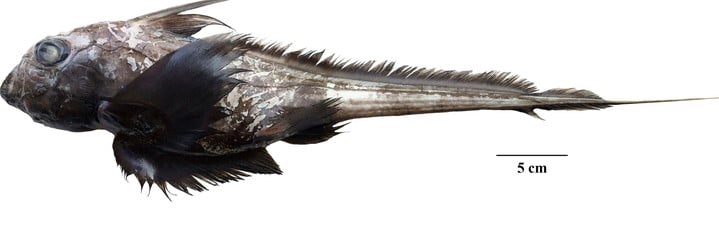
Accordingly, the newly described Chimaera species has a short snout, broad pectoral fins, and a body length of 51 cm. Scientists suspect that the feather-like frills of this creature are related to its ability to move underwater.
The large, gleaming, green eyes of the Chimaera supapae allow them to see in pitch-black waters. Their dark brown skin has no noticeable markings or patterns.
"Evolutionarily, these Chimaera species are among the oldest fish families, with ancestors dating back 300-400 million years. The discovery of new species like Chimaera shows how little we know about the marine environment and how much more we have to discover ," said David Ebert from the Pacific Shark Research Center at San Jose State University (California), the lead author of the study.
David Ebert added that Chimaeras typically live on continental slopes and deep-sea ridges. At depths below 500 meters, they hide in dark waters, feeding on bottom-dwelling animals such as crustaceans, mollusks, and worms.
"Only 53 species of Chimaera are known in the world , and this one is the 54th. Their deep-sea habitat makes them difficult to find, especially in the Andaman Sea, where depths in some areas exceed 4,400 meters," the researcher said.
Minh Hoa (compiled)
Source

![[Photo] General Secretary and President To Lam presides over the meeting to approve the draft report on the results of the second inspection by the Politburo of the Standing Committee of the Hanoi City Party Committee.](https://vphoto.vietnam.vn/thumb/1200x675/vietnam/resource/IMAGE/2026/05/26/1779789811432_a2-bnd-4430-9620-jpg.webp)































































































Comment (0)