


The performance by Uncle Ba Phi captivated many delegates with its storytelling about the prosperous and livable countryside - Photo: THANH HUYEN
Ca Mau still possesses many unique potentials.
The seminar focused on discussing various issues facing rural areas today, such as transforming agricultural economic thinking, promoting local resources, protecting the environment, building "learning rural areas," and the proactive role of the government.
Speaking at the seminar, Mr. Le Van Su, Vice Chairman of the People's Committee of Ca Mau province, said that after many years of implementing the National Target Program for building new rural areas, the province has achieved many positive results. To date, 43 out of 55 communes in the province have met the standards for new rural areas, and the appearance of the countryside has changed significantly with many rural roads being invested in, becoming more modern, clean, and beautiful.
However, according to Mr. Su, building new rural areas cannot stop at just targets or titles, but needs to focus on depth, with people, culture, and the community at its center.
"Sustainable rural development and livable rural areas are a combination of safe living spaces, indigenous cultural spaces, and spaces for close-knit relationships," Mr. Su said.
The leaders of the Ca Mau Provincial People's Committee also stated that the locality possesses many unique potentials such as river, forest, sea, and island ecosystems; especially the U Minh Ha melaleuca forest. Preserving the forest is not only about preserving resources but also about preserving the "soul of the land and water" and the distinctive cultural values of the Southern region.
Change your mindset before changing your approach.
At the seminar, Mr. Le Minh Hoan - former Vice Chairman of the 15th National Assembly - emphasized that to build livable rural areas, it is necessary to change perceptions before changing forms.

Mr. Hoan believes that rural development should not become merely a "renovated space," but rather a place with a true "soul," a place worth living in. - Photo: THANH HUYEN
According to Mr. Hoan, many places now have smooth concrete roads and modern infrastructure. But "after traveling along that clean, beautiful concrete road, if there are no livelihoods, no laughter, and no memories preserved, then the countryside is still not a truly livable space," Mr. Hoan shared.
He argued that rural areas should be viewed as a multi-layered "social space," encompassing safe living spaces, indigenous cultural spaces, and spaces for close-knit community relationships.
According to Mr. Hoan's suggestion, the rural economy in the coming period needs to develop in a multi-value direction, integrating agriculture with tourism, traditional crafts, cultural heritage, and OCOP products to create more livelihoods for the people.
Many delegates at the seminar also pointed out the current state of agricultural production, which is still fragmented, lacks linkages, and the value of agricultural products is not stable; infrastructure in some areas is not synchronized, leading to a situation where a portion of rural laborers leave their hometowns to work elsewhere.

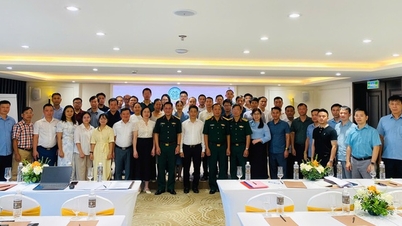
The workshop took place right in the U Minh forest area of Ca Mau, with its stunning forest and river scenery - Photo: THANH HUYEN
Farmer Ho Quoc Trang from Tan Thanh ward believes that for rural areas to be truly livable, people must first have jobs, land for production, and conditions for economic development right in their hometowns.
"In my opinion, a livable rural area must ensure essential infrastructure such as electricity, roads, schools, and health centers; only when people have stable incomes can their cultural and spiritual lives flourish," Mr. Trang said.
Meanwhile, Dr. Tran Minh Hai noted that the phenomenon of farmers leaving their hometowns to work as laborers is still common in many places. In some areas, farmland is being abandoned due to inefficient production.
According to Mr. Hai, to build a livable rural area, it is necessary to keep people in their hometowns, create conditions for them to work, innovate, and increase their income. When living standards improve, cooperatives, partnerships, and businesses operating effectively will contribute to attracting labor back to rural areas.
Representatives from several travel businesses and local residents also suggested that the province should promote the development of rural tourism, ecotourism, and indigenous tourism, linked to the preservation of local ecosystems and culture.
According to some opinions, if the unique advantages of Ca Mau region are properly exploited, the people will not only have additional income but also contribute to preserving the landscape and environment, making the countryside a livable place and an attractive destination for tourists to visit and experience.
Source: https://tuoitre.vn/ca-mau-ban-cach-de-co-vung-nong-thon-dang-song-20260509141059945.htm
![[Image] Hanoi's urban life under the challenge of a "scorching hot" environment](https://vphoto.vietnam.vn/thumb/1200x675/vietnam/resource/IMAGE/2026/05/25/1779706979265_nang-nong-t5-2026-minh-duy-7-4636-jpg.webp)


![[Image] Close-up view of the interchange connecting the two expressways and Long Thanh Airport.](https://vphoto.vietnam.vn/thumb/1200x675/vietnam/resource/IMAGE/2026/05/25/1779703378210_ndo_br_z7863716673926-224453a31600126cce10622af6290afd-4549-jpg.webp)












































































Comment (0)