

From unusual vibrations
On September 10th, after Typhoon Yagi (Typhoon No. 3) swept through several provinces and cities in northern Vietnam, a landslide buried the entire village of Lang Nu, Phuc Khanh commune, Bao Yen district, Lao Cai province, leaving behind immeasurable grief and loss for the local people.
In response to the increasingly severe and unusual nature of natural disasters, on October 2nd, the Department of Geotechnical Engineering and Infrastructure Development, Faculty of Geology, University of Science , Vietnam National University, Hanoi, organized a scientific seminar entitled "The Lang Nu Disaster – Causes and Prevention Solutions," with the participation of many geological experts following their field trip to Lang Nu.
According to Dr. Ngo Van Liem, Head of the Department of Geomorphology and Marine Geography - Environment, Faculty of Geography, University of Science, Vietnam National University, Hanoi , mudflows (debris flow) typically occur during periods of heavy, prolonged rainfall in stream basins in mountainous areas with steep terrain and thick weathered soil layers.
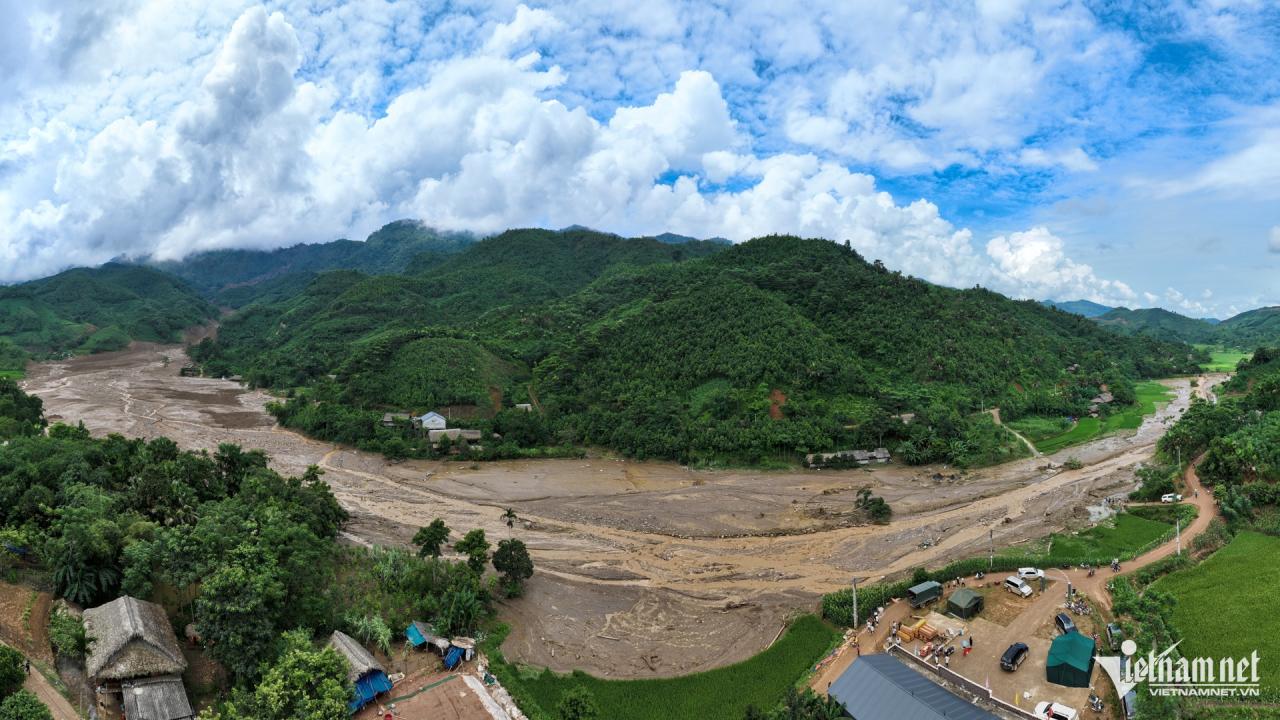
According to descriptions from locals recorded by the media, there was a loud explosion before the landslide. Prior to that, some people saw rocks falling from the high slopes, but even those who saw rocks couldn't escape the subsequent torrent of mud and rocks. So, how can we prevent landslide disasters?
Dr. [Name] stated that there is currently quite a lot of information about the explosions and the rumbling sounds of earth and rocks in the mudslide. A common point is that there were two loud explosions. Based on professional knowledge, it can be concluded that the first explosion was caused by a large landslide near the summit of Con Voi mountain (the origin of the mudslide, landslide 1).
The second explosion was the breach of a temporary dam formed at the narrowest point near the end of the valley (400-500m from Nu Village). This dam was formed by material from landslides on the valley slope (landslide 2) and materials carried by the stream flow. This dam may have formed not long before, or possibly immediately after the landslide at the top triggered landslide 2.

Sentinel 2 satellite image (September 19, 2024) shows the mudslides and landslides that caused the disaster in Nu Village, Phuc Khanh Commune, Bao Yen District, Lao Cai Province (September 10, 2024). Photo: University of Science.
Although the catchment area is not very long (about 3km), it has a steep slope, resulting in very high sediment flow velocities. Therefore, it is difficult to implement effective immediate warning measures, especially since floods often occur at night or near dawn, making early detection and warning very challenging.
“In my opinion, the best way to prevent flooding is to avoid building residential areas below stream mouths and/or in valleys between mountains. These are often proluvial flood cones, or in other words, the accumulated product of floods from previous periods. Floods occur cyclically and will repeat, so it is necessary to avoid building structures in these areas. If there is no better alternative and one still has to live in the aforementioned areas, when heavy rain is forecast, especially continuous heavy rain for many days, finding shelter beforehand is the most feasible and best possible measure,” Dr. Liem shared.
Dr. Liem noted several possible signs "before" flash floods and mudslides occur, such as: a loud explosion coming from upstream of the stream accompanied by a rumbling sound; unusual ground tremors; heavy rain but the stream's water level suddenly decreases or does not increase significantly compared to before the rain, and the water becomes turbid, carrying a lot of mud and debris; cracks appear on the ground, walls, and ceilings...
Upon noticing unusual signs like those described above, people should immediately notify those around them and seek shelter in elevated locations far from the stream's flow (perpendicular to the stream's direction).
The first signs of a landslide.
Dr. Ngo Van Liem stated that cracks on hills and mountains are often an important "indicator" of impending landslides. However, the extent of the cracks requiring relocation depends on specific studies and assessments, taking into account the geological conditions, topography, and many other factors of the area.
If households live at the foot of hills and mountains, especially those who have carved into the slopes of hills and mountains (where there is a thick layer of weathered soil/earth) to build houses, they should consider relocating when they discover cracks on the hillside a few meters long; this is especially important during heavy, prolonged rain, even when cracks are not detected beforehand, as cracks can form and cause landslides in a very short time.
Dr. Liem assessed that from now until the end of the year, the Central and Central Highlands regions will be at higher risk than the northern region, because according to Vietnam's climate characteristics, typhoons and tropical depressions tend to shift southward towards the end of the year. Therefore, special attention should be paid to the risk of landslides and flash floods/mudslides in the Central and Central Highlands regions during the last months of the year.
According to Dr. Liem, to minimize the impact of climate change, every citizen must join hands to protect the surrounding environment. This should start with small daily actions: saving energy (turning off lights and electrical appliances when not needed, using renewable energy, unplugging devices after use, etc.); reducing waste (using recyclable items, limiting the use of single-use plastics, sorting and disposing of waste properly, etc.); planting more trees; saving water; using public transportation; increasing physical activity by cycling or walking, etc.
By making small changes to our lifestyles, we can make a big difference in mitigating and limiting the impacts of climate change, which also means helping to limit and reduce the damage caused by natural disasters.


![[Photo] General Secretary and President To Lam presides over a meeting with the Central Organizing Committee.](https://vphoto.vietnam.vn/thumb/1200x675/vietnam/resource/IMAGE/2026/06/03/1780482764658_a1-bnd-4741-3342-jpg.webp)
![[Photo] Secretary of the National Assembly Party Committee, Chairman of the National Assembly presides over the meeting of the Standing Committee and Executive Committee of the National Assembly Party Committee.](https://vphoto.vietnam.vn/thumb/1200x675/vietnam/resource/IMAGE/2026/06/03/1780480353201_ndo_br_bnd-2585-jpg.webp)






















![[Photo] First session of the 14th Congress of the Vietnam Trade Union](https://vphoto.vietnam.vn/thumb/1200x675/vietnam/resource/IMAGE/2026/06/03/1780465947883_ndo_br_img-3852-jpg.webp)




























![[Video] Sunset at Lap An Lagoon – Where the sun sets over the fishing nets](https://vphoto.vietnam.vn/thumb/1200x675/vietnam/resource/IMAGE/2026/05/31/1780192137701_beach-landscape-sea-water-nature-grass-745871-pxhere-com.jpeg)





































Comment (0)