

| Exports of cinnamon and star anise to Canada surged thanks to the CPTTP agreement. India was Vietnam's largest cinnamon export market in the first nine months of 2023. |
Cinnamon exports generated over $220 million in revenue during the first 10 months of 2023.
According to the Vietnam Pepper Association, in October 2023, Vietnam exported 7,241 tons of cinnamon, with a total export value of 20.5 million USD, a 28.1% increase compared to September.
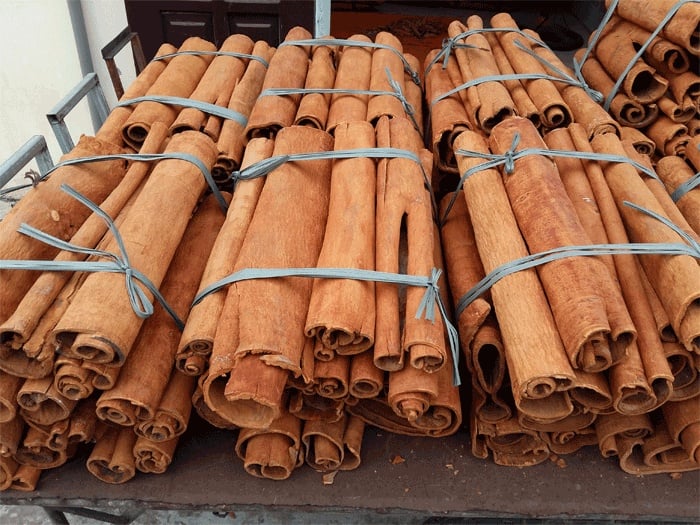 |
| Cinnamon exports brought in over $220 million. |
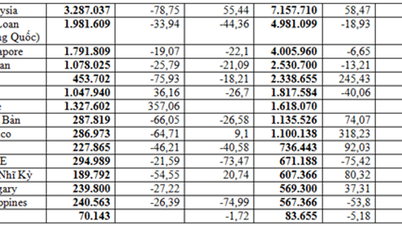
In the Asian region, only exports to India decreased by 10.8% to 2,600 tons, while exports to other markets increased sharply, such as Indonesia (up 93.2%), South Korea (up 225.8%), Pakistan (up 242%), and Bangladesh (up 900%).
Vietnam's second-largest cinnamon export market in October was the United States, with 847 tons, a 24% increase compared to the previous month.
As of the end of October 2023, Vietnam exported 74,744 tons of cinnamon, with a total export value of 220.3 million USD, an increase of 19.2% in volume but a decrease of 1.3% in value compared to the same period last year.
The average export price of cinnamon in the first 10 months of 2023 reached US$2,948 per ton, a decrease of 17.2% compared to the same period in 2022.
The main export markets for Vietnamese cinnamon include: India with 32,795 tons, accounting for 43.9% of the market share and increasing by 24.7%; the United States with 8,379 tons, increasing by 11.2%; Bangladesh with 4,780 tons, increasing by 25.7%; Brazil with 2,538 tons, increasing by 30.6%; and Indonesia with 2,202 tons, increasing by 75.7%.
The top 5 cinnamon exporting companies in the Vietnam Pepper Association include: Prosi Thang Long with 11,971 tons, down 3%; Senspices Vietnam with 4,360 tons, up 49.9%; Son Ha Spices with 3,868 tons, down 5.5%; Olam Vietnam with 2,551 tons, down 35.8%; and Expo Commodities with 2,483 tons, up 61.4%.
Mr. Nguyen Nhu Tiep, Director of the Department of Quality, Processing and Market Development ( Ministry of Agriculture and Rural Development ), stated that due to the increasing demand for raw materials in the food, cosmetics, and pharmaceutical industries, Vietnamese cinnamon and star anise are currently being consumed strongly in many regions of South Asia (India, Bangladesh), the Middle East (UAE, Pakistan), East Asia (Japan, Taiwan (China), South Korea), the United States, and countries in the European Union (EU).
There is still a lack of national-level strategic direction for sustainable development.
According to Mr. Le Viet Anh, Chief of the Office of the Vietnam Pepper Association, Vietnam currently has approximately 166,875 hectares of cinnamon trees, yielding 45,000 tons. Demand for spices in various markets remains high... therefore, Vietnam has a favorable position for spice exports, especially with free trade agreements such as EVFTA and CPTPP.
However, the Vietnamese spice industry still faces many challenges. Specifically, the cinnamon industry still lacks a national strategic direction for sustainable development. Meanwhile, businesses still lack technology and capital to invest in deep processing to enhance product value.
Geopolitical instability is likely to continue causing price volatility rather than supply and demand factors. Meanwhile, competition from other producing countries such as Indonesia and China remains persistent.
Furthermore, the unpredictable nature of climate change will be a major challenge for agriculture globally, while continuously rising costs will significantly impact supply…
Speaking about market trends, Mr. Le Viet Anh said that the current and future trends in the global spice market are green consumption, reduced carbon emissions; traceable products; quality assurance; value-added products, organic products, etc.
Given this situation, to boost exports to various markets, Mr. Viet Anh believes there is only one way: to improve quality and reduce production costs to create high-value, high-quality, and more competitive products. This involves diversifying products, markets, and growing regions.
Businesses should focus more on strategies to enhance deep processing, especially for spices processed from farm to table. Maintaining stable acreage for spice crops according to the Ministry of Agriculture and Rural Development's plan is crucial. In particular, a comprehensive plan for growing and producing areas is needed to reassure investors and encourage long-term investment strategies…
From a market perspective, Mr. Tran Van Cong, Vietnam's Agricultural Counselor to the European Union (EU), noted that Europe is one of the leading importers of spices and flavorings, accounting for approximately one-quarter of the world's total imports, with over 95% of imports from outside Europe coming from developing countries.
Imports from developing countries alone reached €1.8 billion, accounting for 60% of Europe's total imports between 2019 and 2021, an increase of 9% per year. Furthermore, the average import price in Europe is higher than in most other regions. This makes Europe a target market for exporters from developing countries.
However, exporting to this market requires attention to several requirements such as strict control over toxic substances, allergens, pesticide residues, heat treatment, plant quarantine, food safety certification, and a transparent supply chain.
Regarding another key market for Vietnamese spices, the United States, Mr. Pham Quang Huy, Vietnam's Agricultural Counselor in the US, shared that the demand for spices in this market is increasing rapidly due to consumers' need to boost immunity and protect their health in the post-Covid-19 era.
To increase Vietnam's market share of spices in this market and make Vietnam a preferred destination in the global spice supply chain, Mr. Pham Quang Huy suggested that, in addition to raw products, it is necessary to diversify spice products to serve the food, cosmetics, and pharmaceutical industries.
According to Mr. Pham Quang Huy, spice plants not only bring economic value but also possess valuable, indigenous genetic resources, helping to alleviate poverty and contribute to the conservation of biodiversity under the forest canopy... These are important factors that businesses can incorporate to promote Vietnamese spice products in the face of the US market's trend towards green consumption, environmental protection, and emission reduction.
Source link


![[Video] Sunset at Lap An Lagoon – Where the sun sets over the fishing nets](https://vphoto.vietnam.vn/thumb/1200x675/vietnam/resource/IMAGE/2026/05/31/1780187239592_2222.jpeg)





























































































Comment (0)