

Recently, there has been an increasing number of fake apps online that mimic the interface, logo, and colors of legitimate apps, putting users at risk.
For example, users might be mistaken for a legitimate app, and when they download it to their device, the fake app will infiltrate their system and steal their personal information. Then, the malicious actors will create a scenario to scam and extort money from the user.
Fake apps are not limited to a specific sector but are widespread, ranging from banking and healthcare to consulting services. For example, there are fake apps impersonating the government or the General Department of Taxation.
Notably, the appearance of fake apps is not limited to the Google Play Store but also extends to Apple's App Store, despite Apple's fairly strict censorship policies.
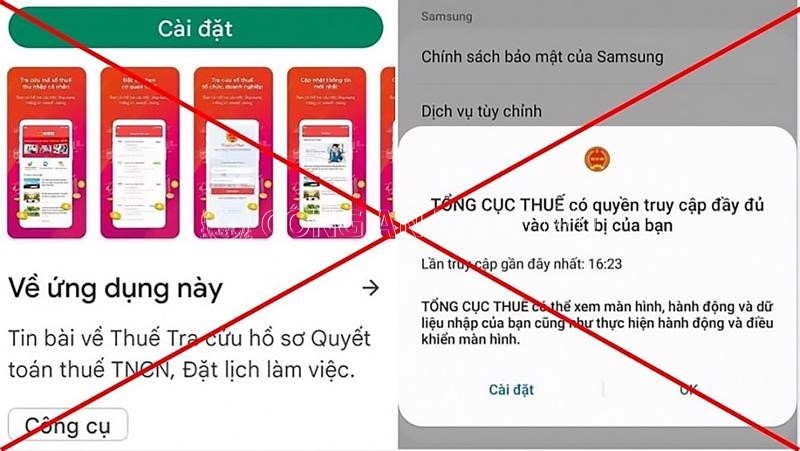
The General Department of Taxation's application has been faked.
To avoid this, users should pay attention to identifying signs such as the app's logo and color. If any differences are detected, however small, further verification is necessary.
Additionally, spelling errors and poor language structure are another sign of counterfeit software. Often, these errors are not accidental but intentionally created to evade copyright scanning tools.
Another way to assess a product is through user reviews. However, caution is advised, as fraudulent software developers may create fake reviews to deceive users. Signs such as disabled comments, low ratings, or numerous negative reviews are clear warning signs.
Finally, checking the number of downloads on app stores is also a useful method. An app that claims to be popular but only has a few hundred or a few thousand downloads is often a sign of unreliable software.
Source: https://nld.com.vn/cach-nhan-biet-app-gia-mao-de-tranh-bi-lua-dao-196240117210129322.htm

![[Photo] Enchanting ancient rose garden on the mountainside in Nghe An](/_next/image?url=https%3A%2F%2Fvphoto.vietnam.vn%2Fthumb%2F1200x675%2Fvietnam%2Fresource%2FIMAGE%2F2025%2F12%2F19%2F1766109900916_vuon-hong-chin-do-thu-hut-du-khach-toi-check-in-o-ha-noi-3-20162778-1671624890024-1671624890104198100259.jpeg&w=3840&q=75)
![[Photo] General Secretary To Lam visits the exhibition space showcasing books, photo exhibitions, and achievements of digital transformation in journalism.](/_next/image?url=https%3A%2F%2Fvphoto.vietnam.vn%2Fthumb%2F1200x675%2Fvietnam%2Fresource%2FIMAGE%2F2025%2F12%2F19%2F1766110879215_1766110240024-jpg.webp&w=3840&q=75)





























































































Comment (0)