

Salaries increased by over 20%.
According to Decree 204/2004/ND-CP, the salaries of officials, civil servants, public employees, and members of the armed forces are calculated by multiplying the base salary by the salary coefficient.
In this system, the salary coefficient is calculated according to the principle that officials, civil servants, and public employees are assigned salaries based on the rank or professional title they hold when appointed to a particular civil servant or public employee category.
The basic salary applied before July 1st was 1.49 million VND/month. From July 1st onwards, the basic salary increased to 1.8 million VND/month, 20.8% higher than the old basic salary.
With this increase in the base salary, the salaries of officials, civil servants, and members of the armed forces will also change, increasing by approximately 20.8%.
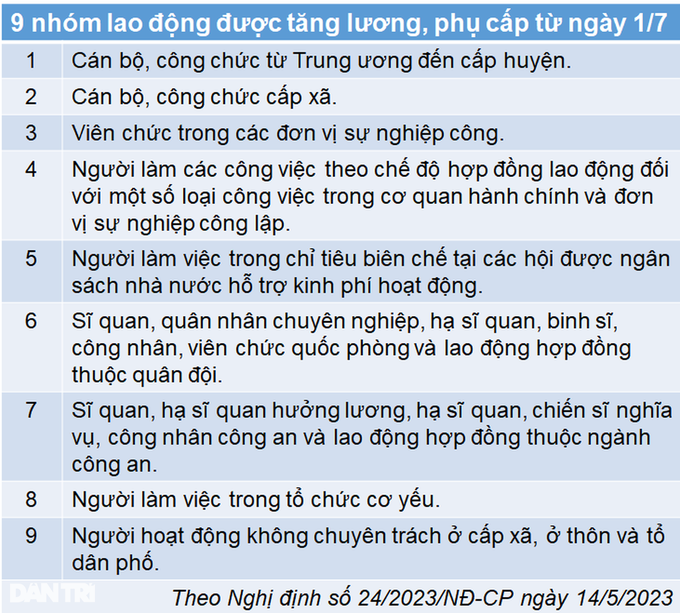
Nine groups of workers will receive a salary increase starting July 1st (Photo: Tung Nguyen).
A series of allowances increased accordingly.
In addition to their salaries, public sector employees also receive an increase in real income as a range of allowances beyond the basic salary are increased in line with the new base salary.
Firstly, there is the seniority allowance exceeding the standard rate. Depending on the position and length of service, this allowance is calculated as a percentage of the salary at the highest salary level in the rank. When the monthly salary increases in line with the base salary, this allowance will also increase accordingly.
Secondly, there is the allowance for holding multiple leadership positions. The allowance is equal to 10% of the current salary plus leadership position allowance and seniority allowance exceeding the standard rate (if any). When salaries, seniority allowances exceeding the standard rate, etc., increase, the allowance for holding multiple leadership positions will naturally also increase.
Thirdly, there is a regional allowance applied to workers in remote, isolated areas with harsh climates. The allowance consists of 7 levels (0.1; 0.2; 0.3; 0.4; 0.5; 0.7 and 1.0) relative to the base salary. When the base salary increases, the actual amount received from this allowance will also increase.
Fourthly, there is a special allowance applied to those working on remote islands and border areas with particularly difficult living conditions. The allowance consists of three levels: 30%, 50%, and 100% of the current salary plus leadership allowance and seniority allowance (if any)... When salaries and leadership/seniority allowances increase, the special allowance will also increase accordingly.
Fifthly, there is an attraction allowance applied to officials, civil servants, and public employees who come to work in new economic zones, economic establishments, and remote islands with particularly difficult living conditions. The allowance consists of four levels as follows: 20%; 30%; 50%; and 70% of the current salary plus leadership position allowance and seniority allowance exceeding the standard rate (if any). When salaries and leadership position and seniority allowances increase, the special allowance will also increase accordingly.
Sixth, there is a mobility allowance applicable to officials, civil servants, and public employees working in certain professions or jobs that frequently involve changes in workplace and residence. The allowance has three levels (0.2, 0.4, and 0.6 times the base salary). When the base salary increases, the actual amount received from this allowance will also increase.
Seventh, there is a hazardous and dangerous work allowance applicable to officials, civil servants, and public employees working in occupations or jobs with hazardous, dangerous, and especially hazardous and dangerous working conditions not yet included in the salary scale. The allowance consists of 4 levels (0.1; 0.2; 0.3 and 0.4 compared to the base salary).
Eighth, there are specific allowances based on occupation or job, including: seniority allowance, preferential allowance based on occupation, responsibility allowance based on occupation, job responsibility allowance, etc. Depending on the position, different allowance levels are granted based on the basic salary.
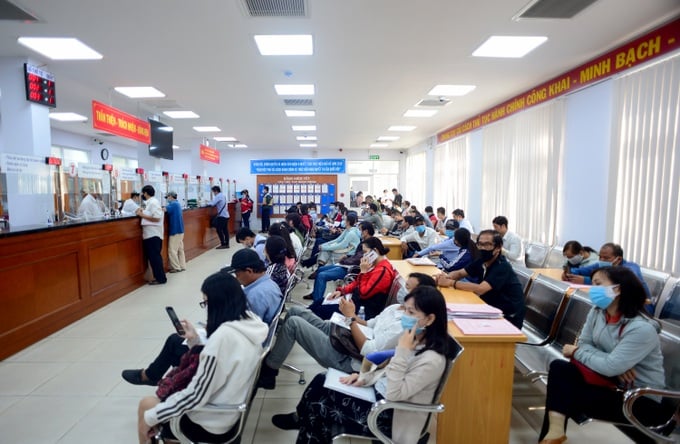
Income for public sector workers improved from July 1st (Photo: QA).
Many subsidies have increased.
In addition to higher monthly incomes due to increased salaries and allowances, workers also benefit from a range of social insurance benefits that have increased in line with the new base salary effective from July 1st.
Firstly, there is the allowance for convalescence and recovery after illness. This allowance is calculated daily, with each day equaling 30% of the basic salary. When the basic salary increases, the allowance for convalescence and recovery after illness will increase from 447,000 VND/day to 540,000 VND/day.
Secondly, there is a one-time allowance for childbirth or adoption. When the base salary increases, the amount of this allowance will increase from 2.98 million VND per child to 3.6 million VND per child.
Thirdly, there is the benefit for rest and recovery after childbirth. From July 1st, this benefit will increase from 447,000 VND/day to 540,000 VND/day.
Fourthly, there is a one-time allowance for work-related accidents and occupational diseases. When the base salary increases, employees will receive a minimum one-time allowance of 9 million VND (for a 5% reduction in working capacity), and then an additional 900,000 VND for each additional 1% reduction in working capacity.
Fifthly, there is the monthly allowance for work-related accidents and occupational diseases. From July 1st, workers will receive a minimum monthly allowance of 540,000 VND (for a 31% reduction in working capacity), and an additional 36,000 VND per month for every additional 1% reduction in working capacity.
Fifthly, there is the allowance for those injured in work-related accidents or occupational diseases. When the base salary increases, this allowance will rise from 1.49 million VND/month to 1.8 million VND/month.
In addition, a series of other social insurance benefits also increase in line with the base salary, such as the one-time death benefit due to work-related accidents or occupational diseases; the benefit for convalescence and health recovery after treatment for injuries or illnesses; funeral allowance; monthly survivor's allowance, etc.
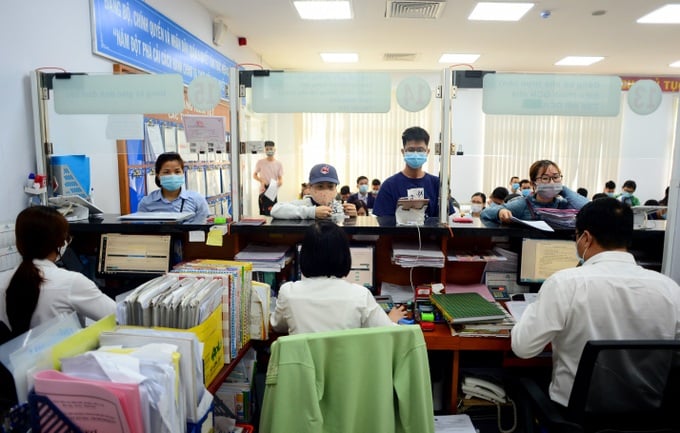
Many subsidies and allowances increase in line with the base salary (Illustrative image: QA).
Early retirement does not result in a reduction in pension entitlement.
According to Decree 115/2015/ND-CP regulating monthly pension levels, male workers with 20 years of social insurance contributions are entitled to a pension equal to 45% of their social insurance contribution salary upon retirement, while female workers with 15 years of social insurance contributions are entitled to a pension equal to 45% of their average monthly social insurance contribution salary upon retirement, with an additional 2% added for each additional year of social insurance contribution.
The monthly pension of eligible workers who retire early is calculated at the same rate as above, and then decreases by 2% for each year of early retirement.
On June 3rd, the Government issued Decree 29/2023/ND-CP regulating the streamlining of personnel for officials, civil servants, and public employees. This Decree takes effect from July 20th.
According to Decree 29/2023/ND-CP, there are three groups of officials, civil servants, and public employees who retire early without having their pension reduced as stipulated above.
Those subject to workforce reduction are those whose age is up to 5 years lower than the prescribed retirement age and who have contributed to compulsory social insurance for 20 years or more, including at least 15 years in arduous, hazardous, or particularly arduous and hazardous occupations or jobs, or at least 15 years working in areas with particularly difficult socio-economic conditions.
Those subject to downsizing are redundant commune-level officials and civil servants resulting from the reorganization of commune-level administrative units, who are at least 10 years younger and at least 5 years younger than the prescribed retirement age, and have contributed to compulsory social insurance for 20 years or more.
Those subject to downsizing are female officials and civil servants at the commune level who are up to 10 years younger and at least 2 years younger than the prescribed retirement age, and who have contributed to compulsory social insurance for 15 to less than 20 years.
Source link



![[Photo] General Secretary and President To Lam presides over a meeting on preparations for the review of one year of operation of the three-tiered government system.](https://vphoto.vietnam.vn/thumb/1200x675/vietnam/resource/IMAGE/2026/06/02/1780391821195_a1-bnd-4595-9717-jpg.webp)

































![[Image] Affirming the aspirations and new standards of the Vietnamese real estate market in the new era.](https://vphoto.vietnam.vn/thumb/1200x675/vietnam/resource/IMAGE/2026/06/03/1780441948766_giai-thuong-bat-dong-san-2026-minh-duy-6-7364-jpg.webp)






























































Comment (0)