

However, this development also poses many challenges related to the role of faculty and academic integrity. Therefore, establishing specific regulations on the principles of technology application in higher education is a necessary requirement.
Ensuring academic integrity
The Ministry of Education and Training is currently soliciting opinions from experts, educators, and scientists on the draft Circular regulating the application of technology in higher education. According to the draft, the application of technology in higher education must adhere to the principle of student-centered learning, aiming to improve the quality of learning, experiences, and holistic development of learners, while ensuring equal and inclusive access.
The application of technology in higher education is comprehensively implemented across training, testing, evaluation, scientific research, administration, and student support services. Higher education institutions are given the autonomy to select and apply technological solutions that align with their development strategies and specific circumstances.
Regarding artificial intelligence (AI) technology, the draft emphasizes the requirement to ensure that AI only plays a supporting role, not replacing lecturers; its use must be transparent, accountable, and not distort learning outcomes; and it must comply with the principles of academic integrity and have appropriate control and monitoring mechanisms.
Higher education institutions are also encouraged to proactively apply digital technology and artificial intelligence in student assessment, but must ensure accuracy, objectivity, transparency, and fairness; align with the learning outcomes of the training program; and guarantee autonomy coupled with accountability and compliance with legal regulations.
In scientific research, higher education institutions are permitted to apply digital technology and artificial intelligence, but must ensure that the technology only supports research activities, is transparent, verifiable, and does not alter the scientific nature of the work; while also complying with regulations on academic integrity and intellectual property rights.
The Ministry of Education and Training requires higher education institutions to issue internal regulations on academic integrity, clearly defining violations, handling procedures, and responsibilities of relevant parties; establishing and operating mechanisms for controlling, monitoring, and handling violations; applying technology to detect fraud; and organizing dissemination and awareness campaigns to improve understanding of academic integrity.
Students, faculty, and stakeholders are responsible for adhering to regulations on academic integrity; being truthful in academic activities; disclosing the use of technology and artificial intelligence in accordance with regulations; and being accountable for their learning, teaching, and research outputs.
Furthermore, the application of technology also serves the management of higher education institutions, provides support services for learners, and develops higher education databases. The draft Circular also addresses the development of a framework for digital and artificial intelligence competencies for learners and teachers in higher education institutions, as stipulated by the Ministry of Education and Training.
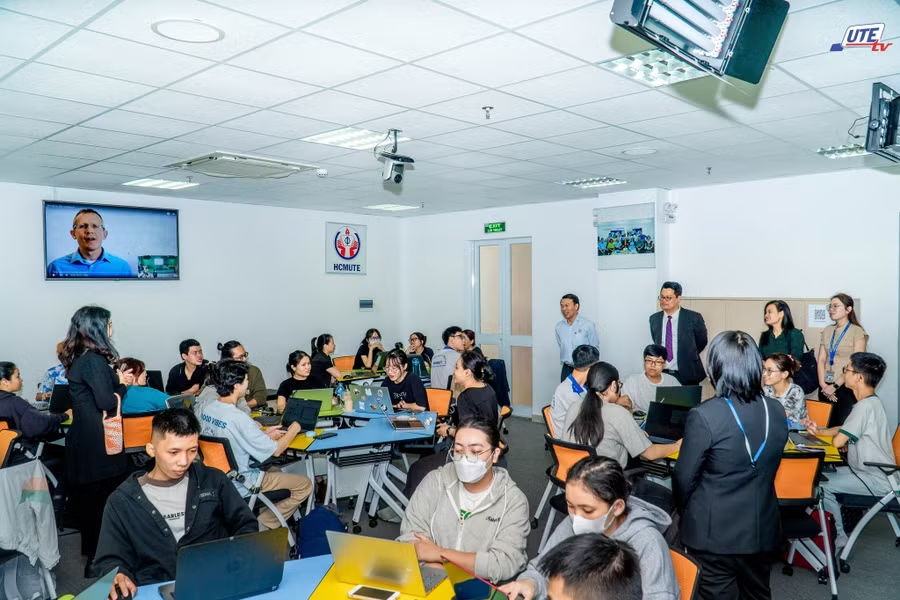
Synchronization is needed in implementation.
Supporting the policy of promoting the application of technology in universities, Mr. Tu Huu Cong, a lecturer at Binh Duong University (Ho Chi Minh City), said that digital technology and artificial intelligence are opening up unprecedented learning and working spaces. With just a few commands, lecturers and students can access a vast knowledge base, receive detailed explanations, and even get support in writing assignments as requested.
From a positive perspective, AI becomes a "virtual teaching assistant" that personalizes learning and enhances the effectiveness of knowledge acquisition. However, according to Mr. Cong, this convenience raises a core issue: the line between using AI to support learning and letting AI "do the work for" is becoming increasingly blurred. When an essay no longer reflects individual thinking but is primarily a product of algorithms, the value of the learning process will be significantly diminished.
Mr. Cong argues that this is precisely the "gray area" of academic ethics in the digital age. Therefore, the issue of academic ethics, in essence, is not just a matter for individuals but also a product of an entire educational ecosystem.
According to Mr. Cong, the Circular needs to include binding conditions to enable schools to establish clear regulations on the use of AI in learning and research. Lecturers need to innovate their assessment methods, focusing on the process, thinking skills, and application abilities rather than solely on the final product. Simultaneously, cheating control technologies need to be updated to keep pace with the development of AI. “More importantly, we need to shift from a prohibitive mindset to one that guides responsible use. Because AI, ultimately, is not the problem; how people use it is the deciding factor,” Mr. Cong emphasized.
Regarding the role of the teacher, Master's student Tu Huu Cong argues that when students can access information with just a click of a mouse, lecturers can no longer simply remain at the level of knowledge transmitters. Instead, the core role is shifting strongly from knowledge provider to learning facilitator, guiding thinking and "gatekeeper" of academic standards.
Accordingly, instructors not only need to update their professional knowledge but also comprehensively innovate their teaching methods. First and foremost, it is necessary to design highly personalized learning activities that encourage independent and creative thinking – elements that AI can hardly replace. Learning tasks linked to practical experience, requiring analysis, critical thinking, and personal connection will help limit copying or dependence on technology.
In the field of scientific research, Master's student Tran Linh Huan from Ho Chi Minh City University of Law noted that while the use of AI offers many benefits, it also carries the risk of researchers becoming dependent on and abusing the technology. Over-reliance on AI in the process of collecting, analyzing, and synthesizing information can inadvertently stifle creativity and personal touch in their research.
Furthermore, technology can lead researchers to inadvertently copy information provided by AI and incorporate it into their research without fully taking steps to protect the intellectual property rights of others, such as citing or obtaining permission to use it.
Therefore, to mitigate the negative impacts and challenges that AI brings to scientific research, according to Master Huân, it is necessary to define AI as a supporting tool, playing a role in enhancing human creativity rather than completely replacing it. This approach will encourage humans to create new values, instead of depending on readily available information synthesized and provided by AI.
From the university's perspective, Mr. Huân suggested strengthening training and development for lecturers and students in AI skills and technologies to support scientific research. This is a crucial solution to promote the application of AI in research, raising awareness of the potential of this technology, and equipping them with the necessary tools and methods to effectively apply AI in research.
In the long term, experts believe that a formal regulatory framework on ethics and security needs to be established. This framework must be comprehensive, including fundamental principles to ensure that AI is used transparently, responsibly, and in accordance with ethical standards in scientific research.
According to the draft Circular, higher education institutions are responsible for organizing the collection, digitization, standardization, updating, storage, management, and exploitation of data for administration, training, scientific research, service provision, and student support; while ensuring data connectivity and sharing within the institution, with the Ministry of Education and Training, and other relevant agencies as prescribed.
Source: https://giaoducthoidai.vn/can-cac-bo-quy-tac-cu-the-de-cao-liem-chinh-post780019.html




























![[Photo] Reception to welcome General Secretary and President To Lam and his wife on their State visit to the Philippines](https://vphoto.vietnam.vn/thumb/1200x675/vietnam/resource/IMAGE/2026/06/01/1780295488620_vna-potal-chieu-dai-chao-mung-tong-bi-thu-chu-tich-nuoc-to-lam-va-phu-nhan-tham-cap-nha-nuoc-toi-philippines-8798060-7855-jpg.webp)


























































Comment (0)