


The stock market continued its downward trend, breaking through the 1,200-point mark on yesterday's derivatives expiration date, April 17th. Many investors fear that the VN-Index may continue to fall sharply in April. An undesirable scenario is a 30-40% drop (entering a downtrend), which would cause stock prices to plummet, with some stocks falling by as much as 70-80%, similar to what happened in 2022. This is comparable to the market correction at the end of September last year, which saw an 18% drop from its peak; even within an uptrend, some stocks still fell by as much as 40%.
Mr. Pham Thanh Doanh - Admin of Pro Securities - expressed the view that there will be strong differentiation in the market during this year's corrections. In previous years, when the market corrected, almost 80% of stocks would correct accordingly. However, this year is different, with quite clear differentiation observed last week.
For now, in my personal opinion, the 1221 level will be a fairly reasonable valuation zone at this stage. In the worst-case scenario, the VN-Index could correct to the 1180 level to fill the upward gap from February 19, 2024. This is the valuation zone for February 2024.
For technically savvy investors, trading can remain calm during this period; however, they should limit their adherence to recommendations from forums/groups, as analysis is currently quite difficult. They can consider lowering margin or optimizing profits by taking some of their gains and observing market information, according to Mr. Pham Thanh Doanh.
From a more optimistic perspective, Dr. Nguyen Duy Phuong, Investment Director of DG Capital, believes that the current market valuation phase is not one of expansion as seen recently. Instead, the market will move in parallel with corporate profit growth, with the year-end growth expected to reach around 1,300-1,350 points. However, during the year, the VN-Index may surpass this level to 1,400 or even 1,500 points, before returning to the 1,300-1,350 point range.
Experts believe that the supporting factor for the market this year will still come from monetary policy.
For the stock market, monetary policy is the most important policy. Currently, Vietnam's monetary policy is loose, and its fiscal policy is also very supportive of the economy and the stock market.
Besides interest rates, the most important factor is that most businesses have passed the most difficult period. In the long term, the market remains in a cycle of low interest rates and easing, but in the short term, caution is still needed regarding two risks.
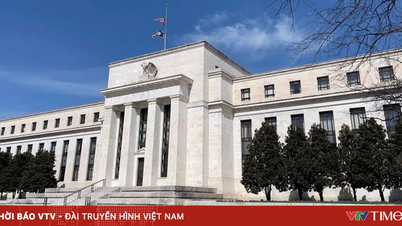
Firstly, if Vietnam continues to keep interest rates low, the Fed, for some reason (high inflation), may maintain high interest rates for a while longer, leading to interest rate differentials and inflationary tensions. Secondly, as the economy shows signs of recovery, the demand for credit growth will follow, and Vietnam's interest rates will bottom out and rise again.
Source



![[Photo] Admire the coral "masterpiece" amidst the million-year-old heritage of Dak Lak province.](https://vphoto.vietnam.vn/thumb/1200x675/vietnam/resource/IMAGE/2026/05/31/1780221235105_anh-man-hinh-2026-05-31-luc-16-53-27.png)
![[Photo] Solemn bathing ceremony and Buddha procession in Hue](https://vphoto.vietnam.vn/thumb/1200x675/vietnam/resource/IMAGE/2026/05/31/1780228263543_1-jpg.webp)


















![[Video] Sunset at Lap An Lagoon – Where the sun sets over the fishing nets](https://vphoto.vietnam.vn/thumb/340x192/vietnam/resource/IMAGE/2026/05/31/1780192137701_beach-landscape-sea-water-nature-grass-745871-pxhere-com.jpeg)





































![[Photo] Admire the coral "masterpiece" amidst the million-year-old heritage of Dak Lak province.](https://vphoto.vietnam.vn/thumb/402x226/vietnam/resource/IMAGE/2026/05/31/1780221235105_anh-man-hinh-2026-05-31-luc-16-53-27.png)





































Comment (0)