


However, the transition to a two-tiered local government model is still facing numerous obstacles related to human resources, infrastructure, and operational mechanisms at the local level.
Currently, the city's administrative apparatus has been streamlined to 103 commune-level administrative units, including 31 wards and 72 communes. Notably, the number of specialized agencies under the City People's Committee has been significantly reduced from 39 units to only 14 agencies and 1 City Public Administrative Service Center. At the grassroots level, the system operates with 309 specialized departments and 103 commune/ward-level Public Administrative Service Centers.
According to Mr. Bui Hoang Liem, Deputy Director of the Department of Internal Affairs of Can Tho City, the two-tiered local government model has initially shown positive results after one year of implementation. Leadership and management have been carried out synchronously and decisively, ensuring that policies from the central government are consistently implemented from the city level down to the grassroots.
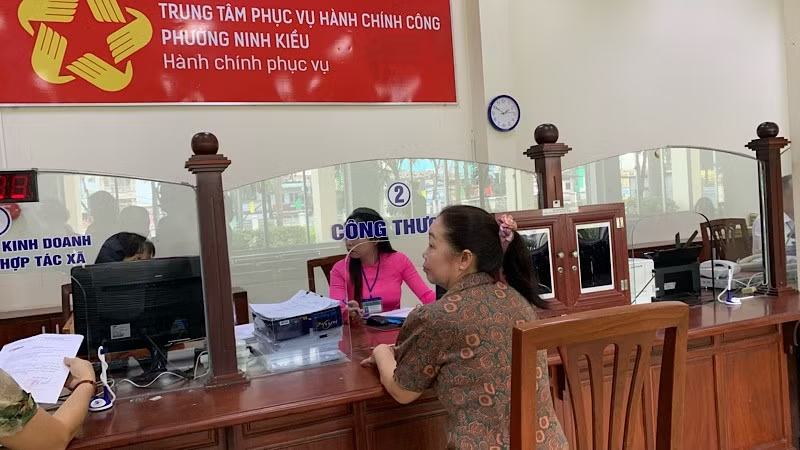
One of the biggest highlights of the new model is the decisive approach to administrative reform and decentralization. The city has received 949 tasks from the central government. To reduce pressure on higher levels and increase autonomy at the grassroots level, the City People's Committee has issued 12 decisions on decentralization and 38 decisions on delegation of authority to commune-level authorities in many key areas.
The establishment of public administrative service centers at the commune and ward levels is seen as an "extension" that helps citizens and businesses access public services conveniently right at the local level. This model not only helps reduce intermediate layers but also gradually modernizes local administration.
Simultaneously, the management of public assets has also been emphasized. The city has reviewed 684 properties (houses and land) and transferred thousands of machines, equipment, and public vehicles to serve the operations of restructured units, ensuring no loss and optimizing resources.
Despite achieving many successes, the actual operation at the local level is revealing systemic difficulties.
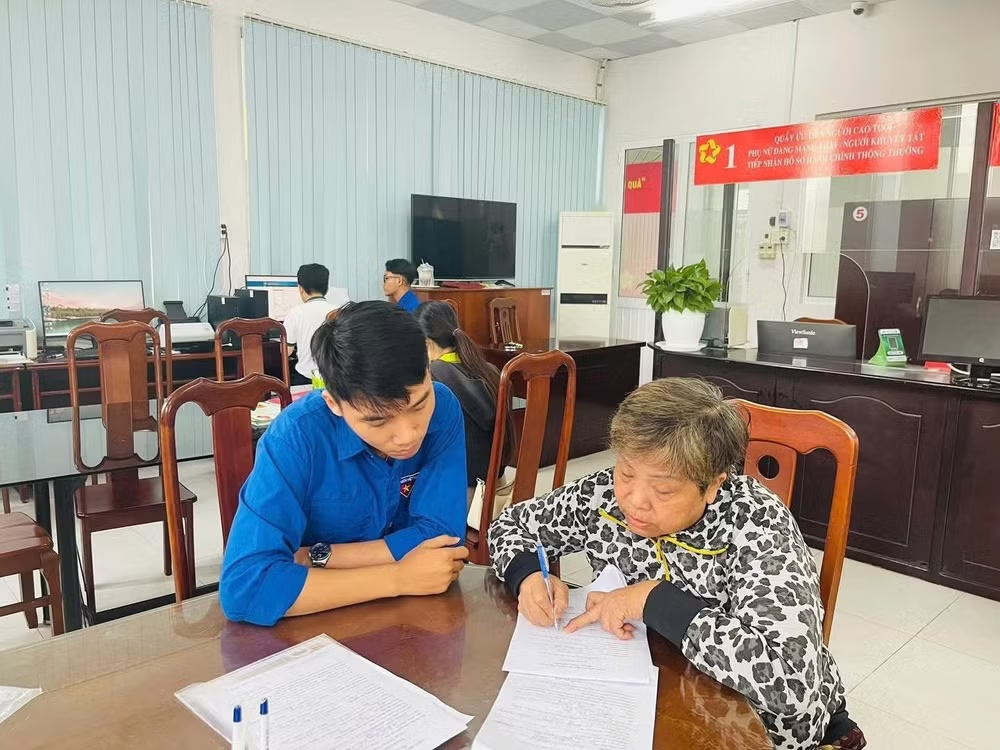
Mr. Tran Viet Thai, Chairman of the People's Committee of Nga Nam Ward, said that after more than 10 months of operating the two-tiered local government system, Nga Nam has received over 14,000 applications from residents, including more than 2,500 from outside the ward. The ward's public administrative service center is striving to process applications for residents according to regulations. However, due to the limited qualifications and capabilities of staff in some areas such as land and economics , they face difficulties in processing administrative applications; limited telecommunications infrastructure, equipment, and funding also sometimes hinder smooth operations.
Furthermore, the two-tiered local government in Can Tho City faces several key challenges, including: A segment of grassroots officials still do not meet the requirements of the new model. Particularly in complex areas such as land management and economics, the limited expertise of officials hinders the processing of citizen applications. The lack of synchronized telecommunications infrastructure, equipment, and databases is a barrier to achieving comprehensive digital transformation.
Regarding assets and funding, Mr. Ngo Anh Tin, Director of the Department of Science and Technology of Can Tho City, pointed out an inadequacy where "one official has two computers" due to old assets not yet being liquidated, leading to the inability to purchase newer, more modern equipment. In addition, funding for the activities of communes and wards is quite limited, affecting the digital transformation process.
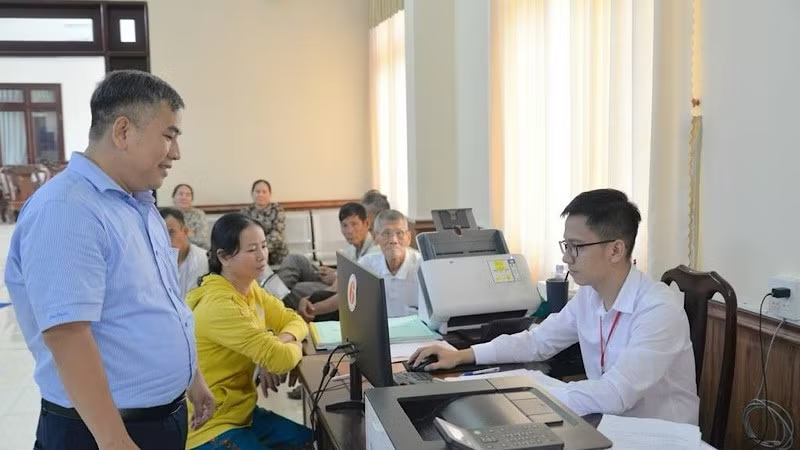
To address existing shortcomings and improve the two-tiered government model, the Chairman of the People's Committee of Can Tho City, Truong Canh Tuyen, requested that departments, agencies, and localities continue to review and refine their organizational structures towards a streamlined, effective, and efficient operation; focus on improving the quality of cadres, civil servants, and public employees, especially at the commune level; promote administrative reform associated with comprehensive digital transformation; strengthen administrative discipline and order; and enhance the responsibility of leaders.
The city has identified improving the quality of its staff, especially at the commune level, as a key priority. Beyond professional training, officials will receive further training in digital skills, problem-solving, and public service ethics to build a workforce with innovative thinking and a high sense of responsibility. As of the end of April 2026, the city has over 4,300 commune-level officials and civil servants, essentially meeting the staffing requirements for operating the new model.
Can Tho will accelerate the completion of digital infrastructure and the construction of a shared database. The goal is to strengthen data connectivity between different levels and sectors, increase the rate of online application processing, and enhance administrative discipline and accountability of leaders as mandatory requirements for the smooth operation of the system.
The two-tiered local government model in Can Tho is undergoing a crucial transformation. With comprehensive solutions ranging from streamlining the administrative apparatus to modernizing technology, the city is striving to build a transparent and open public administration that truly puts citizens and businesses at the center of its service.
Source: https://nhandan.vn/can-tho-go-kho-cho-chinh-quyen-dia-phuong-2-cap-post961090.html

![[Photo] Ba Lang An Lighthouse - the "eye of the sea" amidst the "rock museum" of Quang Ngai province.](https://vphoto.vietnam.vn/thumb/1200x675/vietnam/resource/IMAGE/2026/05/29/1780038698840_anh-man-hinh-2026-05-29-luc-14-10-42.png)
![[Image] Pleasant weather helps students enter the 10th grade entrance exam with confidence.](https://vphoto.vietnam.vn/thumb/1200x675/vietnam/resource/IMAGE/2026/05/29/1780034401612_ngay-1-thi-lop-10-minh-duy-8-5009-jpg.webp)












![[Video] Weather forecast for May 30, 2026: Less intense sunshine in the North, increased thunderstorms in the South.](https://vphoto.vietnam.vn/thumb/402x226/vietnam/resource/IMAGE/2026/05/30/1780095916745_thum-sang-png.webp)
















































Comment (0)