

 |
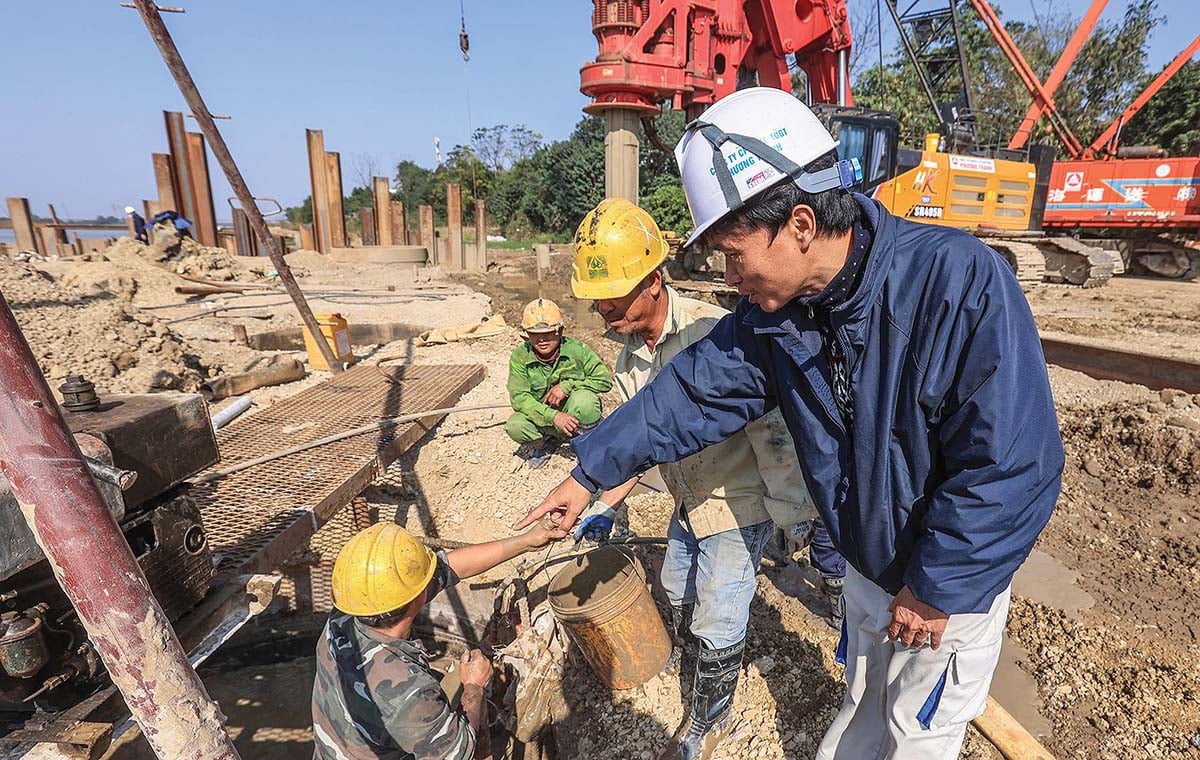
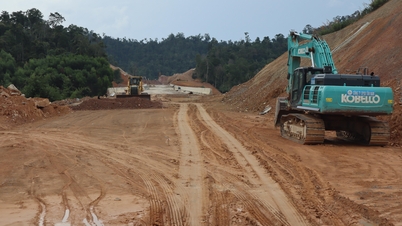
| Construction work is underway on the Tu Lien Bridge Project in Hanoi. |
Struggling to recruit workers
For the past six months, Mr. Nguyen The Khanh, Assistant to the Chairman of the Board of Directors of Phuong Thanh Transportation Investment and Construction Joint Stock Company, has been assigned to work with the human resources department to recruit technicians, machine operators, truck drivers, design engineers, cost estimation and payment engineers, and management staff for the company's construction sites across the country.
Besides posting information on construction engineering forums, Mr. Khanh also directly visited construction and transportation universities and colleges in Hanoi, Da Nang , and Ho Chi Minh City to recruit, but the results were still not as expected.
The workload intensified when, immediately after the Lunar New Year of the Year of the Horse, Mr. Khanh was tasked with urgently recruiting approximately 2,000 workers for electrical work, welding, machinery repair, surveying; workers to operate construction equipment; and about 300 engineers, field technicians, team leaders, deputy team leaders, etc.
"Although we accept applications from engineers and recent graduates, providing on-the-job training directly at construction sites with salaries ranging from 12-40 million VND/month (depending on position and ability); and covering 100% of accommodation and travel expenses to the construction site, we have only been able to recruit about 30% of our needs," Mr. Khanh said.
It should be added that, in the construction sector, Phuong Thanh Company is one of the large and reputable contractors, not only with investors but also recognized for its kindness and dedication to its workers. Besides paying salaries and bonuses on time, Phuong Thanh Company also ensures quite good welfare benefits for its employees, so in previous years, recruitment for this company was always very smooth.
Things have become difficult in the last 3-4 years as many large-scale transportation infrastructure projects have been simultaneously implemented across the country, especially since the end of 2025, causing even large, established companies like Phuong Thanh to have their personnel poached.
According to the Chairman of a road and bridge construction company in the North, he and the Board of Directors recently held a lengthy meeting on production and business orientation to agree on maintaining current projects and not considering taking on any new ones. Known for being hardworking and dedicated, the decision not to rush into taking on new projects shows that he and the company's leadership must have considered the matter very carefully.
As one of the leading and reputable road and bridge construction companies, over the past five years, his company has experienced remarkable growth, directly serving as the main contractor and investor for more than 200 km of expressways, including the Eastern North-South Expressway project.
This has helped the company's revenue increase from VND 3 trillion at the beginning of 2020 to nearly VND 9 trillion by the end of 2025, and is expected to increase to approximately VND 12 trillion in 2026. The company's reputation and practical capabilities are not only the foundation for winning numerous projects and creating jobs worth nearly VND 30 trillion in the next 2-3 years, but also ensure it continuously receives invitations to participate in large-scale transportation infrastructure projects.
According to the explanation, the company was forced to stop accepting new jobs due to the risk of a widespread shortage of manpower, especially technicians, machine operators, and executives. In fact, during the final stages of completing the North-South expressway, many contractors struggled to find mechanics and engineers, even competing fiercely for workers with unreasonable salaries and bonuses.
Mr. Nguyen Quang Tuyen, General Director of Van Cuong Construction Joint Venture Company, said that in the field of bridge and road construction, capital can be borrowed or advanced; machinery and equipment can be leased or purchased through investment, but high-quality human resources are a factor that cannot be trained overnight.
Training a skilled bridge builder or road roller operator requires at least 4-5 years of continuous work; a team leader who is both skilled and dedicated, able to manage his team and supplies and equipment, requires 10-15 years of honing their skills.
"If businesses don't have a self-training policy linked to commensurate salaries and bonuses, they will easily lose skilled workers, especially team leaders or site managers. The constant job hopping of these personnel is causing many business owners headaches," Mr. Tuyen said.
Obstacles to project progress
It should be added that the shortage of transportation workers stems from the difficulties faced by universities and vocational colleges in the field of transportation construction in recruiting students. The situation has only improved in the last one to two years as businesses have begun cooperating with schools in demand-based training, but the scale remains limited, and the gap between current and future needs (for the next 5-10 years) is significant.
The shortage of skilled bridge engineers is becoming increasingly acute due to both a lack of people seeking vocational training and a lack of proper training facilities.
Previously, traffic engineering technicians were typically trained from two sources: colleges under various ministries and departments, and the technical worker training system of the general corporations for transportation construction (CIENCO). After the CIENCOs were privatized, most of the technical worker training schools were dissolved, leaving only a few colleges nationwide interested in training workers in the bridge and road construction industry.
However, due to the demanding nature of this profession, which often requires working far from home, vocational colleges face significant difficulties in recruiting students. Each two-year training course only produces a few hundred skilled workers.
“Currently, many large-scale factories are relocating from cities to rural areas, creating a huge number of jobs. Rural people often choose jobs near home with salaries of 8-10 million VND/month, rather than 'wandering aimlessly, eating and sleeping rough' on construction sites. Now, recruiting road and bridge construction workers in localities that used to be a 'mine' of road and bridge construction workers like Thai Binh, Nam Dinh, Thanh Hoa, and Nghe An is also very difficult,” Mr. Tuyen shared.
Meanwhile, the shortage of highly skilled technicians, engineers, and executives not only makes it difficult for businesses to control project progress and quality, but also creates management loopholes, leading to losses for the businesses themselves.
Except for a very few cases, the majority of Vietnamese construction businesses currently operate efficiently at a revenue scale of less than 10,000 billion VND per year. The lack of a solution to the staffing problem has led many companies to accept stagnation to maintain financial security, despite facing numerous great opportunities to expand their scale, increase revenue, and increase the volume of work.
It is worth noting that after two major groundbreaking and inauguration phases of infrastructure projects in 2025, the volume of work created has reached 3-4 trillion VND, with many projects having very large capital scales, distributed nationwide.
If we include the North-South high-speed railway project and several urban railway projects planned for simultaneous implementation in Ho Chi Minh City and Hanoi, the total construction volume in the next 3-4 years could reach 2-3 trillion VND.
With the current average labor productivity in the road and bridge construction industry at only around 1 billion VND/person/year, a serious shortage of highly skilled workers and operational engineers on a large scale is entirely possible.
This is a reality that needs to be seriously considered by the authorities, and fundamental solutions should be found to work with businesses to address the shortage of human resources, especially in the high-speed rail infrastructure construction sector, which requires a very high level of skilled labor.
Experience shows that Japan, France, Germany, and Italy – countries possessing the original technology for high-speed rail; China, South Korea, and Spain – countries that have successfully adopted and mastered the technology; or Taiwan (China) and Indonesia – specializing in receiving and operating the technology – all simultaneously built national human resource development programs very early on, at least 5-7 years before the project commenced.
“Along with policies prioritizing financial support for businesses to accelerate the application of science and technology and improve labor productivity; mechanisms to promote cooperation between the State, universities, and businesses; and the development of public-private partnership models to combine state budget resources and private sector capital through commissioned training and human resource development, this is the key to solving this problem,” said Associate Professor Dr. Nguyen Thanh Chuong, Chairman of the University Council of the University of Transport and Communications.
Source: https://baodautu.vn/cang-thang-nguon-nhan-luc-cho-cac-dai-du-an-giao-thong-d539261.html






























![[Photo] Reception to welcome General Secretary and President To Lam and his wife on their State visit to the Philippines](https://vphoto.vietnam.vn/thumb/1200x675/vietnam/resource/IMAGE/2026/06/01/1780295488620_vna-potal-chieu-dai-chao-mung-tong-bi-thu-chu-tich-nuoc-to-lam-va-phu-nhan-tham-cap-nha-nuoc-toi-philippines-8798060-7855-jpg.webp)







































































Comment (0)