

In Dong Thap, ecological rice farming not only minimizes the impact of agricultural chemicals but also takes advantage of the flood season to regenerate the rice field ecosystem.
In Dong Thap, ecological rice farming not only minimizes the impact of agricultural chemicals but also takes advantage of the flood season to regenerate the rice field ecosystem.
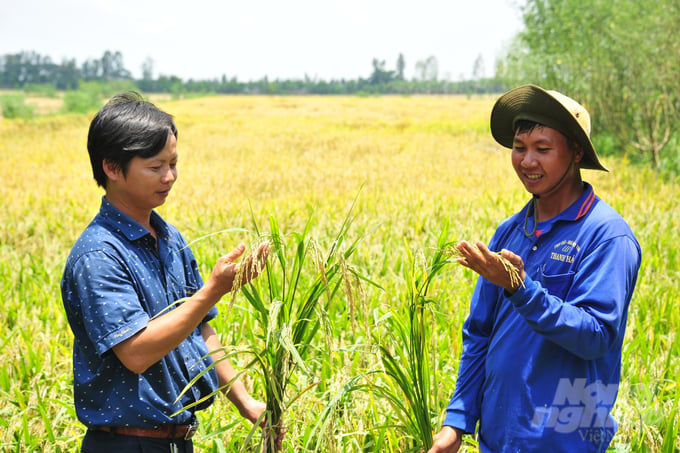
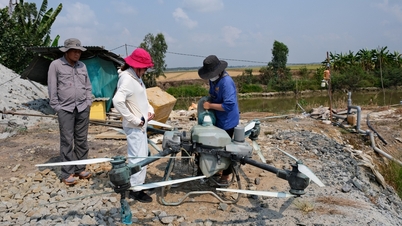
Starting from the 2023-2024 winter-spring crop season, the ecological rice cultivation project began to be implemented on an area of 200 hectares in the area adjacent to Zone A4 of Tram Chim National Park. Photo: Le Hoang Vu.
Red-crowned crane conservation and development project
The conservation of the red-crowned crane in Tram Chim National Park in Tam Nong district, Dong Thap province, is not only an environmental task but also a commitment from humanity to nature. Dong Thap has concretized this commitment with a project to conserve and develop the red-crowned crane, combining ecosystem restoration and the construction of a sustainable ecological rice production model. This model not only contributes to environmental protection but also opens up new avenues for farmers, connecting agricultural production with conservation and economic development.
Starting from the 2023-2024 winter-spring crop season, the ecological rice cultivation project began implementation on an area of 200 hectares in the area adjacent to Zone A4 of Tram Chim National Park, specifically in enclosures No. 25 (Phu Duc commune) and No. 43B (Tan Cong Sinh commune), Tam Nong district. By 2032, this model is expected to expand to the entire buffer zone, becoming a new symbol of harmony between agricultural production and biodiversity conservation.
With its organic farming practices, the ecological rice-growing area not only minimizes the impact of agricultural chemicals but also takes advantage of the flood season to regenerate the rice field ecosystem. In particular, the development of this model also opens up opportunities to build the "Tam Nong Crane Rice" brand – a distinctive product that serves not only the domestic market but also aims for export, creating stable income and improving the health of the local community.
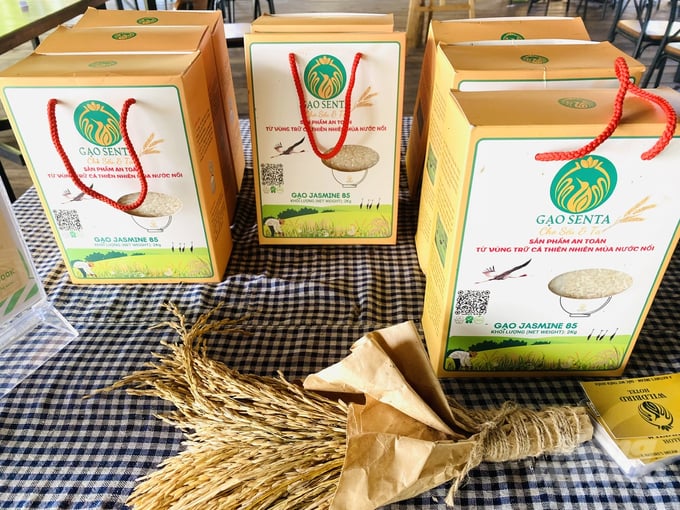
Organic rice – a distinctive product that serves not only the domestic market but also aims for export. Photo: Le Hoang Vu.
To realize this goal, the participation of 12,000 households living around the buffer zone is a crucial factor. Starting in the 2023 summer-autumn crop season, the project began on a scale of 39 hectares with only 4 participating farmers. However, after 4 cultivation seasons, the area has increased to 312.5 hectares with the participation of 41 households in the 2024 summer-autumn crop season, a clear testament to the community's solidarity.
According to Mr. Nguyen Van Man, one of the pioneering farmers participating in the project in Phu Duc commune, reducing the amount of seeds sown from 20kg to 10kg per hectare has saved production costs. Farmers participating in the model do not burn rice straw, thereby reducing smoke, dust, and environmental pollution. "Previously, we used a lot of chemical fertilizers, but now we only use organic fertilizers. Although rice yield has decreased slightly, actual profits have increased thanks to cost savings," Mr. Man shared.
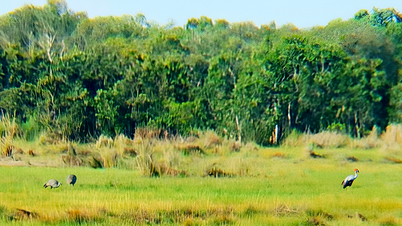
This change in farming practices not only brings economic benefits but also creates a green, clean, and beautiful environment, facilitating the return of the red-crowned crane. For the people of Tam Nong, this crane species holds not only ecological significance but also profound spiritual value. The red-crowned crane is a symbol of prosperity. Wherever the cranes return, the lives of the people will be more abundant.
Ecological rice farming and experiential tourism
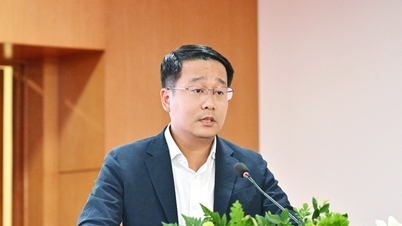
Mr. Tran Thanh Nam, Chairman of the Tam Nong District People's Committee, said that the entire district currently has 170 hectares of organic rice production. In particular, the district is promoting sustainable organic agriculture development, having developed a plan to use electronic logbook applications to monitor fields on smart devices. Simultaneously, they have registered a trademark for rice produced by the Quyet Tien Cooperative and invested in equipment for post-rice processing such as rice flour, cosmetics, and pharmaceuticals. In addition, they are inviting and creating favorable conditions for companies to invest in and consume rice from the model for farmers.
Simultaneously, develop economic models for cooperatives, associations, and farmers' groups that utilize local straw resources for the production of straw mushrooms and organic substrates, traditional organic fertilizer production, and animal feed, thereby increasing income. Develop rice production in conjunction with ecological technology, creating landscapes, attracting natural predators, etc., linked to the development of experiential tourism.
More importantly, the ecological rice farming models in Tam Nong not only protect the environment but also play a crucial role in restoring the ecosystem at Tram Chim National Park. Minimizing the use of agricultural chemicals helps improve soil and water quality, creating favorable conditions for the natural ecosystem to recover and develop.
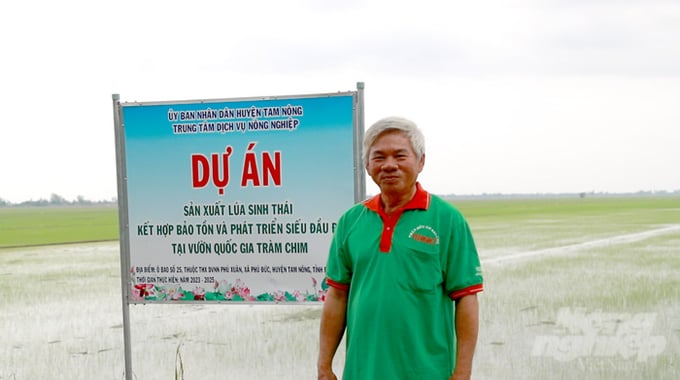
Farmer Nguyen Van Man (Phu Duc commune, Tam Nong district) in his ecological rice field. Photo: Le Hoang Vu.
Mr. Nam emphasized that the ecological rice-growing area in the district is also expected to be linked with ecotourism, transforming the rice fields into attractive destinations for tourists. This will not only enhance the commercial value of rice products but also generate income for the community, contributing to sustainable economic development.
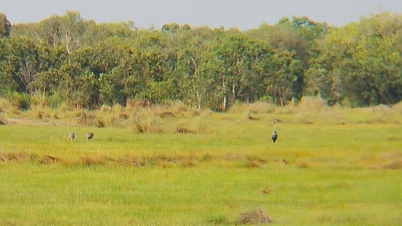
Although the ecological rice fields in Tam Nong have brought about significant changes, the number of red-crowned cranes returning is still not large. However, ecological rice farming is not just an act of cultivation but also a mission to protect life. It helps farmers become wealthy not only financially but also with pride in contributing to building a safe environment for future generations. And on those lush green fields, the cries of the red-crowned cranes will echo as a reminder of the close relationship between humans and nature.
Source: https://nongsanviet.nongnghiep.vn/canh-dong-lua-sinh-thai-goi-seu-dau-do-tro-ve-d412847.html

![[Photo] General Secretary and President To Lam receives Amazon's Senior Vice President David Zapolsky](https://vphoto.vietnam.vn/thumb/1200x675/vietnam/resource/IMAGE/2026/05/22/1779466547770_a1-bnd-3513-6601-jpg.webp)


























































Comment (0)