

Many scams target students and teenagers.
As summer approaches in 2026, the demand for internet, social media, and online platforms among the public, especially students, will increase significantly. This is also the time when malicious actors intensify their online fraud activities, employing increasingly sophisticated methods and tactics to steal assets and personal information.
.jpg)
According to the police, recently there have been many forms of fraud targeting students and teenagers through social media and online applications. The perpetrators often impersonate online collaborators, advertising "easy work with high pay," requiring only simple tasks such as liking posts, watching videos , commenting on products, or closing sales to receive commissions.
Initially, the perpetrators often transfer a small amount of money to build trust. Then, they ask the victims to continue transferring money to "upgrade missions" or "increase profits," before stealing the entire amount. Many students, due to lack of experience and gullibility, have fallen victim to these schemes.
Lam Dong Provincial Police advise parents to strengthen management, attention, and monitoring of their children's internet usage during the summer break.
Furthermore, these individuals exploit teenagers' fondness for online games to carry out scams through programs offering free game gifts, rare items, or invitations to participate in online voting contests. The suspicious links sent often contain malware designed to steal Facebook, Zalo, Gmail, and other personal accounts.
After gaining control of social media accounts, these individuals continue to impersonate the account owners to send messages to relatives and friends asking for money, or to exploit bank accounts to commit illegal acts.
Furthermore, these individuals also impersonate government agencies, telecommunications companies, or schools, calling to inform victims about scholarships, account violations, or requesting personal information verification. Through this, they trick victims into providing OTP codes, bank account information, and login passwords to steal their assets.
Beware of online booking and travel scams.
.jpg)
Notably, taking advantage of the peak summer tourist season, scammers also target people's demand for cheap tours and hotel/homestay bookings. They create fake websites and fan pages impersonating reputable hotels, resorts, and homestays, featuring attractive images and complete information, and run advertisements on social media to build trust.
The consultation process was quite professional, including asking about the number of guests, length of stay, sending room photos, providing a price quote, giving a specific address, and offering attractive promotions if customers made a deposit or paid in advance.
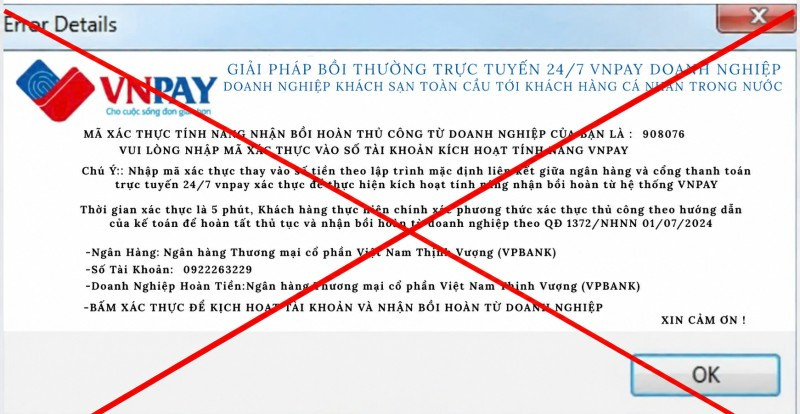
After people transfer money, the scammers continue to notify them of "incorrect transaction syntax," "system not recorded," or "authentication error," then request a re-transfer for a refund. Furthermore, the scammers even impersonate customer service representatives, accountants, or electronic payment support staff to further trick victims into making more transactions and stealing larger sums of money.
Other sophisticated tactics used by these scammers include notifying victims that their accounts have not activated the "cashback" or "transaction unlock" features, and requesting money transfers with messages called "verification codes," "activation fees," or "cashback unlock fees." The scammers often create time pressure, demanding urgent action within minutes to cause victims to panic and lower their guard.
When detecting suspicious signs related to online fraud, people should quickly report it to the nearest police station for guidance and timely assistance.
Given the situation, the police force advises citizens, parents, and students to be more vigilant when participating in online activities. People should absolutely not provide OTP codes, bank account information, or login passwords to strangers under any circumstances; they should not access links from unknown sources, download unfamiliar applications, or believe offers to make quick money online.
For online bookings and travel, people should prioritize using official websites, reputable apps, or contacting accommodations directly to verify information before transferring money. Furthermore, absolutely do not make multiple transfers based on instructions from strangers claiming to "activate refunds," "unlock transactions," or "verify accounts."
The police also urged parents to strengthen supervision, attention, and guidance for their children on safe internet use during the summer break; and to regularly educate and remind students to raise their awareness of online scams.
Source: https://baolamdong.vn/canh-giac-thu-doan-lua-dao-truc-tuyen-gia-tang-dip-he-445006.html


![[Photo] General Secretary and President To Lam presides over a meeting with the Central Organizing Committee.](https://vphoto.vietnam.vn/thumb/1200x675/vietnam/resource/IMAGE/2026/06/03/1780482764658_a1-bnd-4741-3342-jpg.webp)

![[Photo] Secretary of the National Assembly Party Committee, Chairman of the National Assembly presides over the meeting of the Standing Committee and Executive Committee of the National Assembly Party Committee.](https://vphoto.vietnam.vn/thumb/1200x675/vietnam/resource/IMAGE/2026/06/03/1780480353201_ndo_br_bnd-2585-jpg.webp)






























![[Photo] First session of the 14th Congress of the Vietnam Trade Union](https://vphoto.vietnam.vn/thumb/1200x675/vietnam/resource/IMAGE/2026/06/03/1780465947883_ndo_br_img-3852-jpg.webp)





























![[Video] Sunset at Lap An Lagoon – Where the sun sets over the fishing nets](https://vphoto.vietnam.vn/thumb/1200x675/vietnam/resource/IMAGE/2026/05/31/1780192137701_beach-landscape-sea-water-nature-grass-745871-pxhere-com.jpeg)































Comment (0)