

The formation of rainbows is a natural optical phenomenon.
Simply put, the rainbow we see after a rainstorm is caused by sunlight shining on tiny, nearly round water droplets in the air, causing the light to be dispersed and reflected. When sunlight hits the water droplets, it strikes them at different angles, and the droplets reflect the light at different angles. The strongest reflection occurs at an angle of 40-42 degrees, creating the rainbow we see.
Regarding the principle of the rainbow: when sunlight shines on water droplets in the air, the light is refracted and reflected, creating a colorful arc-shaped spectrum in the sky.
In summer, the sky clears after the rain and the sun shines brightly. The moment a rainbow appears in the sky is like a vibrant ribbon of colors stretching across the sun, with shades of red, orange, yellow, green, blue, indigo, and violet.
Why do rainbows have so many colors that appear in the sky?
The colors of a rainbow primarily originate from the scattering effect of prisms on white light, which is resolved into seven distinct colors, and due to internal reflections, this spectrum is reversed.
Generally, the larger the raindrops, the brighter and clearer the rainbow will appear. Raindrops of different sizes will produce different rainbow colors, and white rainbows can even appear.
So why are rainbows curved?
The curvature of a rainbow occurs because light of different colors is refracted by water droplets at varying levels.
Because the Earth's surface is curved and covered by a thick atmosphere, the water content in the air after rain is higher than normal, and refraction occurs when sunlight shines on tiny water droplets in the air.
Additionally, because the Earth's atmosphere is arc-shaped, sunlight is refracted on the surface, creating the arc-shaped rainbows we see.
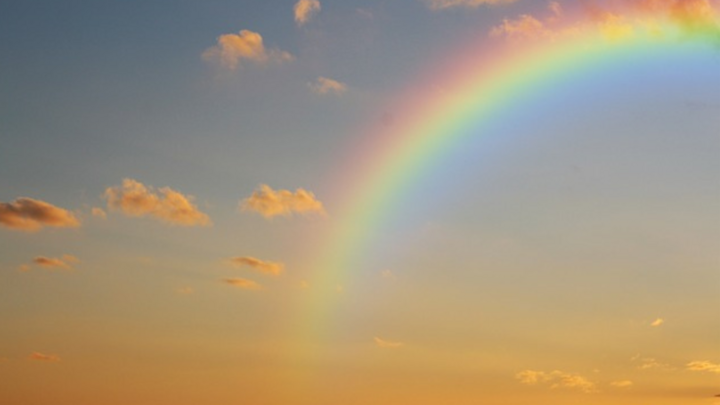
Rainbows are a fascinating natural phenomenon (Photo: pixabay)
Little-known facts about rainbows
Rainbows rarely appear at noon.
Rainbows are typically seen in the morning or evening, due to the dispersion of sunlight as it refracts and reflects through raindrops at temperatures around 42 degrees Celsius. Temperatures are usually higher than these ideal levels at midday, so rainbows rarely form.
Rainbows can appear at night.
Rainbows that appear at night are called lunar rainbows. This phenomenon occurs because rainbows are created by light reflected off the surface of the moon, not by direct sunlight.
It's impossible to see all the colors of the rainbow.
In addition to the seven basic colors of the rainbow that we commonly see, it is also made up of more than a million interconnected colors, including those invisible to the naked eye.
Multiple rainbows can be formed at the same time.
An observer can see more than one rainbow at the same time when light refracts inside a water droplet and splits into its component colors. A double rainbow appears when this happens inside the droplet twice, a triple rainbow when it happens three times, and even a quadruple rainbow if it happens four times.
Minh Anh (compiled)
Source


![[Photo] Prime Minister Pham Minh Chinh presides over a meeting on private sector economic development.](/_next/image?url=https%3A%2F%2Fvphoto.vietnam.vn%2Fthumb%2F1200x675%2Fvietnam%2Fresource%2FIMAGE%2F2025%2F12%2F20%2F1766237501876_thiet-ke-chua-co-ten-40-png.webp&w=3840&q=75)
![[Photo] Prime Minister Pham Minh Chinh presides over the conference announcing the establishment of the International Finance Centre in Vietnam.](/_next/image?url=https%3A%2F%2Fvphoto.vietnam.vn%2Fthumb%2F1200x675%2Fvietnam%2Fresource%2FIMAGE%2F2025%2F12%2F21%2F1766309817714_ndo_br_dsc-3400-jpg.webp&w=3840&q=75)





















































































Comment (0)