

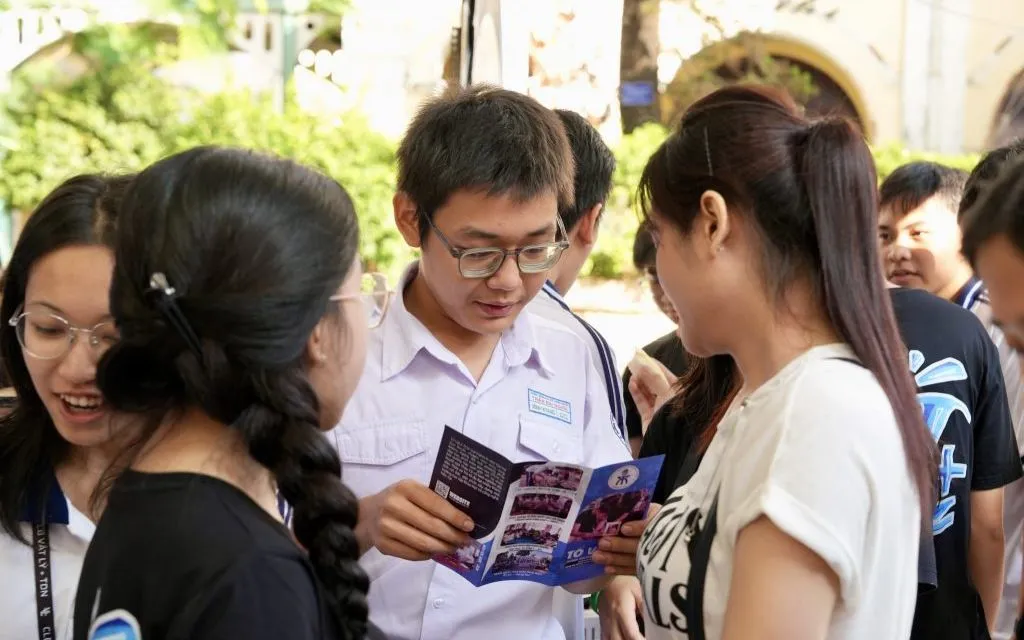
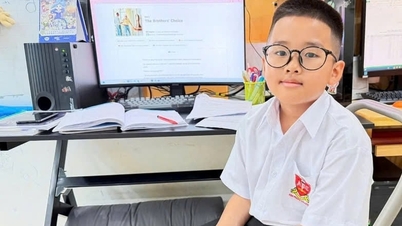
Illustrative image
Resolution 80-NQ/TW of the Politburo on the development of Vietnamese culture clearly defines the goal of ensuring that 100% of students receive regular and effective cultural heritage education. Based on this direction, many schools, educational institutions, and student groups are gradually moving cultural heritage out of the realm of storage and into vibrant experiences within school life.
In the mother-of-pearl inlay village of Chuyen My commune (Hanoi), the "Colorful Inlay" project, implemented by students from the Diplomatic Academy, has given international tourists the opportunity to directly experience the traditional craft. Instead of just observing, visitors can participate in the crafting process, interact with artisans, and learn about the cultural stories behind each product. These hands-on experiences help make the heritage more accessible and relatable to young people and international friends.
Ms. Tran Mai Phuong, Head of the "Mosaic Colors" project organizing committee, believes that the younger generation plays a crucial role in preserving and spreading Vietnamese culture. According to her, even small projects, when implemented with creativity and a proactive spirit, can help bring traditional culture closer to contemporary life and promote it widely to the world .
Not only in projects involving traditional crafts, but many universities are now encouraging students to incorporate cultural elements into their creative products. At Hanoi National University, students from the School of Interdisciplinary Sciences and Arts have drawn inspiration from architectural heritage, the ao dai (Vietnamese traditional dress), and traditional culture to develop fashion designs, accessories, and artworks with a modern flair.
Student Duong Nguyen Quang Anh stated that incorporating images of Vietnamese culture into modern products is a way for heritage to continue "living" in contemporary life. Meanwhile, student Duong Pham Ky Duyen believes that the school's provision of opportunities for students to participate in exhibitions, competitions, and art performances has further motivated young people to be creative and contribute to culture.
According to Mr. Le Quang Phap, a lecturer at the School of Interdisciplinary Sciences and Arts - Vietnam National University, Hanoi, when students are empowered to research, explore, and retell culture in their own language, heritage will gain new vitality and easily spread to the community.
Education experts believe that heritage education is gradually shifting from a theory-based approach to one that is experiential and practical. Associate Professor Dr. Nguyen Viet Khoi, Vice Rector of the School of Interdisciplinary Sciences and Arts - Vietnam National University, Hanoi, believes that Resolution 80 serves as a "guiding principle" for universities to boldly incorporate art and culture into their curricula in a more practical way. According to him, students need to directly experience, create cultural products, and connect with businesses to understand the value of heritage in modern life.
From experiential projects focusing on traditional crafts to innovative products inspired by tradition, it's clear that when heritage is integrated into the classroom and daily life through new approaches, young people not only learn about culture but also directly participate in preserving, continuing, and spreading Vietnamese identity in the modern era.
Source: https://vtv.vn/cay-gene-van-hoa-cho-the-he-tre-tu-giang-duong-den-lang-nghe-100260523005427106.htm
![[Photo] Solemn bathing ceremony and Buddha procession in Hue](https://vphoto.vietnam.vn/thumb/1200x675/vietnam/resource/IMAGE/2026/05/31/1780228263543_1-jpg.webp)
![[Image] Hanoi Police officially crowned champions of V-League 2025/2026](https://vphoto.vietnam.vn/thumb/1200x675/vietnam/resource/IMAGE/2026/05/31/1780244769054_ndo_br_039d561b692be875b13a-jpg.webp)
![[Photo] The General Secretary, President and his wife begin their state visit to the Philippines.](https://vphoto.vietnam.vn/thumb/1200x675/vietnam/resource/IMAGE/2026/05/31/1780230559452_anh-man-hinh-2026-05-31-luc-19-28-11.png)


![[Photo] Admire the coral "masterpiece" amidst the million-year-old heritage of Dak Lak province.](https://vphoto.vietnam.vn/thumb/1200x675/vietnam/resource/IMAGE/2026/05/31/1780221235105_anh-man-hinh-2026-05-31-luc-16-53-27.png)















![[Video] Sunset at Lap An Lagoon – Where the sun sets over the fishing nets](https://vphoto.vietnam.vn/thumb/340x192/vietnam/resource/IMAGE/2026/05/31/1780192137701_beach-landscape-sea-water-nature-grass-745871-pxhere-com.jpeg)


































![[Photo] Admire the coral "masterpiece" amidst the million-year-old heritage of Dak Lak province.](https://vphoto.vietnam.vn/thumb/402x226/vietnam/resource/IMAGE/2026/05/31/1780221235105_anh-man-hinh-2026-05-31-luc-16-53-27.png)




























Comment (0)