

On the morning of May 17th, continuing the agenda of the ninth session, the National Assembly voted to approve the Resolution of the National Assembly on a number of special mechanisms and policies for the development of the private economy .
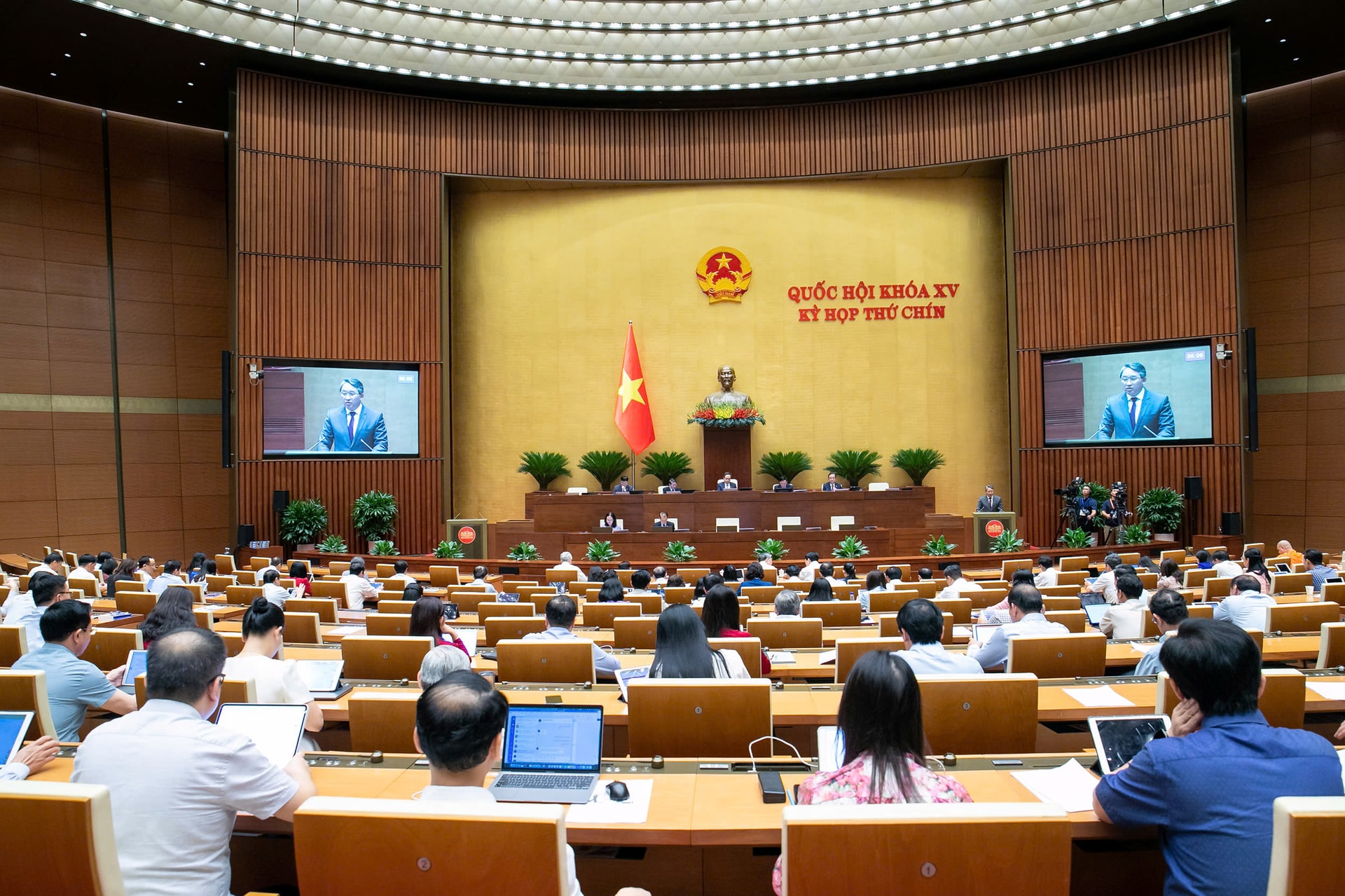
Some notable points: The Resolution stipulates that the number of inspections for each enterprise, household business, or individual business (if any) shall not exceed one time per year, except in cases of clear signs of violations; the number of on-site inspections of enterprises, household businesses, or individual businesses (if any), including inter-agency inspections, shall not exceed one time per year, except in cases of clear signs of violations; on-site inspections of enterprises, household businesses, or individual businesses that comply well with legal regulations shall be waived.
There shall be no discrimination between entities belonging to different economic sectors in the mobilization, allocation, and use of capital, land, resources, assets, technology, human resources, data, and other resource assets.
Legal provisions must not be applied retroactively to disadvantage businesses, household businesses, or individual business owners; the principle of presumption of innocence must be ensured in the investigation, prosecution, and trial of cases; evidence and assets must be handled promptly and effectively without affecting the proof and resolution of the case; damages must be promptly rectified, and assets put into exploitation and use to unlock resources for development and avoid loss and waste...
Local authorities are allowed to use their local budgets to partially support investment in the construction of infrastructure systems for industrial parks, industrial clusters, and technology incubators. Support includes: assistance with land acquisition, compensation, and resettlement; and support for investment in infrastructure projects such as transportation, electricity, water supply, drainage, wastewater treatment, and telecommunications.
High-tech enterprises in the private sector, small and medium-sized enterprises, and innovative startups are supported with a minimum 30% reduction in land lease fees for the first 5 years from the date of signing the land lease contract with the investor operating the infrastructure of industrial parks, industrial clusters, and technology incubators.
The State supports small and medium-sized enterprises, supporting industrial enterprises, and innovative enterprises in leasing unused or underutilized public land and buildings in the locality.
Corporate income tax exemption for 2 years and a 50% reduction in tax payable for the following 4 years applies to income from innovative startup activities of innovative startups, innovative startup investment fund management companies, and intermediary organizations supporting innovative startups. Corporate income tax exemption for small and medium-sized enterprises (SMEs) is granted for 3 years from the date of initial business registration.
The resolution stipulates the cessation of business license fee collection from January 1, 2026; and exemption from fees and charges for organizations, individuals, and businesses for documents that need to be reissued or replaced when restructuring the state apparatus in accordance with the law.
The State expands the participation of private sector enterprises in key projects of great significance to socio-economic development and nationally important projects through direct investment, public-private partnerships, or other forms of cooperation between the State and private sector as prescribed by law.
The competent authority and the investor may choose to apply one of the following forms of ordering, such as limited bidding, direct contracting, or other appropriate forms as prescribed by law, to implement strategic sectors, key national-level scientific research projects and tasks, high-speed railways, urban railways, foundational industries, cutting-edge industries, energy infrastructure, digital infrastructure, green transportation, national defense, security, and urgent tasks, based on ensuring transparency, quality, progress, efficiency, and accountability.
The resolution mandates the Government to complete, by December 31, 2025 at the latest, the review and elimination of unnecessary business conditions, overlapping regulations, inappropriate regulations that hinder the development of private enterprises; to reduce administrative procedure processing time by at least 30%, legal compliance costs by at least 30%, and business conditions by at least 30%, and to continue significant reductions in subsequent years.
Source: https://hanoimoi.vn/cham-dut-thu-nop-le-phi-mon-bai-tu-nam-2026-702560.html
























































![[Image] Close-up view of the 10-lane road connecting to Long Thanh Airport](https://vphoto.vietnam.vn/thumb/402x226/vietnam/resource/IMAGE/2026/04/04/1775291871988_ndo_br_1-resize-5690-jpg.webp)

























Comment (0)