
Exploring Mount Fuji. Photo: LE THUY
Symbol of Japan
When you talk about Japan, you talk about Mount Fuji, and when you talk about Fuji, you're talking about the sacred mountain – the symbol of the Land of the Rising Sun. Mount Fuji stretches across the prefectures of Shizuoka and Yamanashi. From Tokyo, it only takes 100km southwest by train to reach this symbol of the Land of the Rising Sun.
According to historical records, Mount Fuji (Japanese: 富士山 | Fujisan or Fujiyama) was formed by an earthquake in 286 BC. The first eruption occurred approximately 600,000 years ago, while the most recent eruption was over 300 years ago.
Following this eruption, the lava solidified on both sides of the mountain, forming the legendary conical shape we see today. At the summit, there remains a crater with a diameter of over 50 meters and a depth of approximately 250 meters.
In the past, Mount Fuji erupted once every 30 years. Statistics show 18 eruptions between 781 and 1707. However, since the eruption in 1707, the volcano has become unusually quiet.
This is the only active volcano, occasionally erupting with vapor. Around Mount Fuji are many peaks such as Osahidake, Izudake, Jojudake, etc., as well as many beautiful lakes, the most famous being the Five Lakes: Yamanaka, Kawaguchi, Sai, Shoji, and Motosu.
We took the express train to Mount Fuji on a sunny day. The sky was a deep blue. The early autumn breeze was invigorating. I haven't traveled all over Japan, so I don't know for sure, but here in Yamashi Prefecture, it seems like every road winds around the sacred Mount Fuji. Therefore, from anywhere, you can admire the magnificent beauty of this legendary landmark. Japanese roads are already small and neat; the road up Mount Fuji is even more winding and endlessly colorful with foliage.
The winding asphalt road leads visitors up to station number 5, out of a total of 10 stations, at an altitude of 2,500 meters. It was early autumn, and snow had already blanketed the mountaintop. I bent down and scooped up handfuls of pristine white snow, my hands numb with cold. On the gnarled pine trees, scarred by time, the colors of Japanese autumn were beginning to appear—a blend of vibrant green and fading red. Just by reaching out, one could touch the purity of the earth and sky.
Stories surrounding Mount Fuji
In the past, only Shinto lay followers were allowed to travel on Mount Fuji. Women were not permitted to ascend the summit. Today, it is a bustling destination for tourists from all over the world.
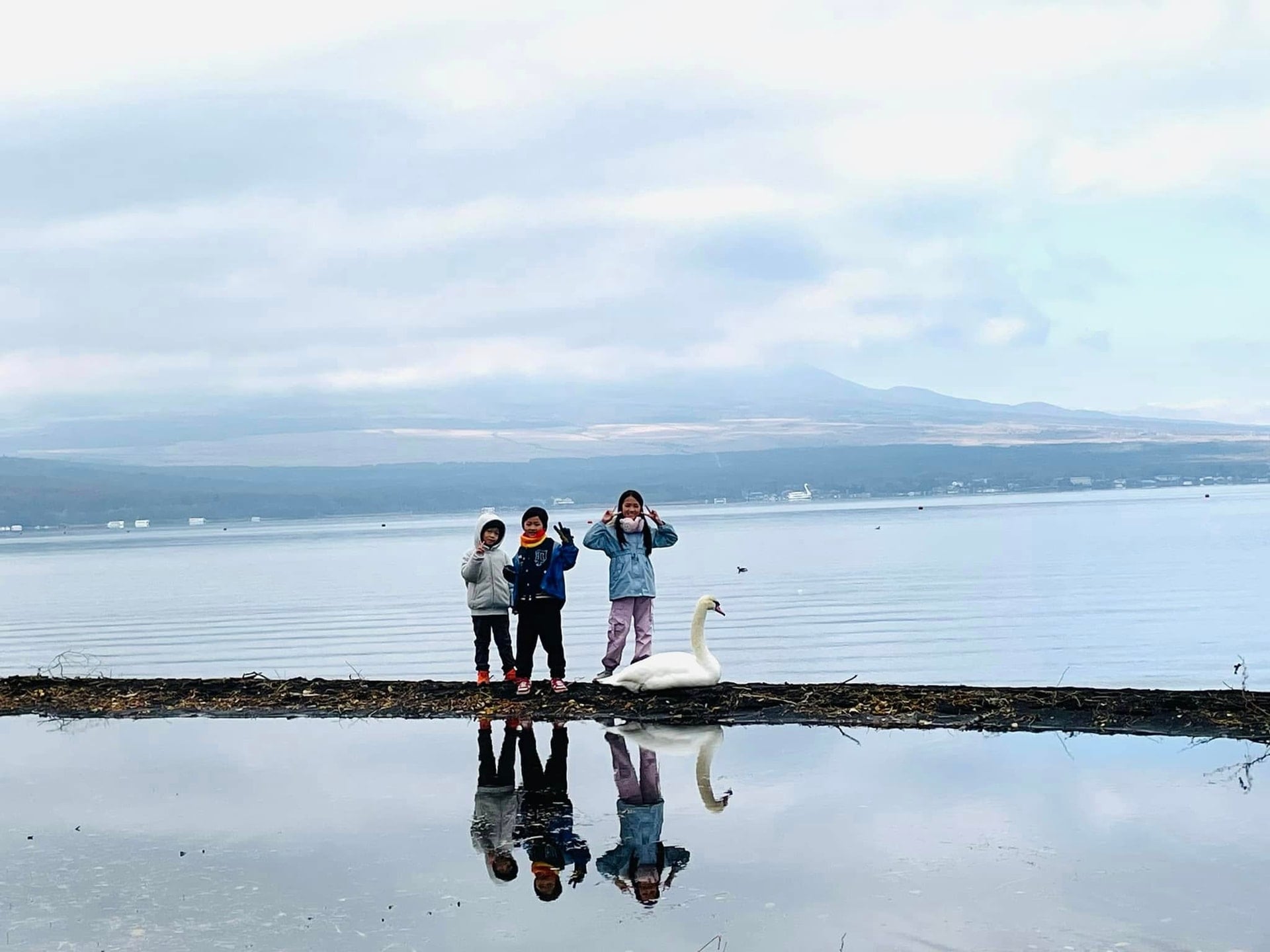
Surrounding Mount Fuji are tranquil lakes. Photo: LE THUY
From station number 5, conquering the summit is a challenge for anyone. You'll have to set off at four or five in the morning, traversing another 2,200 meters in high humidity and thin air to reach the summit at midnight. And you'll have to endure many more hours like that to witness the earliest sunrise in Japan at an altitude of 3,776 meters.
Having studied and worked in Japan for over 9 years, Trac Thuan Quan is considered by his Japanese friends as an ambassador for Yamanashi. According to this amiable tour guide, Japan has three specialties: earthquakes, typhoons, and fresh water.
Among them, the freshwater crystallized from snowflakes on the summit of Mount Fuji and seeping into the earth is considered sacred. The Japanese, with their animistic beliefs, believe that those who drink these drops of snowwater will achieve immortality.
In Yamanashi, we saw quite a few such wells/water tanks within the grounds of Buddhist temples or Sinto shrines. These tanks, carved from solid blocks of rock, are placed in prominent, easily visible locations. Water is drawn from within the mountain, channeled through a bamboo pipe, trickling and murmuring, overflowing the tank, seeping into the rock walls, and then back into the earth—a seemingly endless cycle.
In the ancient village of Oshino Hakkai, there is a pool shaped like Mount Fuji. This pool contains water fed by melting snow and ice from the slopes of Mount Fuji, creating a stream of pure water. The Japanese believe that whoever drinks the water crystallized through this 80,000-year-old lava will achieve immortality. So, like many tourists, I eagerly took a sip and didn't forget to spend 200 yen to buy a few bottles to take home, hoping to have a companion in case I... become immortal/eternal.
However, history has never recorded anyone who is immortal/immortal. In fact, Mount Fuji has witnessed many tragic deaths. This is what happened in the mysterious Aokigahara forest. Due to its geographical structure, this forest has a fairly strong magnetic field. When lost here, compasses cannot determine direction, and people find it difficult to find their way back.
Under the pressures of modern life, many Japanese people are seeking out Aokigahara Forest, near the sacred Mount Fuji, to commit suicide, in the spirit of the Samurai. This is a way to preserve honor, a cultural element highly respected in Japanese society. According to Trac Thuan Quan, Head of Sales and tour guide at Erize Group, this number reaches hundreds each year and shows no sign of stopping. The authorities can only place warning signs at the forest entrance.
Leaving Mount Fuji, I longed to climb the final five stations, to be the first to witness the sunrise in the Land of the Rising Sun. But the days of the laypeople are over. This sacred peak always challenges everyone. Perhaps that is the true value embodying the Sinto philosophy. As for me, I have only just touched Mount Fuji!
Source: https://baoquangnam.vn/cham-tay-vao-phu-si-3156750.html



![[Image] Hanoi's urban life under the challenge of a "scorching hot" environment](https://vphoto.vietnam.vn/thumb/1200x675/vietnam/resource/IMAGE/2026/05/25/1779706979265_nang-nong-t5-2026-minh-duy-7-4636-jpg.webp)













































































Comment (0)