

To prevent AI-based scams, especially Deepfake phishing, technology companies have integrated various AI solutions into mobile devices to detect and warn users in a timely manner.
Risk of personal information leakage
Forbes magazine (USA) recently warned: "875 million Android smartphones worldwide could be at risk with a 60-second hack" due to a serious security vulnerability affecting mobile chips. This vulnerability affects a quarter of Android smartphones, leaving them vulnerable even when locked and before the operating system is loaded. This is just one of many recent warnings highlighting the ever-present cybersecurity risks on mobile devices.
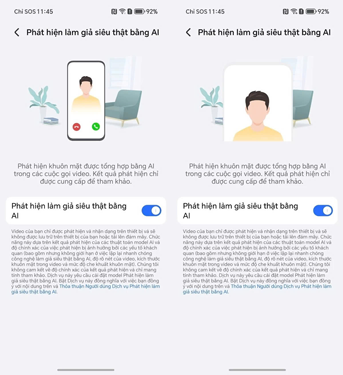
Honor smartphones feature Deepfake scam video call detection. Photo: HONOR
According to a report by Viettel Cyber Security, based on data from its Cybersecurity Knowledge System, the risk of information insecurity in Vietnam continues to increase and spread, with a growing number of cyberattacks and increasingly sophisticated attack scales. In 2024, data leaks also surged in Vietnam, with 14.5 million accounts leaked (accounting for 12% of the global total), leading to a situation where much personal information and business documents are being sold on online platforms – especially on dark web sites.
In recent years, mobile devices have increasingly taken on more functions, replacing computers in daily life, and even becoming a repository of important and sensitive information. However, their security level is significantly lower than that of desktop computers (PCs). Through mobile devices, cybercriminals not only steal personal information and data but also turn them into "gateways" to infiltrate and control network systems. According to cybersecurity company DeepStrike, attacks on mobile devices surged by 52% in 2023, affecting 33.8 million devices. Security firm Kaspersky recorded an average of 2.8 million attacks on smartphones per month in 2024. The mobile security situation is becoming even more serious, threatening all mobile users, and is increasing with the global popularity of artificial intelligence (AI) applications. By exploiting the strengths of AI technology, cybercriminals have even more effective tools to scam users, especially those using mobile devices.
In response to this situation, technology companies have increased investment in mobile security, considering it a key focus in fulfilling their commitment to protecting users. In the early months of 2026, Samsung – the world's largest smartphone manufacturer – caused a sensation by being the first to integrate Privacy Display technology into the Samsung Galaxy S26 Ultra. This is considered a groundbreaking technological innovation from the South Korean company, combining both hardware and software to prevent people around from seeing the content displayed on the mobile screen.
This solution effectively protects against snooping of login information such as passwords, PINs, OTPs, and messages. It also allows users to actively enable or disable the anti-spying feature, or select which applications and regions it's available for.
Tech companies are pulling out all the stops.
According to cybersecurity firm Fortinet (USA), most mobile devices today are integrated with business applications, and therefore need protection to prevent them from becoming tools for infringing personal information. Common mobile device security threats that users face include malicious applications and websites, data leaks, spyware, and social engineering attacks.
To protect private data on smartphones from within, iPhones and many Android devices are equipped with a secure folder feature. This is a private storage area in memory, encrypted and secured with a key, allowing users to keep information they don't want others to access. The recently launched Samsung Galaxy S26 Series takes this a step further with the Private Album feature, integrated directly into the Gallery, allowing users to easily hide selected photos and videos without creating a separate folder or logging into their Samsung Account. Samsung continues to enhance mobile security with Samsung Knox – a multi-layered security platform at the microchip level. Login information and sensitive data are not stored in the cloud or device memory, but are processed and stored on a separate secure chip.
Amidst the global surge in AI-generated video call scams, by mid-2025, Honor became the first smartphone manufacturer to introduce AI Deepfake Detection on its foldable smartphone, the Honor Magic V5. This feature supports OTT applications such as Facebook Messenger, Zalo, Viber, and Google Meet, with a detection time of 3 seconds. Upon detecting unusual activity, the smartphone will display a notification: "Super realistic fake detected." Many subsequent Honor smartphones sold in the Vietnamese market also integrate this feature, with Vietnamese language support.
Most recently, the Galaxy S26 Series also offers intelligent software protections that work silently in the background. The Call Screening feature in Call Assist, powered by AI, can identify calls from unknown numbers and quickly summarize the purpose of the call, helping users manage calls more securely. The Privacy Alerts feature uses machine learning technology to provide real-time notifications when apps with administrative privileges attempt to access sensitive data unnecessarily, such as precise location, call logs, or contacts.
These warnings help users know when an app requests more advanced access permissions, allowing them to be more proactive and transparent in managing permissions.
Special note for mainstream smartphone users
Currently, while mainstream smartphones (priced at $300 or less) account for the largest share of the smartphone market, their security levels are still limited. Therefore, according to experts, users need to focus on implementing necessary measures to proactively protect their personal information on mobile devices. This includes setting strong passwords (containing many characters, including letters, numbers, and symbols, such as "Minh&quan@1517"); using biometric authentication (fingerprint, iris, facial recognition...); enabling 2-factor authentication (2FA) for email and social media accounts; regularly updating security patches provided by the device manufacturer; and being cautious of calls and messages from unknown sources or with suspicious content (such as verification requests or transaction inquiries).
Source: https://nld.com.vn/chan-ai-lua-dao-บน-thiet-di-dong-196260418202145904.htm
![[Photo] First session of the 14th Congress of the Vietnam Trade Union](https://vphoto.vietnam.vn/thumb/1200x675/vietnam/resource/IMAGE/2026/06/03/1780465947883_ndo_br_img-3852-jpg.webp)
![[Photo] General Secretary and President To Lam presides over a meeting with the Central Organizing Committee.](https://vphoto.vietnam.vn/thumb/1200x675/vietnam/resource/IMAGE/2026/06/03/1780482764658_a1-bnd-4741-3342-jpg.webp)

![[Photo] Secretary of the National Assembly Party Committee, Chairman of the National Assembly presides over the meeting of the Standing Committee and Executive Committee of the National Assembly Party Committee.](https://vphoto.vietnam.vn/thumb/1200x675/vietnam/resource/IMAGE/2026/06/03/1780480353201_ndo_br_bnd-2585-jpg.webp)

![[Infographics] Functional groups of digital applications in Thanh Hoa](https://vphoto.vietnam.vn/thumb/402x226/vietnam/resource/IMAGE/2026/06/03/1780479770325_infographics-ca-w1200t0-di2622d199d3163702t11359l1-cac-nhom-chuc-n3.webp)
























































![[Video] Sunset at Lap An Lagoon – Where the sun sets over the fishing nets](https://vphoto.vietnam.vn/thumb/1200x675/vietnam/resource/IMAGE/2026/05/31/1780192137701_beach-landscape-sea-water-nature-grass-745871-pxhere-com.jpeg)








































Comment (0)