

Top European diplomats have met in Luxembourg to develop an action plan to address a range of crises, from the ongoing war in Ukraine to economic instability as the conflict in Iran drives up global energy prices.
However, the European Union's (EU) policy toward Israel and its approach to pressuring Prime Minister Benjamin Netanyahu amid deteriorating security in the Palestinian territories of Gaza, the occupied West Bank, and Lebanon is causing divisions within the 27-member bloc.
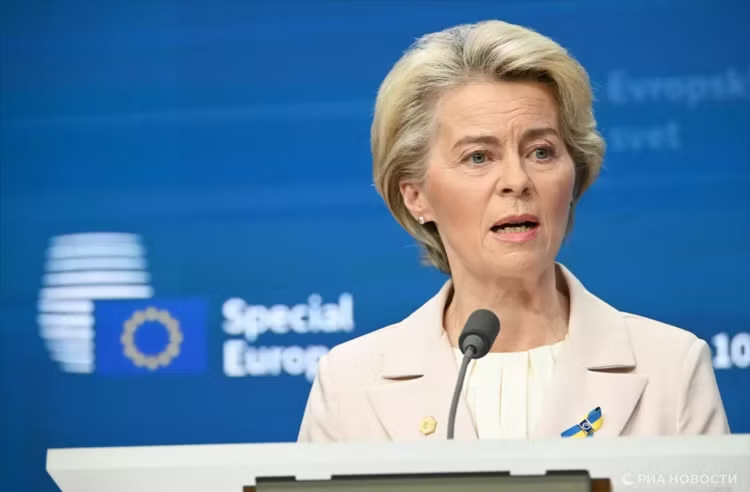
According to AP, the EU currently has an Association Agreement with Israel, signed in 2000, which governs bilateral trade and cooperation. Spain, Slovenia, and Ireland have proposed suspending the agreement entirely, but this move is unlikely to receive the absolute consensus needed from EU member states.
Spanish Foreign Minister José Albares suggested that a partial suspension, targeting only trade aspects, could garner sufficient political support.
"The European Union needs to make it clear to Israel today that change is needed," José Albares emphasized.
The EU has found evidence that Israel violated this agreement during its military operation in Gaza.
Irish Foreign Minister Helen McEntee argued that Israel's expansion of settlements in the West Bank, coupled with ongoing fighting in Lebanon, should prompt EU countries to increase pressure on Israel.
“We need to act. We must ensure that our fundamental values are protected. And we must ensure that any agreements with other countries are enforced and that all parties fulfill their obligations,” McEntee said.
Swedish Foreign Minister Maria Malmer Stenergard said that France and Sweden have proposed a plan to restrict trade with Israeli settlements in the West Bank.
The meeting in Luxembourg took place just one day after 60 countries sent representatives to the Palestinian peace conference in Brussels, Belgium, which included Palestinian Prime Minister Mohamed Mustafa and Bulgarian diplomat Nikolay Mladenov, who was appointed as the High Representative of the Peace Council established by US President Donald Trump.
Meanwhile, one of the strongest dissenting voices in the EU is about to leave office.
Outgoing Hungarian Prime Minister Viktor Orbán has frequently obstructed EU actions regarding support for Ukraine in its conflict with Russia, as well as sanctions against alleged violent Israeli extremists.
EU High Representative for Foreign Policy Kaja Kallas said that Orbán's defeat to pro-European opposition leader Péter Magyar in the recent Hungarian elections could spur action.
"Many issues...have been blocked by Hungary. We are reopening discussions and hope to achieve positive results," she said.
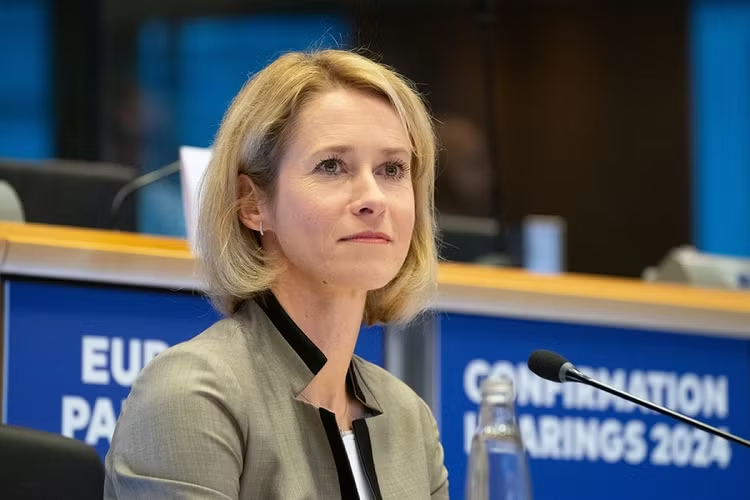
Regarding the Iran issue, EU diplomats have called for a diplomatic solution. Ms. Kallas urged extending the ceasefire between the US and Iran “until a diplomatic solution is found.” “The ceasefire is fragile, but diplomacy needs opportunities,” she emphasized.
German Foreign Minister Johann Wadephul called on Iran to send a negotiating team to Islamabad to meet with US Vice President JD Vance.
"Iran should take the hand that is being offered to them for the benefit of their own people," said Johann Wadephul.
The conflict in Iran has shaken global oil and gas markets and caused concern in the EU, one of the largest energy importers.
While EU foreign ministers met in Luxembourg, transport ministers also held a virtual meeting to discuss how to protect domestic consumers, after the head of the International Energy Agency warned in mid-April that Europe only had enough jet fuel reserves for "about six weeks".
>>> Readers are invited to watch the video: Many countries met in the UK to find solutions to restore shipping routes through the Strait of Hormuz in early April 2026.
Source: https://khoahocdoisong.vn/chau-au-chia-re-vi-cuoc-xung-dot-o-trung-dong-post2149097614.html
![[Image] Close-up view of the interchange connecting the two expressways and Long Thanh Airport.](https://vphoto.vietnam.vn/thumb/1200x675/vietnam/resource/IMAGE/2026/05/25/1779703378210_ndo_br_z7863716673926-224453a31600126cce10622af6290afd-4549-jpg.webp)



![[Image] Hanoi's urban life under the challenge of a "scorching hot" environment](https://vphoto.vietnam.vn/thumb/1200x675/vietnam/resource/IMAGE/2026/05/25/1779706979265_nang-nong-t5-2026-minh-duy-7-4636-jpg.webp)
































































Comment (0)