

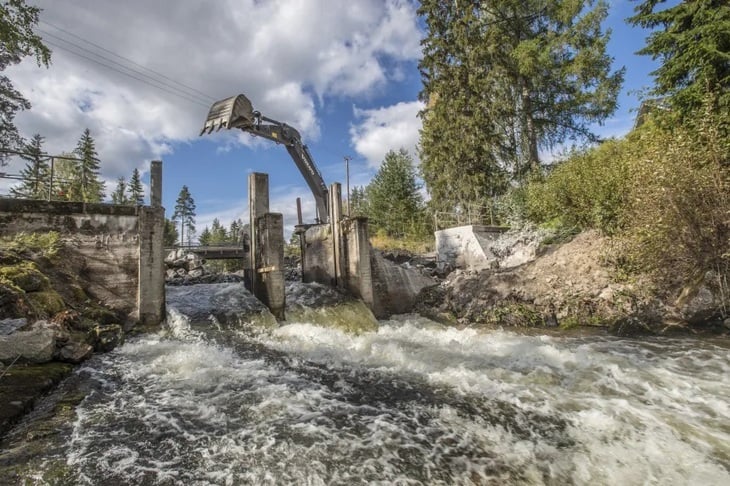
Dismantling the Kangaskoski dam on Finland's Hiitolanjoki River - Photo: STORYMAKERS
After more than a century of being blocked by hydroelectric dams, salmon have returned to the upper reaches of the Hiitolanjoki River in Finland shortly after the last three dams on the river were removed.
This story is becoming symbolic of a new trend in Europe: dismantling outdated dams and waterways to restore river ecosystems.
Over 600 dams have been dismantled.
The latest report from the European Dam Demolition Alliance notes that a record 603 damming structures, including dams, spillways, and culverts, will be dismantled in 21 European countries by 2025.
This figure represents an 11% increase compared to the previous record set in 2024 and is six times higher than in 2020.
The dismantling has helped restore more than 3,740km of free-flowing river, contributing to the European Union's (EU) goal of restoring 25,000km of river by 2030, according to CNN on May 28.
It is estimated that Europe currently has around 1.2 million structures that obstruct river flow, disrupting river systems. Many of these structures were built decades ago to serve hydroelectric power, waterway transport, or agriculture , but are no longer of significant use.

The dismantling of the Vezins dam in France is one of the largest dam demolition efforts in Europe - Photo: AFP
Damming rivers creates many environmental consequences.
When the natural flow of water is blocked, sections of rivers turn into stagnant reservoirs, which easily absorb heat from sunlight, causing the water temperature to rise. These reservoirs also increase water loss due to evaporation and the accumulation of decomposing organic matter, releasing the greenhouse gas methane.
In addition, dams also hinder the spawning migration routes of many fish species such as Atlantic salmon and European eels.
According to the European Commission, more than 42% of the continent's freshwater fish species are threatened, with river fragmentation considered one of the main causes.
Not only are aquatic animals affected, but riparian ecosystems also decline as flow, sediment, and water temperature change.
Experts warn that many old dams are now severely degraded, posing a significant safety risk in the context of increasing flooding and extreme weather events due to climate change.
Dismantling dams requires years of environmental research, technical assessments, and coordination with local communities, but results often appear very quickly. In Finland, for example, salmon returned to spawning grounds that had been isolated for over 100 years during the first migration season after the dam was removed.
Similar projects are also underway in France, the UK, Belgium, Spain, Sweden, and many other countries.
Experts believe that restoring natural water flow not only helps conserve biodiversity but also increases the resilience of ecosystems to climate change.
Source: https://tuoitre.vn/chau-au-thao-do-hang-tram-dap-nuoc-de-cuu-song-ngoi-20260529122008548.htm




































![[Photo] Reception to welcome General Secretary and President To Lam and his wife on their State visit to the Philippines](https://vphoto.vietnam.vn/thumb/1200x675/vietnam/resource/IMAGE/2026/06/01/1780295488620_vna-potal-chieu-dai-chao-mung-tong-bi-thu-chu-tich-nuoc-to-lam-va-phu-nhan-tham-cap-nha-nuoc-toi-philippines-8798060-7855-jpg.webp)




































































Comment (0)