

"You're so beautiful, sister!" "My sister is always so pretty and youthful..."
Those were the comments when my sister Thu Huong posted a short status with a picture. Looking at her photo, no one would guess she's over 60. A woman living in Hanoi with a peaceful life as a retiree after decades of work, with a husband who is a former high-ranking official in a large corporation, incredibly doting and kind; and a successful son with a stable career.
Hanoi during the subsidy period
That's the happiness of a lifetime. Looking at her, beautiful and cheerful, few would think she once had a hard life, but thinking about it carefully, if you're a native Hanoi girl, a girl from the Old Quarter, then almost everyone experienced a difficult life back then. Of course, my sister, my aunt's only daughter, along with her generation, got through those days, in one way or another, with the resilience and love of youth, a time...
In April 1975, after the liberation of Da Nang, I accompanied my grandmother to visit her children and grandchildren in Hanoi and stayed to study in the 7th grade at Thanh Quan Secondary School on Hang Cot Street a few months later when the new school year began. At this time, my aunt was working as an officer in the Organization and Administration Department of the Ministry of Education 's Office at 14 Le Thanh Ton Street. The administrative area consisted of an old villa as the office building, rows of simple offices for various departments, and accommodation for officials from the provinces who came to Hanoi for work. In the middle was a solidly built bomb shelter and a communal dining hall.
 |
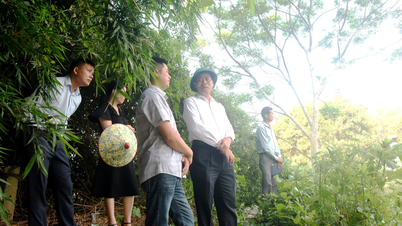
| Mai Xa Chanh village today - Photo: BPT |
My aunt and I lived in a communal room. Right next door was Uncle Thuyen, a logistics officer for the office. He was very skilled at carpentry and often played the zither in his free time at night. After living with my aunt for a while, I moved in with my aunt in the outer row of houses, near the communal dining hall. At this time, Minister Nguyen Van Huyen had just passed away, and Minister Nguyen Thi Binh took over. Work and life in the housing complex continued as usual. I remember that back then in Hanoi, almost every lunchtime, officials and employees had a light meal, called a "continuous meal," where each person usually received three fried dough sticks or a bowl of sticky rice, or a steamed bun...
I often walked to Hoan Kiem Lake and then took the tram to school (the Mo - Buoi tram line ran past my school), which was quite convenient. After school, I would queue at the vegetable and food store in the corner of the small park near Le Thanh Ton - Ly Thuong Kiet street to buy vegetables to take home; in the afternoons, I would climb the tamarind tree in the office courtyard to pick fruit for my aunt to cook soup; and in the evenings, I would go with my friends to catch cicadas along the old trees around the neighborhood…
At that time, Thu Huong was attending a high school near our house. She was 15 years old and had already blossomed into a beautiful, well-behaved young woman. On weekends, our house was filled with joyful laughter when her friends, Kim Quy's daughter (my maternal uncle's daughter, who was then studying at the Police Academy), and other students from schools in Hanoi (children from the South studying in the North, like my sister), would come to visit her. She would cook delicious meals for them, treating them to delicious food while they were far from home and their hometown.
Hue students return to their villages to celebrate Tet.
Then I returned to my hometown in Mai Xa village, Gio Mai commune, now Cua Viet commune, Quang Tri province, to study there. My brothers were either in high school or university. I heard that my sister had passed the entrance exam to Hue University of Education. Of course, that was unusual at the time, because for a Hanoi resident to study in Hue was considered "unconventional" by many. They didn't want to live comfortably in the capital, but chose to go to Hue during the most difficult years. I didn't care about that, and as my father said, "It's nice for you to study in Hue, close to your mother's hometown, your uncles, and your younger siblings..."
So that Tet holiday, she came back to the village to celebrate with my family, and everyone was happy. But at that time, Binh Tri Thien province, like many other provinces, often experienced rice shortages in the last days of the year, with many places suffering from famine. Tet was a joy for children but a source of worry for adults, a constant worry. Normally, food shortages were something to accept due to circumstances, but when the year ended and Tet approached, they had to celebrate properly. Especially when there were honored guests, like my beloved granddaughter coming to celebrate Tet with the family. That was also a significant event in my village back then; many people came to visit, to see "Aunt Huong's daughter, Uncle Ha's granddaughter," chatting and praising her beauty, good behavior, and gentle nature.
Many of my older brother's peers, some the same age or a few years older than my sister, are studying at universities in Hue, so she's very happy to come home for Tet. Those young people, despite the hardships, are always cheerful; they work in the fields and gardens during the day and gather together in the evenings to sing and have fun. My sister said, "You see, I went to Hue to study because I love Hue, and also because studying there allows me to be close to my relatives and friends, my siblings and cousins from my hometown..."
Fortunately, at that time, the whole village ate millet, but my family had rice for my grandmother and younger siblings. This rice came from my mother's hard work selling rice at the Dong Ha and Gio Linh markets, and from the money my father and I earned from catching clams and selling them while setting traps on the river. I'm not trying to dwell on poverty, but the truth is, we ate so much millet that when we opened the pot and saw it, many people would turn away, hiding their sadness. Millet stewed for a long time still wouldn't become soft and tender; chewing millet was just to fill us up, to deceive our hungry stomachs. At those times, we craved rice terribly, even if it was just rice mixed with potatoes and cassava, because the smell of rice would warm our hearts…
Love lasts forever.
My sister came home for Tet (Lunar New Year). Although we no longer ate cornmeal, we still ate rice mixed with sweet potatoes and cassava. Of course, Tet had to be white rice, and the meat was distributed to each household by the cooperative. My father had prepared sticky rice, mung beans, and banana leaves, and together with my mother and brothers, they made banh tet (cylindrical sticky rice cakes). My father also made several pairs of beautifully wrapped banh chung (square sticky rice cakes) to offer on the altar.
These days, we help Dad clean and decorate the house and the altar for Tet. On New Year's Eve, my dad prays for my grandmother's health, family peace and prosperity, favorable weather, and a warm and prosperous village. My sister Thu Huong sits amidst the warm embrace of her family. Beside her are my grandmother (she calls her maternal grandmother), my parents, Uncle Thach, and my siblings – her younger siblings because she is the eldest child of my paternal grandparents. The whole family chats happily, and the first day of the new year arrives with a good night's sleep, so that the next morning they can visit relatives, their voices and laughter echoing along the country roads…
The hectic days leading up to Tet (Lunar New Year) finally passed. The younger children had gradually gotten used to it and became very close to their older sister. On the night of the 29th of Tet, around the pot of sticky rice cakes, the older siblings chatted and sang, while we kids waited for the cakes to cook. Dad took out a few extra cakes for us little ones. Oh, the fragrant smell of sticky rice, those cakes of childhood tasted so delicious. After eating a piece of cake, we all dozed off on the tray and fell asleep, and the older boys had to carry us inside…
As I grew older, I learned that many families didn't have enough rice to eat that year, and some even made bánh tét (Vietnamese sticky rice cake) using millet instead of glutinous rice. They were still wrapped in banana leaves, still round in shape, but they carried the sadness of the past year, hoping for a lighter life. And that was almost the only time; the following year, no family in my village made bánh tét with millet anymore…
My grandmother, my father, and Uncle Thach have all passed away. We also left our hometown to start our own businesses in the South. This Tet – like many Tets to come – my sister won't be returning home to celebrate with my grandmother and uncle as she used to. The village has changed a lot; life is now prosperous and peaceful, and the sad events of the past are behind us. Surely, she still cherishes the warm days of the year-end in her village in Quang Tri, the loving family affection, the cheerful laughter of the children, the songs of the Hue students returning home for Tet on those last nights of the year, the strumming of the guitar by the warm fire…
Bui Phan Thao
Source: https://baoquangtri.vn/van-hoa/202602/chi-ve-an-tet-que-12278e9/
![[Photo] General Secretary and President To Lam presides over the meeting to approve the draft report on the results of the second inspection by the Politburo of the Standing Committee of the Hanoi City Party Committee.](https://vphoto.vietnam.vn/thumb/1200x675/vietnam/resource/IMAGE/2026/05/26/1779789811432_a2-bnd-4430-9620-jpg.webp)




















































Comment (0)