

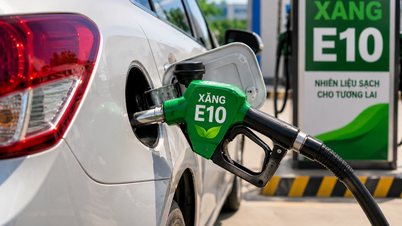
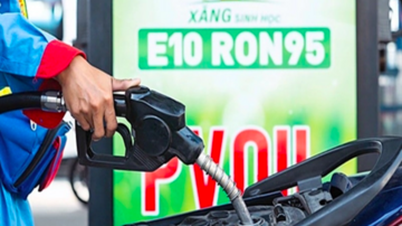
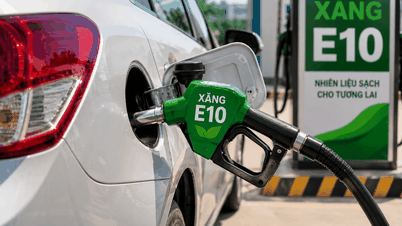
All gas stations must sell E10 gasoline.
The Minister of Industry and Trade issued Circular No. 50/2025/TT-BCT dated November 7, 2025, stipulating the roadmap for applying the blending ratio of biofuels with traditional fuels in Vietnam.
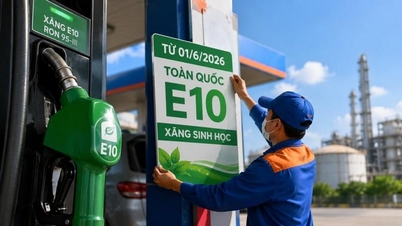
One of the most discussed aspects of this Circular is the regulation on the nationwide application of E10 gasoline starting from June 1, 2026.
According to Clause 1, Article 4 of Circular 50/2025/TT-BCT, from June 1, 2026, unleaded gasoline conforming to current national technical standards must be blended into E10 gasoline for use in gasoline engines nationwide.
Although E10 gasoline will be implemented nationwide from June 1, 2026, this does not mean that all gas stations will only sell E10 gasoline from that date onwards.
Clause 2, Article 4 of Circular 50/2025/TT-BCT stipulates that the blending and mixing of E5RON92 gasoline for use in gasoline engines may continue until December 31, 2030.
Therefore, E5RON92 gasoline will continue to be available on the market until the end of 2030, in accordance with the roadmap stipulated by the Ministry of Industry and Trade.
Changing phones without re-verifying the SIM card may result in the SIM being locked.
According to Article 8 of Circular 08/2026/TT-BKHCN, from June 15, 2026, upon detecting a subscriber changing their terminal equipment compared to the previously used equipment, telecommunications enterprises must implement a review and may temporarily suspend outgoing telecommunications services for a maximum of 2 hours if the subscriber has not yet re-authenticated their facial biometric image.
Verification is performed by comparing a live photograph of the subscriber's face with data in the National Population Database, the National Identity Card Database, the National Immigration Database, or biometric data legally stored at the telecommunications company.
Receive vehicle registration certificate on VNeID, VNetraffic
Circular No. 37/2026/TT-BCA, amending and supplementing a number of articles of the Circulars related to the registration and inspection of vehicles, takes effect from June 8th.
Article 1 of the Circular stipulates that vehicle owners can choose to receive the vehicle registration results via the Public Service Portal, postal service, or directly at the vehicle registration agency.
Simultaneously, electronic data from vehicle registration certificates is integrated into the VNeID and VNeTraffic applications, which are managed and operated by the Ministry of Public Security .
Complete the plan for reorganizing villages and residential areas before June 30th.
This content is stipulated in Directive No. 21/CT-TTg of the Prime Minister on the reorganization of villages and residential areas and the arrangement, utilization, regime, and policies for part-time officials at the commune, village, and residential area levels.
According to Directive No. 21/CT-TTg, the People's Committees of provinces and cities shall conduct a comprehensive review of all villages and residential areas in their localities; develop a comprehensive plan for rearranging and reorganizing villages and residential areas, including a plan for strengthening the team of part-time officials in villages and residential areas after rearrangement and support policies as prescribed.
Addressing the regulations and policies for those who no longer participate in part-time activities at the village or neighborhood level. After completion, the plan must be reported to the Party committee at the same level before being issued.
The People's Committee at the commune level shall develop a plan for the reorganization of villages and residential areas; organize public consultations in accordance with the law; and submit it to the People's Council at the commune level for approval, ensuring transparency and consensus during implementation. This task must be completed before June 30th.
The arrangement of villages and residential areas must ensure compliance with the criteria and conditions stipulated by the Government and the management requirements of the locality when operating the two-tiered local government model.
At the same time, it is necessary to fully consider the specific factors of history, culture, customs, traditions, geographical conditions, national defense, security, and the natural cohesion of the local community, especially in mountainous areas, border regions, islands, areas inhabited by ethnic minorities, and areas with religious elements.
New regulations on non-cash payment documents in certain special cases (June 20, 2026)
Regarding the conditions for deducting input value-added tax, Article 4 of Decree 144/2026/ND-CP also amends and supplements point g, clause 2, Article 26 of Decree 181/2025/ND-CP, which stipulates non-cash payment documents in some special cases as follows:
“g) For goods and services purchased on deferred payment or installment plans with a value of 5 million VND or more, the business establishment shall base its input value-added tax deduction on the written purchase contract, value-added tax invoice, and non-cash payment documents for the goods and services purchased on deferred payment or installment plans.
In cases where non-cash payment documents are not yet available because the payment due date according to the contract or contract addendum has not yet arrived, the business entity is still entitled to deduct input value-added tax. However, if, at the time of payment according to the contract or contract addendum, the business entity does not have non-cash payment documents, it must declare and adjust the deductible input value-added tax downwards for the value of goods and services for which there are no non-cash payment documents in the tax period in which the payment obligation arises according to the contract or contract addendum.
"In cases where, after adjustment, the business has non-cash payment documents, the business is entitled to declare and deduct input value-added tax for the portion of goods and services with non-cash payment documents in the tax period in which the non-cash payment documents are available."
Extend the reduction of import taxes on certain petroleum products to 0% until June 30, 2026.
On March 9, 2026, the Government issued Decree 72/2026/ND-CP adjusting the preferential import tax rate for certain gasoline, diesel, and raw materials for gasoline and diesel production down to 0% in the Preferential Import Tariff Schedule issued with Decree 26/2023/ND-CP, effective until April 30, 2026.
Resolution 25/2026/NQ-CP clearly states: Extend the application period of Decree 72/2026/ND-CP until June 30, 2026.
Therefore, the preferential import tax rate of 0% on certain gasoline, diesel, and raw materials for gasoline and diesel production will continue until June 30, 2026, instead of April 30, 2026.
Source: https://phunuvietnam.vn/chinh-sach-moi-noi-bat-co-hieu-luc-thang-6-2026-23826053013202234.htm




![[Image] Nearly 125,000 Hanoi students completed the Literature exam for the 10th grade entrance exam.](https://vphoto.vietnam.vn/thumb/1200x675/vietnam/resource/IMAGE/2026/05/30/1780117233041_ndo_br_thiet-ke-chua-co-ten-2-png.webp)
































































































Comment (0)