

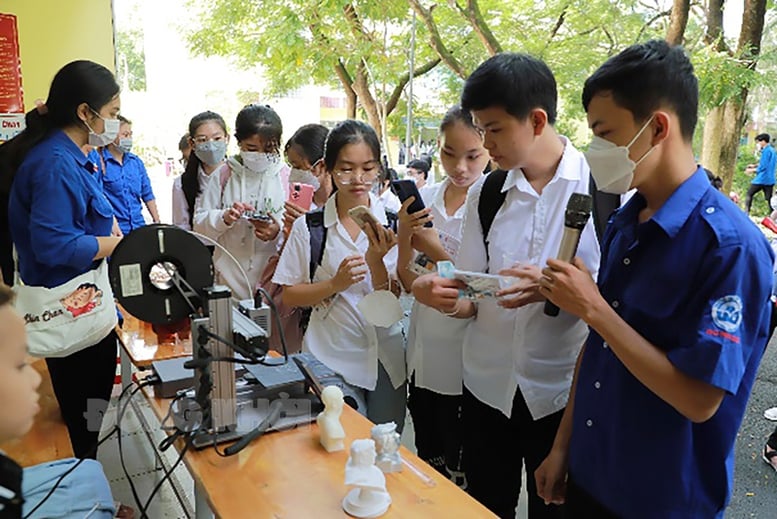
The government has implemented preferential credit policies for students, including undergraduates, master's students, and doctoral candidates in STEM fields.
The new credit policy has many groundbreaking features.
The Government has issued Decision No. 29/2025/QD-TTg on preferential credit for students, master's students, and doctoral students studying science , technology, engineering, and mathematics (STEM). The policy is implemented through the Social Policy Bank.
This is considered a groundbreaking and strategic policy aimed at developing high-quality human resources in STEM fields – in line with the trends of innovation and digital transformation. Decision 29/2025 not only inherits but also expands and upgrades many new points compared to the old regulations, ensuring that learners have the conditions to fully focus on their studies.
A notable new development is the expanded eligibility criteria for loans. The scope of eligible borrowers has been broadened to include not only high school and university students but also master's and doctoral students. The fields and disciplines eligible for loans include life sciences, natural sciences, computer science and information technology, engineering technology, architecture and construction, manufacturing and processing, mathematics and statistics, financial technology, and other key technology sectors as stipulated.
The loan eligibility requirements have also been clarified, including the addition of academic criteria: First-year high school students must have achieved a "good" or higher grade in all three years of high school, or an average grade of 8 or higher in mathematics, physics, chemistry, and biology. Students from the second year onwards must have achieved an "excellent" grade in the immediately preceding academic year. Master's and doctoral students must be recognized by their higher education institution according to regulations.
Adding academic qualifications as a criterion helps support policies target the right people with the necessary skills and potential, thereby increasing the effectiveness of investment in human resources.
Increase loan limits, provide comprehensive support.
A notable difference in Decision 29/2025/QD-TTg is the loan amount and scope of support. Students can borrow the full tuition fee (after deducting scholarships or other support). In addition, they can borrow up to 5 million VND per month to cover living expenses and other study costs.
Therefore, if a student's tuition fee is 10 million VND/month, the total loan amount can reach 15 million VND/month (10 million VND tuition + 5 million VND living expenses). This policy demonstrates comprehensive support, not only covering tuition fees but also ensuring a comfortable life, allowing students to fully focus on their studies and research.
A key new feature is the low interest rate: only 4.8% per year. This is considered a significant advantage, reducing the financial burden compared to many other loan options.
Regarding the loan term, the disbursement period extends from the date of receiving the first loan installment until the end of the course. The first principal and interest repayment is due 12 months after the course ends. The maximum repayment period is equal to the disbursement period.
Thus, with a 5-year course, the total loan term can be up to 11 years, including a 12-month grace period after the course ends. This provision allows students sufficient time to start a business and stabilize their lives before repaying the debt.
Furthermore, the Social Policy Bank may consider extending loan repayment periods in cases where customers are facing difficulties, demonstrating the flexibility and humane nature of the policy.
Mr. Minh
Source: https://baochinhphu.vn/chinh-sach-tin-dung-dot-pha-ho-tro-nhan-luc-khoa-hoc-cong-nghe-102250905170421644.htm

![[Photo] The General Secretary, President and his wife begin their state visit to the Philippines.](https://vphoto.vietnam.vn/thumb/1200x675/vietnam/resource/IMAGE/2026/05/31/1780230559452_anh-man-hinh-2026-05-31-luc-19-28-11.png)

![[Photo] Admire the coral "masterpiece" amidst the million-year-old heritage of Dak Lak province.](https://vphoto.vietnam.vn/thumb/1200x675/vietnam/resource/IMAGE/2026/05/31/1780221235105_anh-man-hinh-2026-05-31-luc-16-53-27.png)
![[Photo] Solemn bathing ceremony and Buddha procession in Hue](https://vphoto.vietnam.vn/thumb/1200x675/vietnam/resource/IMAGE/2026/05/31/1780228263543_1-jpg.webp)




















![[Video] Sunset at Lap An Lagoon – Where the sun sets over the fishing nets](https://vphoto.vietnam.vn/thumb/340x192/vietnam/resource/IMAGE/2026/05/31/1780192137701_beach-landscape-sea-water-nature-grass-745871-pxhere-com.jpeg)




































![[Photo] Admire the coral "masterpiece" amidst the million-year-old heritage of Dak Lak province.](https://vphoto.vietnam.vn/thumb/402x226/vietnam/resource/IMAGE/2026/05/31/1780221235105_anh-man-hinh-2026-05-31-luc-16-53-27.png)




































Comment (0)