

According to the book Dai Nam Nhat Thong Chi, Phan Thiet was established in 1697, when it was one of the four districts belonging to Binh Thuan province. With its potential for maritime economy , Phan Thiet gradually attracted many layers of people to settle there (especially from Central Vietnam). By the 19th century, although not the provincial capital of Binh Thuan, Phan Thiet had become a bustling urban center; with a dense population and interconnected streets, and a constant flow of fishing boats and trading ships.
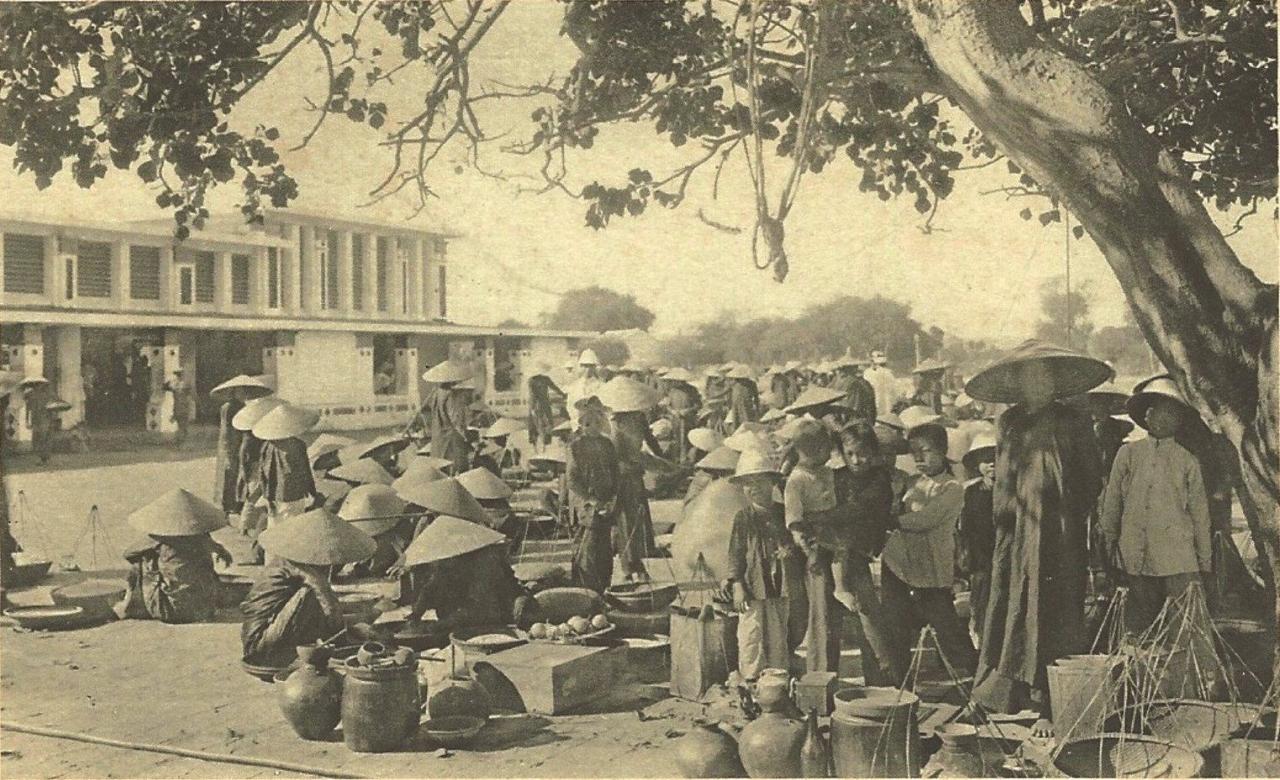
Wherever there are people, there are markets. Markets are usually held in convenient locations with high foot traffic, such as road intersections, river junctions, and village entrances. According to author Truong Quoc Minh, before the 20th century, Phan Thiet had four locations where many people gathered to trade. The largest was the market near the beginning of Quan Bridge (now Le Hong Phong Bridge) with over 500 people visiting, the afternoon market in Long Khe, the market for wandering souls in Duc Thang, the Doi Thieu market in Duc Long, and other makeshift markets easily found in many other places.
The market near Quan Bridge was formed thanks to the great efforts of the people of Duc Thang village and Mr. Tran Chat personally. According to documents from the book "Duc Thang: Indomitable and Resilient" (1930-1975), on September 16th, 1823 (the year of Quy Mui), when General Le Van Duyet was inspecting Phan Thiet, he noticed that the Phan Thiet market was located in an inconvenient area for people's travel and trade. Therefore, the people of Duc Thang village asked Mr. Tran Chat to carry a petition to intercept him and present a request to move the market (from its current location on Phan Boi Chau Street, Duc Nghia Ward) to a new location on the right bank of the Ca Ty River near Quan Bridge for the convenience of the people. Seeing that someone dared to be disrespectful and brazenly obstruct the army's work, Le Van Duyet accused the villagers and beheaded Mr. Tran Chat. Later, reflecting on the matter, the people of Duc Thang had committed such an act of insubordination for the benefit of the entire population. Therefore, the Left Army agreed to allow the market to be relocated, and it subsequently developed into a bustling area.
According to the edict of July 12, 1899, by King Thành Thái, Phan Thiết officially became a city (center urbain), the provincial capital of Bình Thuận. As part of the overall town planning, the Phan Thiết market was also planned for upgrading by the government, so it was moved to its current location. In 1903, the reconstruction of the market was completed, with a more solid structure and a concrete roof. Initially, the market was managed by an Englishman who acted as the contractor, collecting and managing taxes.
… and some of the activities of merchants
Étienne Aymonier, in the journal Excursions et Connaissances de Cochinchine (issue 24-1885), stated: In Phan Thiet, the market is held twice a day; the morning market on the right bank of the Ca Ty River is larger than the afternoon market (on the left bank). The stalls in the market sell not only domestic goods but also many imported goods from China and Europe. Chinese merchants play a very significant role here, dominating almost all activities. And of course, their wealth is immense, and their power is very strong, not unlike the Chinese guilds in Southern Vietnam. In 1883, the Chinese in Phan Thiet planned to assassinate a Frenchman named Granger. But fearing the consequences, their compatriots in Pho Hai prevented them.
According to the writings of several contemporary writers and journalists, besides selling fish sauce, silk fabrics, lamp oil, incense, votive paper, and local agricultural products such as betel nuts, oranges, and pomelos, many ceramic items were also sold here. These included "white or blue porcelain teapots, earthenware pots and pans for boiling water, with parallel spouts and handles, stoneware in a beautiful black or yellowish hue, treasures for those who appreciate the luxurious appearance of rustic vases and jars, and jewelry made of bronze and glass."
Under the strong influence of the Modernization Movement (early 20th century), the awareness of building an independent and self-reliant economy, and the belief that a prosperous people lead to a strong nation, led many Vietnamese people to boldly engage in large-scale business, competing with Chinese and even French merchants. During this period, in addition to the shops of Chinese and Indian merchants, many Vietnamese-owned shops opened along the main street of the market. Significantly, not only did they develop economically, but the small traders in Phan Thiet market also displayed a strong sense of national pride. For example, the movement demanding amnesty for Phan Boi Chau in 1925, and especially the mourning and commemoration of the patriot Phan Chau Trinh (who had come to Phan Thiet in 1905 to spread democratic and reformist ideas) in March 1926. Accordingly, 54 shops in the Phan Thiet market area and the town center voluntarily closed their doors in support; butcher shops refused to slaughter pigs for sale. Moreover, households, merchants, and a large number of people from Phan Thiet gathered together to contribute money and send representatives to Saigon to attend the funeral and offer condolences.
From the 1920s onwards, Vietnamese-language newspapers gradually became deeply integrated into people's lives. At that time, many cases of arbitrary market tax increases were reported by the people in the newspapers. During the years 1929-1933, people were severely affected by the economic crisis but had to bear the burden of taxes that doubled. The newspaper Tiếng Dân (issue 456, published January 23, 1932) reported that in Phan Thiet market, a basket of fish worth only 3 dong had to be taxed 1.5 dong; each chicken or duck was taxed 5 cents; and cotton, worth only 1-2 dong, had to be taxed 2-3 cents. “Some vendors refused to record the prices in silver when they brought goods to the market, so when we pleaded with them, they said they would tell the authorities and have us imprisoned. It was incredibly difficult…!” – a trader recounted. As for the frequent assaults, for example, the following case occurred: At 10:00 AM on August 18, 1932, a woman named Mị went to the market to buy two sacks of sticky rice. Because she needed to buy other things, she temporarily left the rice with an acquaintance who was selling it in the market. Seeing this, a tax collector – a dark-skinned man of Indian origin – approached and demanded tax on the two sacks of rice. The two argued, and because he couldn't collect the tax, the man brutally beat Mị. The police in the market also joined in, grabbing her by the neck and dragging her to the police station. The article also stated: "This kind of drama wasn't the first time it had been performed in Phan Thiết market; it had happened many times before."
Although these abuses of power have been reported to the authorities, they may not be fully resolved. However, this initial step shows that small traders have become aware of their basic rights, using the pressure of public opinion and the press as a powerful weapon to fight against oppression. This is partly due to the influence of books and newspapers with progressive democratic ideas sold in the Phan Thiet market area, including Han Lam Commercial - the only distributor in Binh Thuan of books from the Tieng Dan newspaper printing house.
During the democratic and social welfare movement (1936-1939), small traders in Phan Thiet market also fiercely fought against the French colonial tax policies. A prime example was the three-day strike (from the 15th to the 17th of the first lunar month of the Year of the Ox - February 24-26, 1937). As a result, the strike was successful; the colonial authorities forced the market tax collector, Pham Van Ba, to reduce the tax by more than half and publicly post the reduction around the market and in crowded areas.
In August 1945, responding to the call of the Provisional Viet Minh Committee of Binh Thuan province, small traders in the large market and merchants in the town enthusiastically donated and supported the revolution until the final victory. Under the people's democratic regime, small traders in Phan Thiet market were free to do business, joining hands with the people of the province to develop socio-economic conditions and protect their homeland.
In conclusion
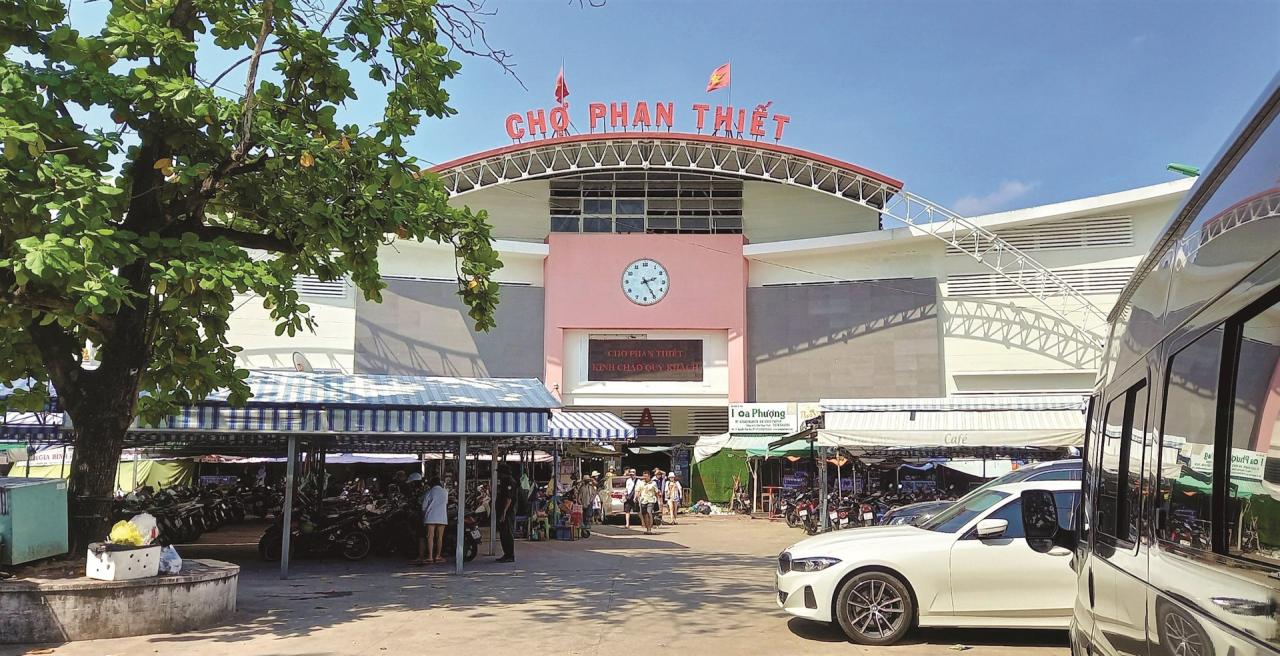
The above is a brief overview of some milestones in the formation and typical activities of the small traders at Phan Thiet Market. Having accompanied the city's development for over 300 years, Phan Thiet Market was rebuilt with state investment. After more than two years of construction (starting in May 2013), the new Phan Thiet Market was completed and put into operation (August 2015). With a scale of one ground floor and one upper floor on a usable area of 13,523 m², it is equipped with many modern facilities, effectively meeting the business needs of small traders and the shopping needs of people in Phan Thiet and neighboring districts.
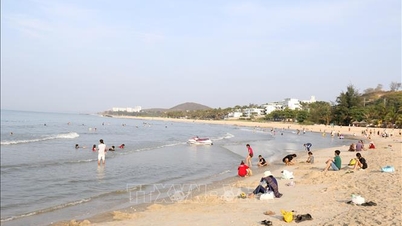
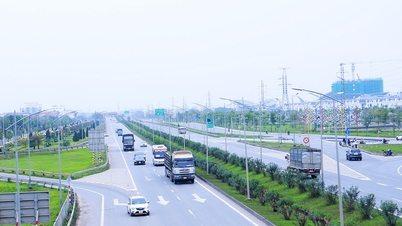
Recently, thanks to the opening of new highways and the hosting of the 2023 National Tourism Year – Binh Thuan – Green Convergence, many people from other provinces have flocked to Phan Thiet. And Phan Thiet market is one of the must-see destinations. Tourists come here not only to shop, but also to experience the soul of the coastal countryside and the historical values of Binh Thuan. In other words, "the market is a place where you can understand the whole from the individual."
References and citations:
100 Years of Phan Thiet Town. Published by the Phan Thiet Town Party Committee - People's Council - People's Committee - Fatherland Front Committee (1998); Tieng Dan Newspaper, issues: 456 (January 23, 1932); 462 (February 20, 1932); 518 (September 3, 1932); Camille Paris. Travelogue of Central Vietnam along the main road. Hong Duc Publishing House (2021); Duc Thang: Indomitable and Resilient (1930-1975). Published by the Duc Thang Ward Party Committee (2000); Phan Thiet: Tradition of Revolutionary Struggle (Volume I). Published by the Standing Committee of the Phan Thiet Town Party Committee (1989); National History Institute of the Nguyen Dynasty. Dai Nam Nhat Thong Chi, Volume 3. Thuan Hoa Publishing House (2006); Binh Thuan Provincial People's Committee. Binh Thuan Gazetteer. Published by the Department of Culture and Information (2006); Various authors. Customs, Salt Tax, Alcohol Tax. The Gioi Publishing House (2017).
Source


![[Photo] National Assembly Chairman Tran Thanh Man working with the Standing Committee of the Law and Justice Committee](https://vphoto.vietnam.vn/thumb/1200x675/vietnam/resource/IMAGE/2026/05/21/1779378929214_ndo_br_1-4610-jpg.webp)
![[Photo] General Secretary and President To Lam presides over a working session with the Central Policy and Strategy Committee on the development of the materials industry.](https://vphoto.vietnam.vn/thumb/1200x675/vietnam/resource/IMAGE/2026/05/21/1779359935432_a3-bnd-3129-1412-jpg.webp)



































































Comment (0)