


Should you choose a major based on trends or your abilities?
In reality, university education typically lasts 4–5 years. A field that is currently in high demand may not necessarily maintain its position after graduation. Many fields once considered "trendy" have become saturated after only a few years, while new professions are constantly emerging due to the impact of technology, AI, and digital transformation.
Based on recent years' enrollment data, Associate Professor Dr. Vu Sy Cuong, an expert in Public Finance and Macroeconomics , believes that economics-related fields have maintained strong appeal to students for many years and remain a high-demand area for training. According to him, economics-related fields now have a broader scope than before, integrating more interdisciplinary knowledge and new professional skills to meet the demands of the labor market.
However, Associate Professor Vu Sy Cuong emphasized that choosing a major is only one part of the career journey, not the only factor determining success. More importantly, it is whether students truly love, are willing to invest time and dedication, and pursue that profession long-term.
Addressing the dilemma many students face when choosing between information technology and business administration, Associate Professor Phung The Dong (International Training Institute, Hanoi University of Finance and Banking) stated that these are not two separate fields but rather complement each other strongly. According to Professor Dong, current information technology students also need to understand business, management, and the market to create products with practical value. Conversely, business administration students also need to equip themselves with technological knowledge to adapt to the digital transformation process.
Mr. Dong suggested that instead of focusing solely on technical studies, students should choose interdisciplinary programs such as management information systems or technology-integrated business. These fields provide students with both a management foundation and a technological understanding, enabling them to better adapt to the needs of businesses.
Cultivating adaptability and lifelong learning skills.
According to Associate Professor Bui Huy Nhuong, Deputy Director of the National Economics University, in the period leading up to university admissions, students are facing two important decisions: choosing a major and choosing a university. However, many candidates still focus heavily on which majors are easy to find jobs in or have high demand for manpower, without looking further ahead at the fluctuations of the labor market.
Mr. Nhuong believes that a currently "hot" industry may no longer hold its position after four years, and even job requirements may change significantly when students graduate. Therefore, it is not only important to choose the right major but also to build lifelong learning capabilities to adapt to a rapidly changing labor market.
Another issue noted by experts is that students shouldn't just look at the name of the major but should carefully research the training program. In reality, even within the same major, each university may offer multiple programs with different specializations. For example, the Auditing major at the National Economics University currently has programs such as Standard Auditing, Internal Auditing, and Integrated Auditing with ACCA certification. Despite differing specializations, these programs still ensure the core knowledge foundation of the major.
Similarly, the Health Economics program belongs to the Economics major but integrates in-depth modules on healthcare and medical services. Graduates receive a Bachelor of Economics degree but have an added advantage when applying for jobs at hospitals, medical facilities, non-governmental organizations, or consulting firms both domestically and internationally.
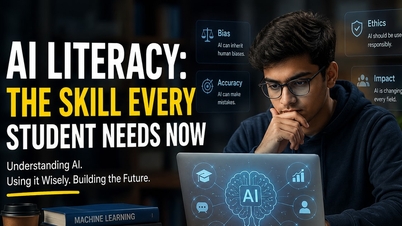
In the context of a rapidly changing job market, the concept of "one profession for a lifetime" is gradually becoming outdated. Employers now not only need people with specialized knowledge but also highly value their ability to learn, adapt, think critically, communicate, and solve problems.
Professor Do Ngoc Minh, currently working at the University of Illinois Urbana-Champaign and also the Vice-Chancellor of VinUni University, believes that in the future, the boundaries between professions will become increasingly blurred. An engineer may need to understand business; a marketing student must know how to analyze data; and an economics student needs to be proficient in technology and artificial intelligence. Therefore, interdisciplinary competence is considered a crucial advantage.
Instead of trying to find a field that "will never go out of style," students should prepare themselves with skills that "are not easily replaced." In a constantly changing job market, the ability to learn and adapt may be more important than the name of the major on their university degree.
Source: https://daidoanket.vn/chon-nganh-hoc-gi-de-khong-loi-thoi.html



![[Image] Hanoi's urban life under the challenge of a "scorching hot" environment](https://vphoto.vietnam.vn/thumb/1200x675/vietnam/resource/IMAGE/2026/05/25/1779706979265_nang-nong-t5-2026-minh-duy-7-4636-jpg.webp)



































































































Comment (0)