

This was also emphasized during the 2026 National Disaster Prevention and Control Week, which took place from May 15 to 22, with the theme "Community working together to prevent and control natural disasters".
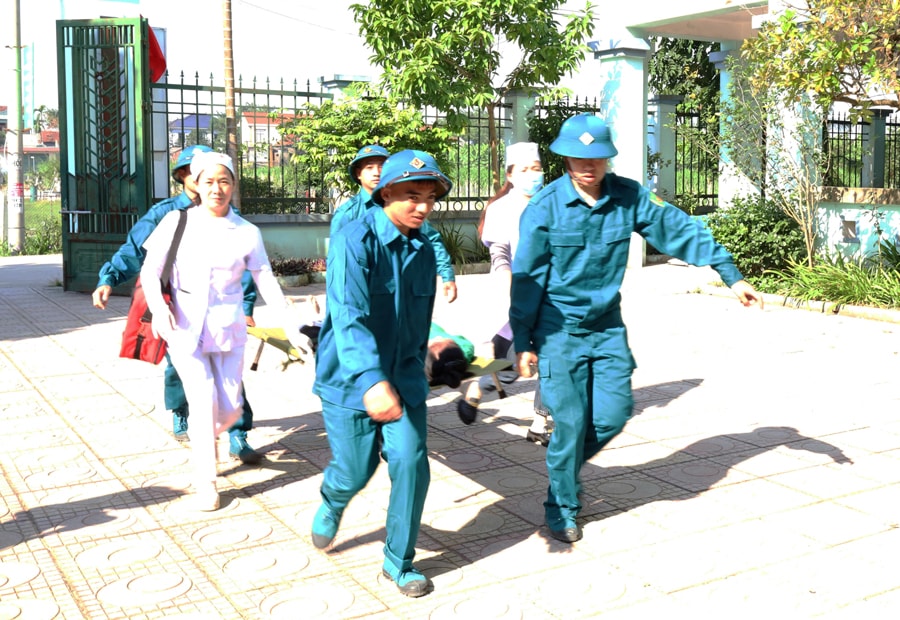
Community consciousness determines resilience.
Through summarizing disaster prevention and control work in 2025 and implementing tasks for 2026, many communes and wards in Hanoi have frankly pointed out bottlenecks at the grassroots level. The common lesson shows that, to withstand natural disasters, what needs to be strengthened first and foremost is not only the quality of infrastructure, the provision of materials and equipment, but also the sense of responsibility of officials and citizens, and the effective implementation of the "four on-the-spot" principle (on-the-spot command; on-the-spot forces; on-the-spot equipment and materials; on-the-spot logistics).
In Xuan Mai commune, Deputy Chairman of the People's Committee Trinh Ba Thuong said that the locality has a complex terrain and is frequently affected by flash floods. However, some difficulties stem from human factors.
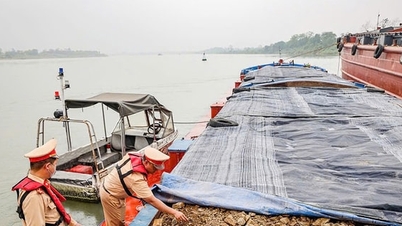
According to Trinh Ba Thuong, Vice Chairman of the People's Committee of Xuan Mai commune, some people still do not fully understand the danger of natural disasters and have a complacent and negligent attitude; in some cases, people are rowing boats and fishing in floodwaters, arbitrarily removing sandbags used for flood prevention, and encroaching on the dike protection corridor. When the community does not truly consider disaster prevention and control as its own responsibility, proactive action from the grassroots level is difficult to achieve.
In Tran Phu commune, Vice Chairman of the People's Committee Nguyen Manh Ha frankly acknowledged that disaster prevention and control efforts last year still had some shortcomings. The awareness and responsibility of some departments and a segment of the population were insufficient; there was still a complacent attitude and a lack of proactiveness in prevention and response when situations arose; and coordination between forces was not always effective.
According to Mr. Nguyen Manh Ha, the reasons are that the propaganda work in some areas has not been truly widespread; the proactive and preventive awareness of a segment of the population is still limited; the preparation of forces, materials, and equipment has sometimes been inadequate; and the inspection, review, and handling of areas with potential safety risks have not been carried out regularly and promptly.
Not only is there a lack of community awareness, but in some areas, the initial response capacity of local forces is also limited. A representative from Trung Giã commune stated that, based on the experience of responding to storms and floods in 2025, the locality realized that the local force was still insufficient, rescue and relief skills were uneven, and communication and coordination in conditions of power outages and signal loss remained passive.
From a city-wide perspective, Nguyen Dinh Hoa, Deputy Director of the Hanoi Department of Agriculture and Environment, stated that in some areas, the consolidation of the commune-level Civil Defense Command Boards is still slow; information and reporting are not truly timely; and the preparation of supplies and equipment according to the "four on-the-spot" principle is not proactive.
In particular, Comrade Nguyen Dinh Hoa emphasized a thought-provoking reality: at times, while forces were working hard to support local communities in combating floodwaters and moving belongings to higher ground, there were still people standing around watching, filming, and taking pictures indifferently, as if it were not their business, or the business of their village or commune.
These assessments clearly show that while natural disasters may become increasingly extreme, the severity of the damage often depends on the proactive approach of the local authorities. When each official fulfills their responsibilities, each force coordinates closely, and each citizen participates, the resilience of the locality will be significantly enhanced.
Enhancing the capabilities of local forces.
Beyond simply pointing out limitations, Hanoi is gradually strengthening its response capabilities at the grassroots level. Colonel Phung Chi Cao, Deputy Chief of Staff of the Hanoi Capital Command and Head of the Office of the City's Civil Defense Command, stated that all 126 communes and wards in the city are continuing to review and consolidate their commune-level disaster prevention and control task forces, with the core being the militia, reserve forces, and with the participation of youth unions, women's associations, and other grassroots forces.
In addition to strengthening its organizational structure, Hanoi is also focusing on improving the knowledge and skills of local forces and citizens. In 2025, the Department of Agriculture and Environment organized 60 awareness-raising conferences, 37 conferences guiding community-based disaster risk assessment, and 60 training conferences for commune-level rapid response forces. The city also completed the "Enhancing Community Awareness and Community-Based Disaster Risk Management" project for the 2021-2025 period and is advising on its implementation for the 2026-2030 period. These figures demonstrate that Hanoi is shifting from mere public awareness campaigns to enhancing skills in responding to and handling situations at the grassroots level.
In addition, Hanoi's units and localities have coordinated with military and police units regarding personnel and equipment for disaster prevention, response, and recovery. The city has also developed online operational scenarios, coordinated the development of regulations for flood control in the inner city, researched the installation of weather and flood monitoring and warning stations, and applied technology to support command and control…
However, to deepen the spirit of "community cooperation in disaster prevention and control," it is crucial to continue addressing the shortcomings that have been identified. This includes more timely strengthening of grassroots organizations; more thorough assessment of vulnerable points; more adequate supplies and equipment; faster information and reporting; and more effective guidance on disaster response skills for the people.
Therefore, the 2026 National Disaster Prevention and Control Week is not only an opportunity for communication, but also a reminder of the responsibility to act. Disasters don't wait for us to be prepared. Therefore, only when each commune and ward is truly proactive, each local force has sufficient capacity, and each citizen is clearly aware of their responsibility, can Hanoi be more resilient in the face of natural disasters.
Source: https://hanoimoi.vn/chung-tay-tu-co-so-vung-vang-truoc-thien-tai-750015.html
![[Image] Hanoi's urban life under the challenge of a "scorching hot" environment](https://vphoto.vietnam.vn/thumb/1200x675/vietnam/resource/IMAGE/2026/05/25/1779706979265_nang-nong-t5-2026-minh-duy-7-4636-jpg.webp)


![[Image] Close-up view of the interchange connecting the two expressways and Long Thanh Airport.](https://vphoto.vietnam.vn/thumb/1200x675/vietnam/resource/IMAGE/2026/05/25/1779703378210_ndo_br_z7863716673926-224453a31600126cce10622af6290afd-4549-jpg.webp)













































































Comment (0)