

To achieve Vietnam's goal of net-zero carbon dioxide emissions by 2050, a comprehensive transformation is needed, including many businesses transitioning to new technologies and renewable energy.
At the seminar "Net Zero - Green Transition: Opportunities for Leaders" organized by Vietnam Television on the morning of June 27th, experts and managers argued that green growth is a complex problem balancing the acceleration of economic development with the goal of sustainable development, especially for a country in transition like Vietnam. In this process, businesses play a central role.
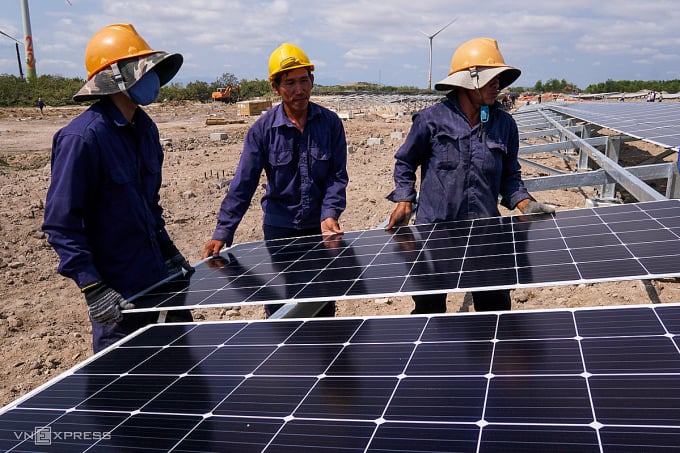
Solar power is being encouraged for use in both businesses and daily life. The photo shows workers constructing the Trung Nam solar power project (Thuan Bac district, Ninh Thuan province), February 2019. Photo: Quynh Tran
Speaking at the event, Deputy Minister of Planning and Investment Nguyen Thi Bich Ngoc stated that pollution originates not only from production but also from consumption. Accordingly, the National Strategy on Green Growth aims for a Net Zero commitment by 2050, reflected in 18 thematic groups, 57 task groups and activities, and 134 specific tasks. Achieving this requires comprehensive changes from awareness and production to consumption and policy. "We need to quantify green transformation solutions based on science, technology, and innovation," she said, adding that state support and initial investment incentives to encourage businesses to innovate and adopt new initiatives are essential.
Associate Professor Dr. Nguyen Dinh Tho, Director of the Institute of Strategy, Policy and Resources and Environment, Ministry of Natural Resources and Environment , said that the draft Circular Economy Action Plan of Vietnam is expected to be submitted to the Government in December this year. The plan aims to minimize the use of fossil fuels, reduce environmental emissions, and extend the life cycle of products. "The circular economy will be a tool towards achieving Net Zero by 2050," said Dr. Tho.
To achieve this, Mr. Tho stated that the State plays a facilitating role, formulating policies and encouraging businesses to participate in the green transformation process through land incentives, green credit, etc. Businesses are the key entities that creatively design and integrate policies into practice for sustainable development.
In fact, many businesses have adopted technologies such as solar power systems to provide clean energy, helping to reduce emissions, or reusable materials, biodegradable plastic bags, etc.
To date, approximately 140 countries, representing nearly 90% of total global emissions, including major emitters like the US, China, and India, have committed to or are working toward achieving Net Zero. Each country sets its own timeline.
To achieve this goal, the majority will need to reach it by 2050, with a few exceptions by 2035 and at the latest by 2070.
Hai Minh
Source link
![[Image] Close-up view of the interchange connecting the two expressways and Long Thanh Airport.](https://vphoto.vietnam.vn/thumb/1200x675/vietnam/resource/IMAGE/2026/05/25/1779703378210_ndo_br_z7863716673926-224453a31600126cce10622af6290afd-4549-jpg.webp)


![[Image] Hanoi's urban life under the challenge of a "scorching hot" environment](https://vphoto.vietnam.vn/thumb/1200x675/vietnam/resource/IMAGE/2026/05/25/1779706979265_nang-nong-t5-2026-minh-duy-7-4636-jpg.webp)
















![[GALLERY] 3 "dead games" that gamers regret the most](https://vphoto.vietnam.vn/thumb/402x226/vietnam/resource/IMAGE/2026/05/25/1779718386120_de-2-png.webp)





































































Comment (0)