

Opening up markets, granting planting area codes, and establishing standardized packaging facilities.
Pressure from technical standards and food safety regulations continues to be a major challenge for Vietnamese agricultural products in 2025, as many markets tighten controls and increase warnings. In this context, the crop production and plant protection sectors have maintained stable production and export growth in many key products.
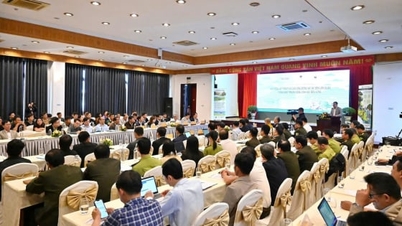
This information was presented at the conference summarizing production work in 2025 and implementing the plan for 2026, organized by the Department of Crop Production and Plant Protection on the afternoon of December 25th.

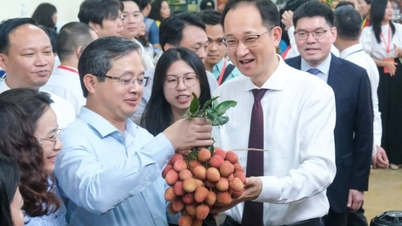
The conference was attended and chaired by Deputy Minister Hoang Trung, leaders of the Department, and specialized units. Photo: Bao Thang.
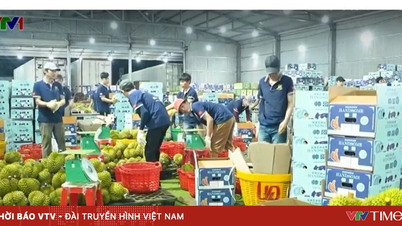
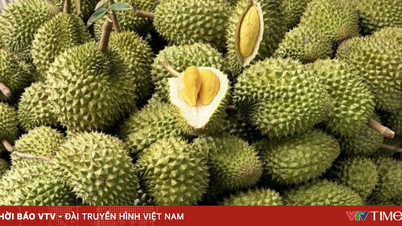
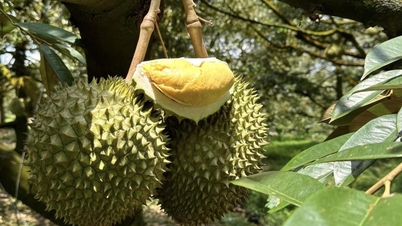
In 2025, agricultural production will continue to shift towards improving quality and efficiency, linked to requirements for reducing emissions, traceability, and meeting market standards. Technical negotiations, market access, and the issuance of planting area codes and packaging facility codes will be implemented synchronously, helping to maintain export growth in product groups such as durian, banana, dragon fruit, and mango.
From the beginning of the year, the Department identified six key tasks, thereby creating a foundation for exports to maintain their growth momentum, as evidenced by the decrease in the number of warnings and violation notifications from importing markets. In particular, the group of long-term crops continued to maintain its growth momentum, showing clear effectiveness in managing growing areas and organizing production.
Along with market expansion, food quality and safety management is being tightened in a way that is based on classification and risk management. Plant quarantine activities, pest monitoring, and handling alerts from importing countries are implemented with specific responsibilities assigned to growing regions, production facilities, and exporting businesses. "If quality is not well controlled right from the raw material source, the risk of alerts and market loss will be very high," Director Huynh Tan Dat analyzed.
According to the Director, 2025 clearly demonstrates the need to shift from stage-by-stage management to chain-by-chain management, and from pre-inspection to post-inspection with control. This approach helps focus resources on high-risk points while improving compliance discipline throughout the entire agricultural production and export chain.
However, the crop production and plant protection sector still faces many challenges. Technical and food safety standards are becoming increasingly stringent, while compliance capacity varies unevenly among localities and businesses. Climate change, environmental pollution, and pest outbreaks continue to put significant pressure on production.

Deputy Minister Hoang Trung directed that risks be "locked down" through inspection and supervision. Photo: Bao Thang.
At the conference, the specialized departments offered numerous suggestions to enhance the effectiveness and efficiency of state management areas under the Department's jurisdiction. Among these, the issue of food safety management for imported products stood out, specifically regarding product boundaries and specialized inspection procedures.
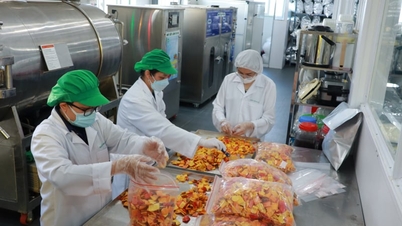
When agricultural products have undergone preliminary processing or processing to a certain extent (cleaning, cutting, drying, freezing, etc.), determining whether these products fall under the jurisdiction of the Department or the Ministry of Industry and Trade as processed foods is often inconsistent. In some cases, businesses have to simultaneously undergo plant quarantine and food safety inspections according to the regulations of the agricultural sector, while also having to supplement documentation as required by other ministries.
The agency is tasked with controlling pesticide residues and pests according to industry standards, but if a product uses additives or post-harvest treatments, businesses may have to meet additional standards issued by the Ministry of Health . The lack of full mutual recognition of risk assessment and inspection results means that an imported shipment may be subject to repeated inspections, prolonging customs clearance times and increasing compliance costs.
Further decentralization to local authorities.
Vietnam is a country with a large volume of import and export goods. Therefore, shifting the management of imported food safety to post-inspection and decentralizing it to local authorities, in order to reduce congestion and lower costs for businesses while maintaining control discipline, is the direction proposed by Deputy Minister Hoang Trung.
The Deputy Minister argued that managing through "pre-inspection" at border crossings easily concentrates pressure at one point, while local forces are not permanently stationed at border crossings. According to him, the general principle being pursued is "one task assigned to one unit," therefore, the Ministry of Agriculture and Environment's management of imported food safety is justified. However, the system's capacity must be reassessed, and a suitable approach designed.
First, businesses are responsible for reporting to the competent authorities assigned by the local government. At the same time, the central government develops unified procedures and guidelines for local authorities to implement, followed by inspection and supervision. The Deputy Minister emphasized that decentralization must be accompanied by sufficiently detailed guidance so that local authorities can "do it." If only tasks are delegated without post-inspection procedures, the risks remain high, and the ultimate responsibility still falls back on the Ministry.

Director Huynh Tan Dat identified the priority of completing the institutional system in 2026. Photo: Bao Thang.
From the perspective of post-inspection, the Deputy Minister directly emphasized the need for a robust data platform. For effective post-inspection, a sufficiently strong database is required for risk-based management, encompassing everything from growing regions and packaging facilities to compliance history and test results. He viewed digital transformation as a fundamental solution and stressed that implementation cannot stop at reporting; it must create truly effective management tools.
In addition, there is a requirement to "lock in" risks through inspection and monitoring. The Deputy Minister directed the early establishment of a plan to inspect growing areas, packaging facilities, testing laboratories, and experimental activities under the authority of the Department, to detect violations early and correct them promptly, avoiding disruptions to exports when markets tighten standards.
He also emphasized the role of management agencies in "commissioning" science and technology, focusing on large-scale, multidisciplinary problems to create new growth opportunities, rather than short-term tasks. Simultaneously, he stressed the need for proactive national reserves to respond to the flood season and ensure resources are available to support localities when requested.
Highly appreciating the achievements of the crop production and plant protection sector in 2025, Deputy Minister Hoang Trung requested the entire sector to continue innovating management methods, taking food quality and safety as the foundation for growth in the new phase.
In 2026, the Department of Crop Production and Plant Protection prioritizes the completion of institutional systems, standards, and technical regulations, linking agricultural product quality management with market demands and sustainable development goals. Digital transformation will be accelerated in the management of growing areas, traceability, food safety monitoring, and plant quarantine.
The Department also focuses on improving enforcement capacity at the grassroots level, strengthening coordination between localities, and supporting businesses and cooperatives in complying with technical requirements. According to Director Huynh Tan Dat, only when quality is consistently controlled can Vietnamese agricultural products go far and sustainably in the international market.
Source: https://nongnghiepmoitruong.vn/chuyen-quan-ly-sang-hau-kiem-tang-phan-cap-giam-chi-phi-tuan-thu-d791339.html


![[Photo] First session of the 14th Congress of the Vietnam Trade Union](https://vphoto.vietnam.vn/thumb/1200x675/vietnam/resource/IMAGE/2026/06/03/1780465947883_ndo_br_img-3852-jpg.webp)





































![[Video] Sunset at Lap An Lagoon – Where the sun sets over the fishing nets](https://vphoto.vietnam.vn/thumb/1200x675/vietnam/resource/IMAGE/2026/05/31/1780192137701_beach-landscape-sea-water-nature-grass-745871-pxhere-com.jpeg)






























Comment (0)